


Laurie Anderson's Big Science
Published on 25. March 2022
Book
Paperback/Softback
188 pages
978-0-19-092602-1 (ISBN)
Description
Shimmering in maximal minimalism, joyful bleakness, and bodiless intimacy, Laurie Anderson's Big Science diagnosed crises of meaning, scale, and identity in 1982. Decades later, the strange questions it poses loom even larger: How do we remain human when our identities are digitally distributed? Does technology bring us closer together or further apart? Can we experience the stillness of "now" when time is always moving? How does our experience become memory?
Laurie Anderson pioneered new techniques and aesthetics in performance art, becoming its first and most enduring superstar. In this book, author S. Alexander Reed dives into the wonderfully strange making and meanings of this singular album and of its creator's long artistic career. Packed with scrupulous new research, reception history, careful description, and dizzying creativity, this book is an interdisciplinary love letter to a record whose sounds, politics, and expressions of gendered identity grow more relevant each day.
Laurie Anderson pioneered new techniques and aesthetics in performance art, becoming its first and most enduring superstar. In this book, author S. Alexander Reed dives into the wonderfully strange making and meanings of this singular album and of its creator's long artistic career. Packed with scrupulous new research, reception history, careful description, and dizzying creativity, this book is an interdisciplinary love letter to a record whose sounds, politics, and expressions of gendered identity grow more relevant each day.
Reviews / Votes
As for this classic album, Reed's three-dimensional excavation and explication of the musical and conceptual components of every song, made the end result even more impressive. * Jeremy Shatan, anearful blog * [Reed] also doesn't shy away from musicological dissection when it seems useful, but always provides a way in for the uninitiated, using musical examples that almost everyone will know. * Jeremy Shatan, Anearful * Reed's fascinating multi-perspectival account of Big Science is a carefully argued and much needed exposition of this enigmatic work. Historical, contextual, and textual insights deftly examine the intersecting personal, cultural and philosophical themes Anderson explores, both in Big Science and in her work leading to and from it. * Sean Albiez, Ph.D., Co-editor of Brian Eno: Oblique Music and Kraftwerk: Music Non Stop *More details
Series
Language
English
Place of publication
New York
United States
Target group
Professional and scholarly
Illustrations
17 figures
Dimensions
Height: 210 mm
Width: 140 mm
Thickness: 11 mm
Weight
238 gr
ISBN-13
978-0-19-092602-1 (9780190926021)
Copyright in bibliographic data and cover images is held by Nielsen Book Services Limited or by the publishers or by their respective licensors: all rights reserved.
Schweitzer Classification
Other editions
Additional editions
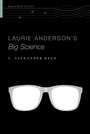
S. Alexander Reed
Laurie Anderson's Big Science
Book
03/2022
Oxford University Press Inc
€108.94
Shipment within 15-20 days
Person
Dr. S. Alexander Reed is a musician and scholar of subculture, pop, and technology. Author of the acclaimed book Assimilate: A Critical History of Industrial Music, he has also published in Bloomsbury's 33 1/3 book series, Slate, the Journal of Popular Music Studies, the Journal of Musicological Research, Perspectives of New Music, Popular Music and Society, ImageTexT, the Journal of Popular Music Education, and elsewhere. As a musician, producer, and remixer, he has dozens of recording credits. Reed teaches at Ithaca College, and has previously been on faculty at NYU's Clive Davis Institute for Recorded Music, The University of Florida, and The College of William and Mary.
Content
I. FINDING THE NOW IN BIG SCIENCE
II. TOO BIG TO FAIL
---
III. DESCRIBING SIDE 1
IV. FLIPPING THE RECORD
V. DESCRIBING SIDE 2
---
VI. NEW MUSIC vs. NEW WAVE
VII. THE GENDERED MAKING OF UNGENDERED STYLE
VIII. BIGNESS AS USUAL
Acknowledgements
Works Cited
II. TOO BIG TO FAIL
---
III. DESCRIBING SIDE 1
IV. FLIPPING THE RECORD
V. DESCRIBING SIDE 2
---
VI. NEW MUSIC vs. NEW WAVE
VII. THE GENDERED MAKING OF UNGENDERED STYLE
VIII. BIGNESS AS USUAL
Acknowledgements
Works Cited