

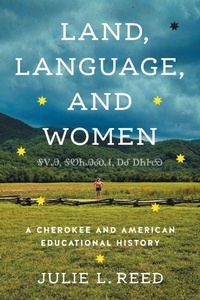
Land, Language, and Women
A Cherokee and American Educational History
Will be published approx. on 31. January 2026
Book
Paperback/Softback
288 pages
978-1-4696-8490-1 (ISBN)
Description
Historians largely understand Native American education through the Indian boarding schools and reservation schools established by the US government during the nineteenth and twentieth centuries. But Native Americans taught and learned from one another long before colonization, and while white settlers and institutions powerfully influenced Indigenous educational practices, they never stopped Native people from educating one another on their own terms.
In this ambitious and imaginatively conceived book, Julie L. Reed uses Cherokee teaching and learning practices spanning more than four centuries to reframe the way we think about Native American educational history. Reed draws on archaeological evidence from Southeastern US caves, ethnohistorical narratives of Cherokee syllabary development, records from Christian mission schools, Cherokee Nation archives, and family and personal histories to reveal surprising continuity amid powerful change. Centering the role of women as educators across generations in Cherokee matrilineal society, the power of land to anchor learning, and the significance of language in expressing sovereignty, Reed fundamentally rethinks the nature of educational space, the roles played by teachers and learners, and the periodization imposed by US settler colonialism onto the Indigenous experience.
In this ambitious and imaginatively conceived book, Julie L. Reed uses Cherokee teaching and learning practices spanning more than four centuries to reframe the way we think about Native American educational history. Reed draws on archaeological evidence from Southeastern US caves, ethnohistorical narratives of Cherokee syllabary development, records from Christian mission schools, Cherokee Nation archives, and family and personal histories to reveal surprising continuity amid powerful change. Centering the role of women as educators across generations in Cherokee matrilineal society, the power of land to anchor learning, and the significance of language in expressing sovereignty, Reed fundamentally rethinks the nature of educational space, the roles played by teachers and learners, and the periodization imposed by US settler colonialism onto the Indigenous experience.
More details
Language
English
Place of publication
Chapel Hill
United States
Target group
Professional and scholarly
Product notice
Paperback (trade)
Illustrations
20 illustrations - 7 drawings, 13 halftones, 1 maps, notes, bibl., index - 13 Halftones, unspecified - 7 Line drawings, unspecified - 1 Maps - Index - Bibliography
Dimensions
Height: 234 mm
Width: 156 mm
Thickness: 17 mm
Weight
481 gr
ISBN-13
978-1-4696-8490-1 (9781469684901)
Copyright in bibliographic data and cover images is held by Nielsen Book Services Limited or by the publishers or by their respective licensors: all rights reserved.
Schweitzer Classification
Other editions
Additional editions
E-Book
12/2025
The University of North Carolina Press
€24.49
Available for download
Person
Julie L. Reed is associate professor of history at Pennsylvania State University.