

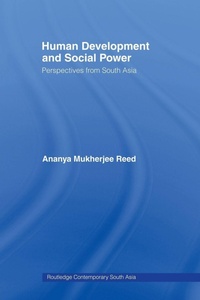
Human Development and Social Power
Perspectives from South Asia
1st Edition
Published on 31. August 2008
Book
Paperback/Softback
176 pages
978-0-415-48131-1 (ISBN)
Description
In South Asia and beyond, human development continues to be in a state of crisis. Each successive Human Development Report (HDR) and the pervasive global failure to achieve the Millennium Development Goals are constant reminders of this crisis. An equally, and even more distressing dimension of human development is its great unevenness. Even in countries with high levels of human development it was noted that gender differences were significant. Levels of educational attainment and incomes remain significantly unequal between social groups, constituted along other categories of difference such as race, ethnicity and religion, as do levels of economic and political participation.
This book explores the unevenness of human development with respect to the question of difference. The author develops a conceptual framework that focuses on social power, whereby human development is seen as a process/es of reconstruction of the matrices of social power. The approach builds on three main components: a relational rather than an identity-centric view of difference; a transformative notion of social justice - as opposed to a distributive understanding of justice; and the notion of agency. These are applied to the South Asian reality, where important insights into structural aspects of human development can be obtained in terms of religion, gender and caste.
Written accessibly and lucidly, this book will be of interest to students and researchers in development studies, political economy, political science, public policy, governance, security studies, human rights, social and religious studies and South Asia.
This book explores the unevenness of human development with respect to the question of difference. The author develops a conceptual framework that focuses on social power, whereby human development is seen as a process/es of reconstruction of the matrices of social power. The approach builds on three main components: a relational rather than an identity-centric view of difference; a transformative notion of social justice - as opposed to a distributive understanding of justice; and the notion of agency. These are applied to the South Asian reality, where important insights into structural aspects of human development can be obtained in terms of religion, gender and caste.
Written accessibly and lucidly, this book will be of interest to students and researchers in development studies, political economy, political science, public policy, governance, security studies, human rights, social and religious studies and South Asia.
Reviews / Votes
"This volume will be an eye opener...the book has a number of promising discussions on the South Asian development experience" - V. Lakshmi Narayanan, Journal of Human Development and Capabilities, 11: 3, 2010More details
Series
Language
English
Place of publication
London
United Kingdom
Publishing group
Taylor & Francis Ltd
Target group
College/higher education
Dimensions
Height: 234 mm
Width: 156 mm
Thickness: 11 mm
Weight
301 gr
ISBN-13
978-0-415-48131-1 (9780415481311)
Copyright in bibliographic data and cover images is held by Nielsen Book Services Limited or by the publishers or by their respective licensors: all rights reserved.
Schweitzer Classification
Other editions
Additional editions
Book
06/2008
1st Edition
Routledge
€141.12
Shipment within 15-20 days
E-Book
06/2008
1st Edition
Routledge
€41.99
Available for download
E-Book
06/2008
1st Edition
Routledge
€41.99
Available for download
Person
Ananya Mukherjee Reed is a political economist based at York University, Toronto, Canada. Her previous publications include Perspectives on India's Corporate Economy: Exploring The Paradox of Profits (2001); and (ed.) Corporate Capitalism in Contemporary South Asia: Conventional Wisdoms and South Asian Realities (2003).
Content
Introduction: Human Development - Has the Paradigm Failed Us?1. Conceptualising Human Development: Towards a Social Power Approach2. Human Development in India: A Profile of Unevenness3. Uneven Human Development in India: A Social Power Perspective4. Human Development in Pakistan and Bangladesh: A Profile5. Uneven Human Development in Pakistan and Bangladesh6. Conclusions: Agency, Human Development & Social Power