

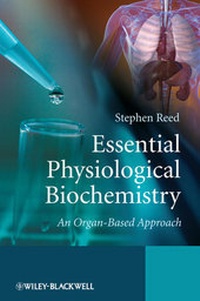
Essential Physiological Biochemistry
An Organ-Based Approach
Published on 20. November 2009
Book
Paperback/Softback
344 pages
978-0-470-02636-6 (ISBN)
Description
This text provides a fresh, accessible introduction to human metabolism that shows how the physiological actions of selected organs can be explained by their particular biochemical processes.
Focusing on metabolic integration, rather than pathways, this book opens with three introductory chapters that explore the principles of metabolism and its control before moving onto 'themed' chapters that investigate liver, communication systems (endocrine and neurological), blood and vascular system, muscle and adipose tissue and renal biochemistry.
Targeted at non-biochemistry majors who need to get to grips with key biochemical concepts and ideas, this textbook is an essential guide for all undergraduate biomedical science, sports science, nutrition and other allied health students.
Key features:
* A fresh, accessible primer that adopts a unique, organ-system based approach to human metabolism.
* Assumes only a basic understanding of chemistry.
* Chapters are arranged specifically to enable readers to grasp key concepts and to aid understanding.
* Some chapters include 'Case Notes, illustrating key aspects of metabolism in cells, tissues and organs.
More details
Other editions
Additional editions
E-Book
04/2013
Wiley
€46.99
Available for download
Book
11/2009
Wiley
€180.50
Article exhausted; check different version
E-Book
09/2009
Wiley
€46.99
Available for download
Person
Dr. Stephen Charles Reed, Department of Biomedical Sciences, University of Westminster, London, UK.
Content
1. Introduction to Metabolism
2. Dynamic and Quantitative Aspects of Metabolism: Bioenergetics and Enzyme Kinetics
3. Principles of Metabolic Control: Enzymes, Substrates, Inhibitors and Genes
4. Biochemistry of Intercellular Communication; Metabolic Integration and Coordination
5. Biochemistry of the Blood and the Vascular System
6. Biochemistry of the Liver
7. Biochemistry of Muscle
8. Biochemistry of the Kidneys
9. Biochemistry of Connective Tissue: Bone and Adipose
Appendix 1: Answers to Problems
Appendix 2: Table of Important Metabolic Pathways
Index