

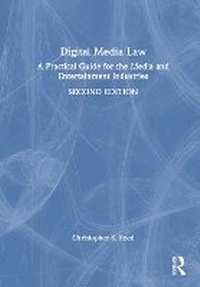
Digital Media Law
A Practical Guide for the Media and Entertainment Industries
2nd Edition
Will be published approx. on 19. December 2025
Book
Hardback
324 pages
978-1-041-11255-6 (ISBN)
Description
Digital Media Law offers a practical guide to the law of media and communication focusing on digital channels, models, and technologies. It draws together the aspects of media law that are most critical for those engaged in the production and distribution of digital media, from traditional broadcasters and internet-based services to major internet platforms.
As an expert scholar and educator in media law, Christopher S. Reed brings considerable experience as an in-house lawyer for a U.S.-based media company with extensive news, sports, and entertainment operations. This blend of practical and scholarly insight delivers a textbook which packs foundational principles and concepts into the context of the digital environment, focusing on how those doctrines are applied in the face of rapidly evolving newsgathering, production,and distribution technologies. Now in its second edition, the book has been fully updated and includes a new chapter on artificial intelligence. It ties legal principles to real-world events or situations, providing insights into digital media policy and an integrated fictional case study of a media enterprise.
This accessible textbook is the ideal companion for advanced undergraduate and graduate students as well as practitioners interested in law, journalism, and media studies.
As an expert scholar and educator in media law, Christopher S. Reed brings considerable experience as an in-house lawyer for a U.S.-based media company with extensive news, sports, and entertainment operations. This blend of practical and scholarly insight delivers a textbook which packs foundational principles and concepts into the context of the digital environment, focusing on how those doctrines are applied in the face of rapidly evolving newsgathering, production,and distribution technologies. Now in its second edition, the book has been fully updated and includes a new chapter on artificial intelligence. It ties legal principles to real-world events or situations, providing insights into digital media policy and an integrated fictional case study of a media enterprise.
This accessible textbook is the ideal companion for advanced undergraduate and graduate students as well as practitioners interested in law, journalism, and media studies.
More details
Edition
2nd edition
Language
English
Place of publication
London
United Kingdom
Publishing group
Taylor & Francis Ltd
Target group
College/higher education
Professional and scholarly
Postgraduate, Professional Practice & Development, and Undergraduate Advanced
Illustrations
9 s/w Zeichnungen, 5 s/w Tabellen, 16 s/w Abbildungen, 7 s/w Photographien bzw. Rasterbilder
5 Tables, black and white; 9 Line drawings, black and white; 7 Halftones, black and white; 16 Illustrations, black and white
Dimensions
Height: 250 mm
Width: 175 mm
Thickness: 23 mm
Weight
764 gr
ISBN-13
978-1-041-11255-6 (9781041112556)
Copyright in bibliographic data and cover images is held by Nielsen Book Services Limited or by the publishers or by their respective licensors: all rights reserved.
Schweitzer Classification
Other editions
Additional editions
E-Book
12/2025
2nd Edition
Routledge
€79.49
Available for download
E-Book
12/2025
2nd Edition
Routledge
€79.49
Available for download
Book
approx. 12/2025
2nd Edition
Routledge
€86.70
Not yet published
Previous edition
Book
10/2022
1st Edition
Routledge
€175.50
Article exhausted; check for reprint
Person
Christopher S. Reed is a distinguished professor of practice and affiliate faculty at Franklin Pierce School of Law, University of New Hampshire, U.S., and the executive vice president and general counsel of Fox Television Stations (FTS).
Content
1. Defining Digital Media 2. Law and the U.S. Legal System 3. The First Amendment 4. Defamation 5. Invasion of Privacy 6. Newsgathering 7. Reporting on the Government 8. Commercial Speech and Advertising 9. Radio and Television 10. The Internet 11. Intellectual Property 12. Artificial Intelligence 13. Case: Mountain One Media