

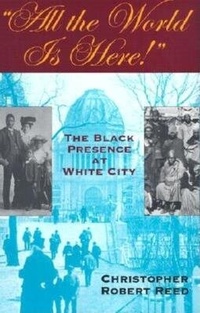
All the World is Here!
The Black Presence at White City
Published on 1. December 1999
Book
Hardback
336 pages
978-0-253-33566-1 (ISBN)
Description
The 1893 World's Columbian Exposition in Chicago showed Western Europeans and other peoples of the world that America had come of age. Simultaneously, African Americans dreamed that they could participate fully as citizens, celebrating true emancipation. African Americans flocked to the fair, arriving by the thousands. The author examines why they came and the ways in which they participated in the Exposition. Before the fair opened, militant African American journalist Ida B. Wells of Memphis suggested to several journalistic colleagues, including Frederick Douglass, that they write a multilingual pamphlet exposing the proscribed status of African Americans to liberals in America and Western Europe. They produced the reason why the colored American is not in the World's Columbian Exposition. This document, however, according to Reed was limited for there was a noticeable black presence as patron, worker, lecturer, and entertainer at the fair. Overall, the expectation of African Americans as regards the fair varied, reflecting the disparate interests and backgrounds found among seven and one half million Black citizens.
The well-educated, highly assimilated African Americans sought not just representation, but membership, at the highest level of planning and decision-making. They envisioned themselves as planners of the event. Further, they carefully prepared themselves to participate in major intellectual and cultural events, such as the myriad parliaments and congresses which included dialogues on topics such as religion, women, dentistry, education, labour, and Africa. The venerable abolitionist, Frederick Douglass, who embodied the dream that inclusion within the American mainstream was possible would never forget America's World's Fair snubs. Douglass was but one prominent African American leader involved in the Columbia Exposition. Also participating in this historical event were, Ida B. Wells, James Weldon Johnson, Scott Joplin, Paul Lawrence Dunbar, Robert S. Abbott, George Washington Carver, and Nancy Green, better known by her commercial persona of "Aunt Jemima." Their stories of pathos and joy, along with disappointment and hope are also part of the story of the "Black Presence at White City."
The well-educated, highly assimilated African Americans sought not just representation, but membership, at the highest level of planning and decision-making. They envisioned themselves as planners of the event. Further, they carefully prepared themselves to participate in major intellectual and cultural events, such as the myriad parliaments and congresses which included dialogues on topics such as religion, women, dentistry, education, labour, and Africa. The venerable abolitionist, Frederick Douglass, who embodied the dream that inclusion within the American mainstream was possible would never forget America's World's Fair snubs. Douglass was but one prominent African American leader involved in the Columbia Exposition. Also participating in this historical event were, Ida B. Wells, James Weldon Johnson, Scott Joplin, Paul Lawrence Dunbar, Robert S. Abbott, George Washington Carver, and Nancy Green, better known by her commercial persona of "Aunt Jemima." Their stories of pathos and joy, along with disappointment and hope are also part of the story of the "Black Presence at White City."
Reviews / Votes
"An important re-examination of African American history, ... it introduces a large number of Afro American individuals of accomplishment little known today, this volume includes significant, ... illustrations to support the argument." --ChoiceMore details
Series
Language
English
Place of publication
Bloomington, IN
United States
Target group
Professional and scholarly
Illustrations
35 b&w photographs & 3 b&w illustrations
Dimensions
Height: 228 mm
Width: 154 mm
ISBN-13
978-0-253-33566-1 (9780253335661)
Copyright in bibliographic data and cover images is held by Nielsen Book Services Limited or by the publishers or by their respective licensors: all rights reserved.
Schweitzer Classification
Content
Preface Acknowledgements Introduction Part One: Around the Nation 1. Expectations 2. Participation and Protest 3. Race, Class, Gender Part Two: In Host City Chicago 4. The Domain of Work 5. The Social Order Part Three: At the Fair 6. "They Met at the Fair": Linkages 7. The Scope of Involvement Part Four: "All the World is Here!" 8. Continental Africa at the Fair: Dahomey Village 9. On the Fairgrounds: The Haytian Pavilion 10. Diasporan and Continental Africa Meet: The Congress on Africa Appendix I: Frederick Douglass's Speech at Colored American Day Appendix II: Colored People's Blue Book Appendix III: Commentaries from Midway Types Appendix IV: "Judge," a poem by A. T. Worden Notes Index