

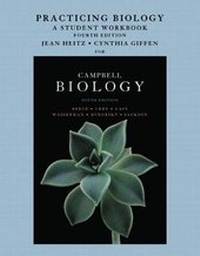
Practicing Biology
A Student Workbook for Campbell Biology
4th Edition
Published on 12. November 2010
Book
Paperback/Softback
368 pages
978-0-321-68328-1 (ISBN)
Description
This workbook focuses on key ideas, principles, and concepts that are fundamental to understanding biology. The overall organization follows that of Campbell BIOLOGY, 9/e. A variety of hands-on activities, such as mapping and modeling, suit different learning styles and help readers discover which topics they do not fully understand, and then modify any misconceptions that they may have. Activities focus on reading and developing graphs and basic skills. MARKET: Intended for those interested in gaining a basic understanding of General Biology Laboratory
More details
Other editions
New editions
Book
02/2014
5th Edition
Pearson
€42.79
Article not available at the moment
Previous edition
Neil Campbell | Jane Reece | Jean Heitz
Practicing Biology
Book
02/2008
3rd Edition
Pearson
€24.12
Article exhausted; check for reprint
Persons
Jane B. Reece
As Neil Campbell's longtime collaborator, Jane Reece has participated in every edition of BIOLOGY. Earlier, Jane taught biology at Middlesex County College and Queensborough Community College. Her research as a doctoral student and postdoc focused on genetic recombination in bacteria. Besides her work on BIOLOGY, she has been a coauthor on Biology: Concepts & Connections, Essential Biology, and The World of the Cell.
Lisa A. Urry
Lisa Urry (Units 1-3) is a professor and developmental biologist, and recent Chair of the Biology Department, at Mills College. After graduating from Tufts University with a double major in Biology and French, Lisa completed her Ph.D. in molecular and developmental biology at MIT. She has published a number of research papers, most of them focused on gene expression during embryonic and larval development in sea urchins. Lisa is also deeply committed to promoting opportunities for women in science education and research.
Michael L. Cain
Michael Cain (Units 4 and 5) is an ecologist and evolutionary biologist who is now writing full time. Michael earned a joint degree in Biology and Math at Bowdoin College, an M.Sc. from Brown University, and a Ph.D. in Ecology and Evolutionary Biology from Cornell University. As a faculty member at New Mexico State University and Rose-Hulman Institute of Technology, he taught a wide range of courses including introductory biology, ecology, evolution, botany, and conservation biology. . Michael is the author of dozens of scientific papers on topics that include foraging behavior in insects and plants, long-distance seed dispersal, and speciation in crickets. In addition to his work on Campbell BIOLOGY, Michael is also the lead author of an ecology textbook.
Steven A. Wasserman
Steve Wasserman (Unit 7) is a professor at the University of California, San Diego (UCSD). He earned his A.B. in Biology from Harvard University and his Ph.D. in Biological Sciences from MIT. Through his research on regulatory pathway mechanisms in the fruit fly Drosophila, Steve has contributed to the fields of developmental biology, reproduction, and immunity. As a faculty member at the University of Texas Southwestern Medical Center and UCSD, he has taught genetics, development, and physiology to undergraduate, graduate, and medical students. He has also served as the research mentor for more than a dozen doctoral students and more than 50 aspiring scientists at the undergraduate and high school levels. Steve has been the recipient of distinguished scholar awards from both the Markey Charitable Trust and the David and Lucille Packard Foundation. In 2007, he received UCSD's Distinguished Teaching Award for undergraduate teaching.
Peter V. Minorsky
Peter Minorsky (Unit 6) is a professor at Mercy College in New York, where he teaches evolution, ecology, botany, and introductory biology. He received his B.A. in Biology from Vassar College and his Ph.D. in Plant Physiology from Cornell University. He is also the science writer for the journal Plant Physiology. After a postdoctoral fellowship at the University of Wisconsin at Madison, Peter taught at Kenyon College, Union College, Western Connecticut State University, and Vassar College. He is an electrophysiologist who studies plant responses to stress. Peter received the 2008 Award for Teaching Excellence at Mercy College.
Robert B. Jackson
Rob Jackson (Unit 8) is a professor of biology and Nicholas Chair of Environmental Sciences at Duke University. Rob holds a B.S. in Chemical Engineering from Rice University, as well as M.S. degrees in Ecology and Statistics and a Ph.D. in Ecology from Utah State University. Rob directed Duke's Program in Ecology for many years and just finished a term as the Vice President of Science for the Ecological Society of America. Rob has received numerous awards, including a Presidential Early Career Award in Science and Engineering from the National Science Foundation. He also enjoys popular writing, having published a trade book about the environment, The Earth Remains Forever, and two books of poetry for children, Animal Mischief and Weekend Mischief.
As Neil Campbell's longtime collaborator, Jane Reece has participated in every edition of BIOLOGY. Earlier, Jane taught biology at Middlesex County College and Queensborough Community College. Her research as a doctoral student and postdoc focused on genetic recombination in bacteria. Besides her work on BIOLOGY, she has been a coauthor on Biology: Concepts & Connections, Essential Biology, and The World of the Cell.
Lisa A. Urry
Lisa Urry (Units 1-3) is a professor and developmental biologist, and recent Chair of the Biology Department, at Mills College. After graduating from Tufts University with a double major in Biology and French, Lisa completed her Ph.D. in molecular and developmental biology at MIT. She has published a number of research papers, most of them focused on gene expression during embryonic and larval development in sea urchins. Lisa is also deeply committed to promoting opportunities for women in science education and research.
Michael L. Cain
Michael Cain (Units 4 and 5) is an ecologist and evolutionary biologist who is now writing full time. Michael earned a joint degree in Biology and Math at Bowdoin College, an M.Sc. from Brown University, and a Ph.D. in Ecology and Evolutionary Biology from Cornell University. As a faculty member at New Mexico State University and Rose-Hulman Institute of Technology, he taught a wide range of courses including introductory biology, ecology, evolution, botany, and conservation biology. . Michael is the author of dozens of scientific papers on topics that include foraging behavior in insects and plants, long-distance seed dispersal, and speciation in crickets. In addition to his work on Campbell BIOLOGY, Michael is also the lead author of an ecology textbook.
Steven A. Wasserman
Steve Wasserman (Unit 7) is a professor at the University of California, San Diego (UCSD). He earned his A.B. in Biology from Harvard University and his Ph.D. in Biological Sciences from MIT. Through his research on regulatory pathway mechanisms in the fruit fly Drosophila, Steve has contributed to the fields of developmental biology, reproduction, and immunity. As a faculty member at the University of Texas Southwestern Medical Center and UCSD, he has taught genetics, development, and physiology to undergraduate, graduate, and medical students. He has also served as the research mentor for more than a dozen doctoral students and more than 50 aspiring scientists at the undergraduate and high school levels. Steve has been the recipient of distinguished scholar awards from both the Markey Charitable Trust and the David and Lucille Packard Foundation. In 2007, he received UCSD's Distinguished Teaching Award for undergraduate teaching.
Peter V. Minorsky
Peter Minorsky (Unit 6) is a professor at Mercy College in New York, where he teaches evolution, ecology, botany, and introductory biology. He received his B.A. in Biology from Vassar College and his Ph.D. in Plant Physiology from Cornell University. He is also the science writer for the journal Plant Physiology. After a postdoctoral fellowship at the University of Wisconsin at Madison, Peter taught at Kenyon College, Union College, Western Connecticut State University, and Vassar College. He is an electrophysiologist who studies plant responses to stress. Peter received the 2008 Award for Teaching Excellence at Mercy College.
Robert B. Jackson
Rob Jackson (Unit 8) is a professor of biology and Nicholas Chair of Environmental Sciences at Duke University. Rob holds a B.S. in Chemical Engineering from Rice University, as well as M.S. degrees in Ecology and Statistics and a Ph.D. in Ecology from Utah State University. Rob directed Duke's Program in Ecology for many years and just finished a term as the Vice President of Science for the Ecological Society of America. Rob has received numerous awards, including a Presidential Early Career Award in Science and Engineering from the National Science Foundation. He also enjoys popular writing, having published a trade book about the environment, The Earth Remains Forever, and two books of poetry for children, Animal Mischief and Weekend Mischief.
Content
87 activities and two data-analysis and graphing appendixes (one for PCs and one for Macs)