

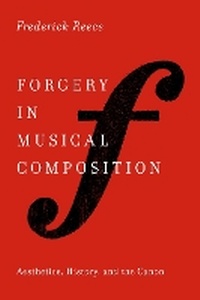
Forgery in Musical Composition
Aesthetics, History, and the Canon
Published on 21. May 2025
Book
Hardback
256 pages
978-0-19-761830-1 (ISBN)
Description
We all know about art forgeries, but why write fake classical music? In Forgery in Musical Composition, Frederick Reece investigates the methods and motives of mysterious musicians who sign famous historical names like Haydn, Mozart, and Schubert to their own original works. Analyzing a series of genuinely fake sonatas, concertos, and symphonies in detail, Reece's study exposes the shadowy roles that forgeries have played in shaping perceptions of authenticity, creativity, and the self within classical music culture from the 1790s to the 1990s.
Holding a magnifying glass to a wide array of phony works, Forgery in Musical Composition explains how skillful fakers have succeeded in the past while also proposing active steps that scholars and musicians can take to better identify deceptive compositions in the future. Pursuing his topic from case to case, Reece observes that fake historical masterpieces have often seduced listeners not simply by imitating old works, but rather by mirroring modern cultural beliefs about innovation, identity, and meaning in music. Here forged compositions have important truths to tell us about knowing and valuing works of art precisely because they are not what they appear.
Holding a magnifying glass to a wide array of phony works, Forgery in Musical Composition explains how skillful fakers have succeeded in the past while also proposing active steps that scholars and musicians can take to better identify deceptive compositions in the future. Pursuing his topic from case to case, Reece observes that fake historical masterpieces have often seduced listeners not simply by imitating old works, but rather by mirroring modern cultural beliefs about innovation, identity, and meaning in music. Here forged compositions have important truths to tell us about knowing and valuing works of art precisely because they are not what they appear.
Reviews / Votes
This book is suitable for academic music libraries. * D. Arnold, Choice * Reece's book is a tour de force and a must-read for any musician, critic, or scholar willing to confront how our aesthetic tastes around authenticity can be navigated. * Daniel Barolsky, Notes *More details
Language
English
Place of publication
New York
United States
Target group
College/higher education
Product notice
sewn/stitched
Cloth over boards
Illustrations
11 illustrations
Dimensions
Height: 240 mm
Width: 167 mm
Thickness: 24 mm
Weight
513 gr
ISBN-13
978-0-19-761830-1 (9780197618301)
Copyright in bibliographic data and cover images is held by Nielsen Book Services Limited or by the publishers or by their respective licensors: all rights reserved.
Schweitzer Classification
Other editions
Additional editions
E-Book
03/2025
OUP eBook
€70.49
Available for download
E-Book
03/2025
OUP eBook
€70.49
Available for download
Person
Frederick Reece is Assistant Professor of Music History at the University of Washington. His research centers on the music and culture of the long nineteenth century, with a particular focus on issues of authorship and authenticity. Reece's articles and reviews have appeared in such venues as the Journal of Musicology and the Journal of the American Musicological Society. Educated at the University of Oxford and Harvard University, he is the recipient of the American Musicological Society's Paul A. Pisk Prize and Alvin H. Johnson AMS 50 Fellowship.
Content
List of Music Examples List of Figures List of Tables Preface Acknowledgments Introduction: The Van Meegeren Syndrome PART I. ROMANTIC CULTURES OF FORGERY, 1791-1945 1. Mozartian Swan Songs 2. Kreislerian Fantasies PART II. MODERN CULTURES OF FORGERY, 1945-2000 3. Schubert's Untrue Symphony 4. Haydn's Missing Link Epilogue Bibliography Index