

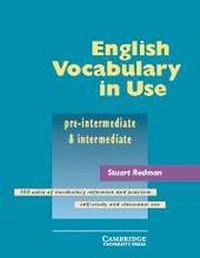
English Vocabulary in Use Pre-intermediate and Intermediate with Answers
Published on 20. February 1997
Book
Paperback/Softback
272 pages
978-0-521-55737-5 (ISBN)
Description
Vocabulary in Use Pre-intermediate and Intermediate is a vocabulary book for intermediate learners of English, primarily designed as a self-study reference and practice book, but which can also be used for classroom work. In its style and format it is similar to its upper intermediate and advanced equivalent, English Vocabulary in Use. ? 100 easy-to-use units: over 2,500 vocabulary items in a wide range of topic areas are presented, contextualise and explained and explained on left-hand pages with a variety of follow-up activities on right-hand pages. ? Helps to build on and expand existing vocabulary. ? Suggests tips and techniques for good learning habits. ? Designed to be flexible: can be used both for self-study and in class. ? Provides a comprehensive key with not only answers to the exercises but also more comments on how the language is used. ? Includes a detailed index with phonetic transcriptions.
Reviews / Votes
'English Vocabulary in Use must be one of the most comprehensive and user-friendly vocabulary books on the market, and is therefore strongly recommended.' The Journal, 1997 'Redman provides in one book what teachers and students have had to go to a number of sources to find in the past.' BBC English, 1997 ' It seems to be the perfect book for vocabulary revision in a class with mixed abilities.' ETAS Newsletter, Switzerland, 1998More details
Series
Language
English
Place of publication
Cambridge
United Kingdom
Target group
ELT/ESL
Product notice
Paperback (trade)
Illustrations
300 Line drawings, unspecified
Dimensions
Height: 246 mm
Width: 189 mm
Thickness: 18 mm
Weight
530 gr
ISBN-13
978-0-521-55737-5 (9780521557375)
Copyright in bibliographic data and cover images is held by Nielsen Book Services Limited or by the publishers or by their respective licensors: all rights reserved.
Schweitzer Classification
Other editions
New editions
Book
11/2001
2nd Edition
Cambridge University Press
€23.51
Article exhausted; check for reprint
Person
Content
Acknowledgements; Introduction; Part I. Learning: 1. Learning and revising with this book; 2. Keeping a vocabulary notebook; 3. Using a dictionary; 4. English language words; 5. Problems with pronunciation; 6. Classroom language; Part II. Word Formation: 7. Prefixes; 8. Noun suffixes; 9. Adjective suffixes; 10. Zero affixation; 11. Compound nouns; 12. Compound adjectives; Part III. Phrase Building: 13. Collocation (word partners); 14. Verb or adjective + preposition; 15. Preposition + noun; 16. Phrasal verbs form and meaning; 17. Phrasal verbs grammar and style; 18. Idioms and fixed expressions; 19. Make do have take; 20. Give keep break catch see; 21. Get uses and expressions; 22. Go uses and expressions; 23. Apologies excuses and thanks; 24. Requests invitations and suggestions; 25. Opinions agreeing and disagreeing; 26. Specific situations and special occasions; Part IV. Parts of Speech (Special Problems): 27. Uncountable nouns and plural nouns; 28. Verbs + ing form or infinitive; 29. Verb patterns; 30. Adjectives; 31. Prepositions place; 32. Adverbs frequency and degree; Part V. Connecting and Linking: 33. Time and sequence; 34. Addition and contrast; 35. Similarities differences and conditions; 36. Reason purpose and result; Part V. Topocs: The World Around US: 37. The Physical world; 38. Weather; 39. Using the land; 40. Animals and insects; 41. Countries nationalities and language; Part VI. People: 42. The human body and what it does; 43. Describing people's appearance; 44. Describing character; 45. Human feelings and actions; 46. Family and friends; 47. Ages and stages; Part VII. Daily Life: 48. Daily routines; 49. Homes and buildings; 50. Around the home 1; 51. Around the home 2; 52. Everyday problems; 53. Money; 54. Health illness and disease; 55. Health injuries; 56. Clothes; 57. Shops and shopping; 58. Food; 59. Cooking and restaurants; 60. Town and country; 61. On the road; 62. Transport Work; 63. Work duties conditions and pay; 64. Jobs; 65. The career ladder; 66. In the office and in the factory; 67. Business and finance; 68. Sales and marketing; Part VIII. Leisure and Entertainment: 69. Hobbies; 70. Sport games people and places; 71. Sport winning losing and scoring; 72. Cinema and theatre; 73. Music art and literature; Part IX. Technology and Communication: 74. Newspapers; 75. Television; 76. On the telephone; 77. Computers; Part X. Social Concerns: 78. Education school; 79. Education university; 80. Law and order; 81. Crime; 82. Politics; 83. Bureaucracy; 84. War and peace; 85. Pollution and the environment; Part XI. Tourism: 86. Air travel; 87. Hotels; 88. A sightseeing holiday; 89. On the beach and in the country; Part XII. Notional Concepts: 90. Time; 91. Numbers; 92. Distance and dimension; 93. Shapes colours and patterns; 94. Partitives; 95. The senses; 96. Notices and warnings; 97. Vague language; 98. American English; 99. Formal and informal English; 100. Abbreviations and abbreviated words; Key; List of phonetic symbols; Pronunciation problems; Index.