

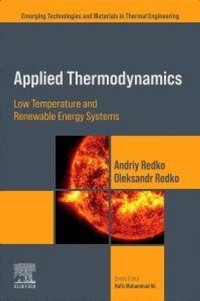
Applied Thermodynamics
Low Temperature and Renewable Energy Systems
Will be published approx. on 1. May 2026
Book
Paperback/Softback
600 pages
978-0-443-30148-3 (ISBN)
Description
Applied Thermodynamics: Low-Temperature and Renewable Energy Systems considers current trends in its field and helps readers realize tasks associated with the efficient use and conversion of energy. Today's industry demands and the sustainable development goals of the United Nations are shaping the future of thermodynamics. New applications of energy and energy conversion processes are being developed, which have received little attention in thermodynamics. Applied Thermodynamics: Low-Temperature and Renewable Energy Systems pairs key fundamentals with practical applications that support sustainability. After outlining basic concepts and positions of thermodynamics, the authors break down both theory and the classic governing laws of thermodynamics, then provide readers an overview of thermodynamic processes. The text shifts to practical application examples, examining open systems, heat power plants, HVAC and power supply systems from renewable sources, methods and the efficiency of thermal systems, machines and equipment. Geared to students and researchers, the book is packed with solved problems and self-control tests to facilitate understanding. Thermodynamics centres on energy and is central to engineering curricula worldwide. This text fosters practical innovation in a well-established field, by offering readers a contemporary examination of a topic as essential to energy as heat itself. Grounded in classical principles, this contemporary reference considers throughout the context of our current energy mix, applying the critical lens of sustainability and sustainable options for energy conversion. Applied Thermodynamics: Low-Temperature and Renewable Energy Systems delivers fundamentals alongside relevant practical applications of energy conversions from varied energy sources that contribute to the replacement of fossil fuels and the reduction of carbon emissions.
More details
Series
Language
English
Place of publication
Philadelphia
United States
Target group
Professional and scholarly
Product notice
Paperback (trade)
Unsewn / adhesive bound
Dimensions
Height: 229 mm
Width: 152 mm
Weight
449 gr
ISBN-13
978-0-443-30148-3 (9780443301483)
Copyright in bibliographic data and cover images is held by Nielsen Book Services Limited or by the publishers or by their respective licensors: all rights reserved.
Schweitzer Classification
Persons
Redko Andriy is a Doctor of technical sciences at Kharkiv National University of Construction and Architecture, and Professor in the department of Heat, gas supply, ventilation and using WHR. He defended his PhD dissertation on the problem of gypsum dehydration in a boiling bed under pressure and he is currently researching processes of heat treatment and combustion of various fuels in a boiling bed. Redko Oleksandr is Doctor of technical sciences and Professor, department of Heat, gas supply, ventilation and using WHR at the Kharkiv National University of Construction and Architecture. He defended his Dr. S thesis on the problem of intensification of heat processes in a boiling bed and is currently researching processes of low-grade fuel combustion in a boiling bed.
Author
Professor, Department of Heat Gas Supply, Ventilation and Use of Thermal Secondary Resources, Kharkiv National University of Civil Engineering and Architecture, Kharkiv, Ukraine
Chairman, Department of Heat Gas Supply, Ventilation and Use Thermal of Secondary Resources, Kharkiv National University of Civil Engineering and Architecture, Kharkiv, Ukraine
Content
PART 1 CONCEPTS AND BASIC LAWS
1. BASIC CONCEPTS AND PROVISIONS OF THERMODYNAMICS
2. FIRST LAW OF THERMODYNAMICS
3. SECOND LAW OF THERMODYNAMICS
4. THERMODYNAMICS METHODS
5. EQUILIBRIUM OF THE THERMODYNAMIC SYSTEM, PROCESSES, PHASE TRANSITIONS OF PURE MATTER
6. THERMODYNAMIC PROPERTIES OF PURE AND MULTICOMPONENT
7. THE FIRST LAW APPLIED TO CONTROL VOLUMES
8. THE FIRST LOW APPLIED FOR A CONTROL VOLUME
PART II THERMODYNAMICS APPLICATIONS IN ENGINEERING
9. CYCLES OF REFRIGERATION AND HEAT POWER INSTALLATIONS
10. THERMODYNAMIC EFFICIENCY OF HEAT MACHINES, SYSTEMS AND EQUIPMENT
11. THERMODYNAMICS OF HEATING, VENTILATION AND AIR CONDITIONING SYSTEMS
12. THERMODYNAMICS OF ENERGY SUPPLY SYSTEMS WITH RENEWABLE ENERGY SOURCES
1. BASIC CONCEPTS AND PROVISIONS OF THERMODYNAMICS
2. FIRST LAW OF THERMODYNAMICS
3. SECOND LAW OF THERMODYNAMICS
4. THERMODYNAMICS METHODS
5. EQUILIBRIUM OF THE THERMODYNAMIC SYSTEM, PROCESSES, PHASE TRANSITIONS OF PURE MATTER
6. THERMODYNAMIC PROPERTIES OF PURE AND MULTICOMPONENT
7. THE FIRST LAW APPLIED TO CONTROL VOLUMES
8. THE FIRST LOW APPLIED FOR A CONTROL VOLUME
PART II THERMODYNAMICS APPLICATIONS IN ENGINEERING
9. CYCLES OF REFRIGERATION AND HEAT POWER INSTALLATIONS
10. THERMODYNAMIC EFFICIENCY OF HEAT MACHINES, SYSTEMS AND EQUIPMENT
11. THERMODYNAMICS OF HEATING, VENTILATION AND AIR CONDITIONING SYSTEMS
12. THERMODYNAMICS OF ENERGY SUPPLY SYSTEMS WITH RENEWABLE ENERGY SOURCES