

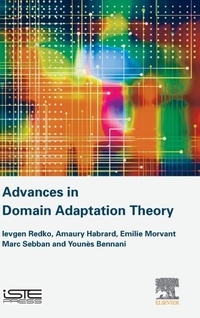
Advances in Domain Adaptation Theory
Available Theoretical Results
Published on 14. August 2019
Book
Hardback
208 pages
978-1-78548-236-6 (ISBN)
Description
Advances in Domain Adaptation Theory gives current, state-of-the-art results on transfer learning, with a particular focus placed on domain adaptation from a theoretical point-of-view. The book begins with a brief overview of the most popular concepts used to provide generalization guarantees, including sections on Vapnik-Chervonenkis (VC), Rademacher, PAC-Bayesian, Robustness and Stability based bounds. In addition, the book explains domain adaptation problem and describes the four major families of theoretical results that exist in the literature, including the Divergence based bounds. Next, PAC-Bayesian bounds are discussed, including the original PAC-Bayesian bounds for domain adaptation and their updated version.
Additional sections present generalization guarantees based on the robustness and stability properties of the learning algorithm.
Additional sections present generalization guarantees based on the robustness and stability properties of the learning algorithm.
Reviews / Votes
"This book goes beyond the common assumption of supervised and semi-supervised learning that training and test data obey the same distribution. When the distribution changes, most statistical models must be reconstructed from new collected data that may be costly or even impossible to get for some applications. Therefore, it becomes necessary to develop approaches that reduce the need and the effort demanded for obtaining new labeled samples, by exploiting data available in related areas and using it further in similar fields. This has created a new family of machine learning algorithms, called transfer learning: a learning setting inspired by the capability of a human being to extrapolate knowledge across tasks to learn more efficiently. This book provides an overview of the state-of-the-art theoretical results in a specific - and arguably the most popular - subfield of transfer learning, called domain adaptation." --Mathematical Reviews ClippingsMore details
Language
English
Place of publication
United Kingdom
Target group
Professional and scholarly
Product notice
Laminated cover
Dimensions
Height: 229 mm
Width: 152 mm
Thickness: 13 mm
Weight
452 gr
ISBN-13
978-1-78548-236-6 (9781785482366)
Copyright in bibliographic data and cover images is held by Nielsen Book Services Limited or by the publishers or by their respective licensors: all rights reserved.
Schweitzer Classification
Other editions
Additional editions
Ievgen Redko | Emilie Morvant | Amaury Habrard
Advances in Domain Adaptation Theory
Available Theoretical Results
E-Book
08/2019
Elsevier
€110.00
Available for download
Persons
Ievgen Redko is an associate professor at INSA in Lyon since 2016. He obtained his PhD in computer Science, specialized in Data Science in 2015. Emilie Morvant is a Lecturer and a professor assistant at the Jean Monnet of Saint-Etienne University. She obtained her PhD in 2013 in Computer Science. Amaury Habrard is a full professor at the Jean Monnet of Saint-Etienne University (UJM), he is also a member of the CNRS and the Computer Science department of UJM. He obtained his PhD in 2004 at the University of Saint-Etienne and his habilitation thesis in 2010. Marc Sebban is a professor at the University of Jean Monnet of Saint-Etienne since 2001. He obtained his accreditation to lead research in 2001 and his PhD in 1996. Younes Bennani obtained his PhD in 1992, and his accreditation to lead research in 1998. Dr. Younes Bennani joined the Computer Science Laboratory of Paris-Nord (LIPN-CNRS) at Paris 13 University in 1993.
Content
1. Introduction
2. State-of-the-art on statistical learning theory
3. Domain adaptation problem
4. Divergence based bounds
5. PAC-Bayes bounds for domain adaptation
6. Robustness and adaptation
7. Stability and hypothesis transfer learning
8. Impossibility results
9. Conclusions and open discussions
2. State-of-the-art on statistical learning theory
3. Domain adaptation problem
4. Divergence based bounds
5. PAC-Bayes bounds for domain adaptation
6. Robustness and adaptation
7. Stability and hypothesis transfer learning
8. Impossibility results
9. Conclusions and open discussions