

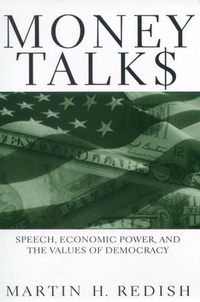
Money Talks
Speech, Economic Power, and the Values of Democracy
Published on 1. August 2001
Book
Hardback
334 pages
978-0-8147-7538-7 (ISBN)
Description
Many have argued that soft money and special interests are destroying the American electoral system. And yet the clarion call for campaign finance reform only touches on the more general belief that money and economic power have a disastrous impact on both free expression and American democracy. The nation's primary sources of communication, the argument goes, are increasingly controlled by vast corporate empires whose primary, or even exclusive motive is the maximization of profit. And these conglomerates should simply not be granted the same constitutional protection as, say, an individual protester.
And yet neither the expenditure of money for expressive purposes nor an underlying motive of profit maximization detracts from the values fostered by such activity, claims Martin H. Redish. In fact, given the modern economic realities that dictate that effective expression virtually requires the expenditure of capital, any restriction of such capital for expressive purposes will necessarily reduce the sum total of available expression. Further, Redish here illustrates, the underlying motive of those who wish to restrict corporate expression is disagreement with the nature of the views they express.
Confronting head-on one of the sacred cows of American reformist politics, Martin H. Redish here once again lives up to his reputation as one of America's most original and counterintuitive legal minds.
And yet neither the expenditure of money for expressive purposes nor an underlying motive of profit maximization detracts from the values fostered by such activity, claims Martin H. Redish. In fact, given the modern economic realities that dictate that effective expression virtually requires the expenditure of capital, any restriction of such capital for expressive purposes will necessarily reduce the sum total of available expression. Further, Redish here illustrates, the underlying motive of those who wish to restrict corporate expression is disagreement with the nature of the views they express.
Confronting head-on one of the sacred cows of American reformist politics, Martin H. Redish here once again lives up to his reputation as one of America's most original and counterintuitive legal minds.
Reviews / Votes
A thoughtful, provocative, and important work from one of the nation's foremost First Amendment scholars, covering some of the most significant debates in free speech law today. - Professor Eugene Volokh,UCLA Law School Martin Redish, one of our foremost first amendment scholars, examines one of the most important issues of our times: May the government intervene to "improve" the marketplace of ideas by restricting the speech of the economically powerful and perhaps subsidizing the speech of the less powerful? Redish concludes that such intervention is not in service of, but more often opposed to, core first amendment values. Anyone interested in the constitutional and policy implications of campaign finance reform and other proposals to "equalize" speech must read this book. - Larry Alexander,Warren Distinguished Professor of Law, University of San DiegoMore details
Language
English
Place of publication
New York
United States
Target group
Professional and scholarly
Product notice
Trade binding
Dimensions
Height: 235 mm
Width: 162 mm
Thickness: 26 mm
Weight
590 gr
ISBN-13
978-0-8147-7538-7 (9780814775387)
Copyright in bibliographic data and cover images is held by Nielsen Book Services Limited or by the publishers or by their respective licensors: all rights reserved.
Schweitzer Classification
Other editions
Additional editions
E-Book
06/2001
New York University Press
€41.99
Available for download
Person
The author of numerous books and for a quarter century one of the country's most provocative commentators on free speech issues, Martin H. Redish is the Louis and Harriet Professor of Law and Public Policy at Northwestern University School of Law.