

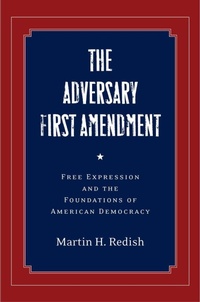
The Adversary First Amendment
Free Expression and the Foundations of American Democracy
Published on 12. June 2013
Book
Hardback
256 pages
978-0-8047-7215-0 (ISBN)
Description
The Adversary First Amendment presents a unique and controversial rethinking of modern American democratic theory and free speech. Most free speech scholars understand the First Amendment as a vehicle for or protection of democracy itself, relying upon cooperative or collectivist theories of democracy. Martin Redish reconsiders free speech in the context of adversary democracy, arguing that individuals should have the opportunity to affect the outcomes of collective decision-making according to their own values and interests.
Adversary democracy recognizes the inevitability of conflict within a democratic society, as well as the need for regulation of that conflict to prevent the onset of tyranny. In doing so, it embraces pluralism, diversity, and the individual growth and development deriving from the promotion of individual interests. Drawing on previous free speech scholarship and case studies of controversial speech, Redish advances a theory of free expression grounded in democratic notions of self-promotion and controlled adversary conflict, making a strong case for its application across such areas as commercial speech, campaign spending, and anonymous speech.
Adversary democracy recognizes the inevitability of conflict within a democratic society, as well as the need for regulation of that conflict to prevent the onset of tyranny. In doing so, it embraces pluralism, diversity, and the individual growth and development deriving from the promotion of individual interests. Drawing on previous free speech scholarship and case studies of controversial speech, Redish advances a theory of free expression grounded in democratic notions of self-promotion and controlled adversary conflict, making a strong case for its application across such areas as commercial speech, campaign spending, and anonymous speech.
Reviews / Votes
"Redish presents an interesting new approach to explaining the importance of freedom of expression in American political discourse . . . On the whole, the author should be commended for an excellent book that is well researched and very timely; freedom of expression is seemingly always being challenged by world events, so a passionate defense is always welcome . . . Recommended."-B. W. Monroe, CHOICE "The goals of this book are then to defend the descriptive and normative pedigree of this democratic theory; to explain the purported inexorable logical and conceptual linkages between this theory of democracy and the philosophical foundations of a right of free expression; and to reconnoiter the implications of those linkages for pertinent case-law issues . . . [T]he intellectual dynamism of Redish's defense of those goals makes this book worthy of attention and of political science-oriented assessments of its strengths and weaknesses."-Ira L. Strauber, The Law and Politics Book Review "Martin Redish sets forth and forcefully defends a powerful and important theory of the First Amendment, persuasively illustrating its application in three significant areas: commercial speech, campaign spending, and anonymous speech. This is a must-read for anyone interested in First Amendment theory."-Eugene Volokh, University of California, Los Angeles School of Law "Redish's The Adversary First Amendment is a passionate defense of a strong and broad right of freedom of expression. Although Redish justifies freedom of expression by its contribution to democratic self-rule, he argues that adversary democracy requires protection of free expression in all domains in which individuals discover their interests and values and that it cannot be restricted to political arenas or to 'public discourse.' Although Redish's theory of free expression puts him at odds with some leading First Amendment theorists, his arguments are formidable. The Adversary First Amendment is destined to be part of the First Amendment canon."-Larry Alexander, University of San Diego School of LawMore details
Edition
New edition
Language
English
Place of publication
Palo Alto
United States
Target group
College/higher education
Professional and scholarly
Edition type
New edition
Product notice
Cloth
Dimensions
Height: 231 mm
Width: 155 mm
Thickness: 20 mm
Weight
476 gr
ISBN-13
978-0-8047-7215-0 (9780804772150)
Copyright in bibliographic data and cover images is held by Nielsen Book Services Limited or by the publishers or by their respective licensors: all rights reserved.
Schweitzer Classification
Person
Martin H. Redish is the Louis and Harriet Ancel Professor of Law and Public Policy at Northwestern University School of Law. He is the author of Wholesale Justice (Stanford, 2008) and The Logic of Persecution (Stanford, 2004).
Content
1. Introduction: The First Amendment and American Democracy
2. Adversary Democracy and American Political Theory
3. Cooperative Democracy and Public Discourse: The Flawed Free Speech Theories of Robert Post and Alexander Meiklejohn
4. Commercial Speech and the Twilight Zone of Viewpoint Discrimination
5. The Anticorruption Principle, Free Expression, and the Democratic Process
6. Adversary Democracy, Political Fraud, and the Dilemma of Anonymity
7. Conclusion: The Optimistic Skepticism of the Adversary First Amendment
2. Adversary Democracy and American Political Theory
3. Cooperative Democracy and Public Discourse: The Flawed Free Speech Theories of Robert Post and Alexander Meiklejohn
4. Commercial Speech and the Twilight Zone of Viewpoint Discrimination
5. The Anticorruption Principle, Free Expression, and the Democratic Process
6. Adversary Democracy, Political Fraud, and the Dilemma of Anonymity
7. Conclusion: The Optimistic Skepticism of the Adversary First Amendment