

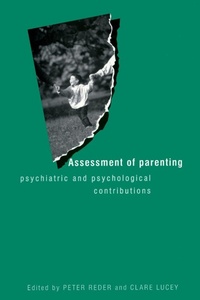
Assessment of Parenting
Psychiatric and Psychological Contributions
Published on 26. October 1995
Book
Paperback/Softback
314 pages
978-0-415-11454-7 (ISBN)
Description
These are the sorts of questions that face mental health practitioners who are increasingly involved in complex child care cases which come before the courts. They have been given little guidance to date on how these assessments should be made, especially where a decision has to be taken as to whether a child has experienced `significant harm.'
In this much needed book senior clinicians consider the principles and practice of parenting assessments and how they guide courts' decisions about children's welfare. They describe a number of frameworks for assessment and discuss the factors which help predict the risk of future maltreatment or the likelihood of successful rehabilitation. Throughout the book the emphasis is on the need to integrate the assessments of all relevant professionals in order to serve the best interests of the child, while also addressing the parents' potential to improve their caretaking skills. Offering guidance in areas of crucial significance for child, family and professional alike Assessment of Parenting will be widely welcomed.
In this much needed book senior clinicians consider the principles and practice of parenting assessments and how they guide courts' decisions about children's welfare. They describe a number of frameworks for assessment and discuss the factors which help predict the risk of future maltreatment or the likelihood of successful rehabilitation. Throughout the book the emphasis is on the need to integrate the assessments of all relevant professionals in order to serve the best interests of the child, while also addressing the parents' potential to improve their caretaking skills. Offering guidance in areas of crucial significance for child, family and professional alike Assessment of Parenting will be widely welcomed.
Reviews / Votes
'Well written and pleasurable to read... The book will be valuable to psychiatrists, psychologists, social workers and lawyers. The editors have gathered excellent contributions from eminent psychiatrists and psychologists. Those involved in parenting assessment and in the legal aspects of child care, particularly child psychiatrists, will find this book a must.' - British Journal of Psychiatry `well written and pleasurable to read... The book will be valuable to psychiatrists, psychologists, social workers and lawyers. The editors have gathered excellent contributions form eminent psychiatrists and psychologists. Those involved in parenting assessment and in the legal aspects of child care, particularly child psychiatrists, will find this book a must.' - British Journal of Psychiatry'This book makes a valuable contribution to the field and will, I am sure, be widely used as a reference source.' - Clinical Child Psychology and Psychiatry
'... this is a useful guide for all workers in the child care field, unique in its broad coverage of current thinking.' - Therapeutic Communities (1997) Vol 18(3)
More details
Language
English
Place of publication
London
United Kingdom
Publishing group
Taylor & Francis Ltd
Target group
Professional and scholarly
Professional and Professional Practice & Development
Dimensions
Height: 234 mm
Width: 156 mm
Thickness: 17 mm
Weight
477 gr
ISBN-13
978-0-415-11454-7 (9780415114547)
Copyright in bibliographic data and cover images is held by Nielsen Book Services Limited or by the publishers or by their respective licensors: all rights reserved.
Schweitzer Classification
Other editions
Additional editions
E-Book
02/2014
1st Edition
Routledge
€49.99
Available for download
E-Book
02/2014
1st Edition
Routledge
€49.99
Available for download
Book
10/1995
Routledge
€106.65
Article exhausted; check different version
Persons
Dr Peter Reder, Clare Lucey
Content
1: Introduction; 1: Significant issues in the assessment of parenting; 2: Components of parenting assessments; 2: Assessing family functioning in parenting breakdown; 3: The meaning of the child; 4: The child's perspective; 5: Emotionally abusive experiences; 6: Assessing protectiveness in cases of child sexual abuse; 7: Assessing treatability; 8: Predicting maltreatment; 9: Quantitative measures of parenting; 10: Giving due consideration to the family's racial and cultural background; 3: Specific circumstances; 11: Parents with psychiatric problems; 12: Parents who misuse drugs and alcohol; 13: Parents with learning disability; 14: Parents who are gay or lesbian; 15: Parents who have killed their partner; 16: Alternative caretakers; 17: What constitutes reasonable contact?; 4: Conclusions; 18: Balanced opinions