

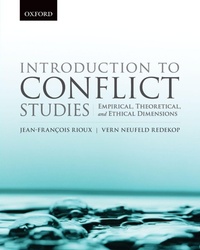
Introduction to Conflict Studies:
Empirical, Theoretical, and Ethical Dimensions
1st Edition
Published on 27. September 2012
Book
Paperback/Softback
528 pages
978-0-19-544654-8 (ISBN)
Description
Introduction to Conflict Studies: Empirical, Theoretical, and Ethical Dimensios is a survey textbook that takes a multidisciplinary approach to study the nature of conflict, the actions of people in conflict, and the processes used to deal with conflict. The wider goal of the book is to provide the reader with an accurate and balanced view of the main schools of thought on conflict analysis and conflict resolution.
Organized into five parts, each section is built around answering a question central to the aspect of conflict under discussion. These questions are:
1. What is conflict?
2. How is conflict experienced at different levels in the world at the present time?
3. What are the causes and dynamics of conflict from different perspectives?
4. How do we, and can we, deal with conflict?
5. What ethical issues emerge from the study of conflict and from interventions in conflicts?
The content is supported by concise chapter conclusions and a full range of pedagogical features, including questions for critical thinking and case studies highlighting actual conflicts and their outcomes, along with an analysis of the effectiveness of the approaches taken in addressing the conflict.
Organized into five parts, each section is built around answering a question central to the aspect of conflict under discussion. These questions are:
1. What is conflict?
2. How is conflict experienced at different levels in the world at the present time?
3. What are the causes and dynamics of conflict from different perspectives?
4. How do we, and can we, deal with conflict?
5. What ethical issues emerge from the study of conflict and from interventions in conflicts?
The content is supported by concise chapter conclusions and a full range of pedagogical features, including questions for critical thinking and case studies highlighting actual conflicts and their outcomes, along with an analysis of the effectiveness of the approaches taken in addressing the conflict.
Reviews / Votes
"This text covers an impressive amount of intellectual ground. . . . The authors have capably presented both the unity and diversity of conflict studies."--Nathan Funk, University of Waterloo
"The book covers a vast array of theoretical literature and would be very useful for someone coming to the subject matter for the first time."
--Paul Gecelovsky, University of Western Ontario
More details
Language
English
Place of publication
Toronto
Canada
Target group
College/higher education
Introduction to Conflict Studies is intended for introductory courses in conflict studies taught out of conflict studies programs and political science, sociology, psychology, and law departments at the first- and second-year university level. Conflict studies is an emerging and increasingly popular field of academic study, with many universities adding certificate or degree programs to their offerings to satisfy the growing demand for graduates with a background in conflict resolution and management.
Product notice
Paperback (trade)
Unsewn / adhesive bound
Illustrations
40 photos; 47 figures; 13 tables; 11 maps
Dimensions
Height: 254 mm
Width: 206 mm
Thickness: 25 mm
Weight
971 gr
ISBN-13
978-0-19-544654-8 (9780195446548)
Copyright in bibliographic data and cover images is held by Nielsen Book Services Limited or by the publishers or by their respective licensors: all rights reserved.
Schweitzer Classification
Persons
Dr Vern Neufeld Redekop is an associate professor in the Department of Conflict Studies at Saint Paul University in Ottawa, Ontario. He has written numerous articles, papers, and contributed chapters on conflict studies and resolution, and has published three books on the subject.
Dr Jean-Francois Rioux is an associate professor in the Department of Conflict Studies at Saint Paul University. He's written extensively on conflict studies, Canadian foreign policy, and armed conflicts, including two books in French and one in English.
Dr Jean-Francois Rioux is an associate professor in the Department of Conflict Studies at Saint Paul University. He's written extensively on conflict studies, Canadian foreign policy, and armed conflicts, including two books in French and one in English.
Content
PREFACE; ACKNOWLEDGEMENTS; INTRODUCTION; PART I: BACKGROUND; CHAPTER OBJECTIVES; INTRODUCTION; A DEFINITION; THE OBJECTS OF CONFLICT; THE STRUCTURE OF CONFLICT; DISPUTES, CONTESTS, AND CONFLICTS; IS CONFLICT ALWAYS DESTRUCTIVE?; CONFLICT, AGGRESSION, VIOLENCE; CONCLUSION; DISCUSSION QUESTIONS; PART II: CONFLICT AND CONFLICT RESOLUTION IN THE CONTEMPORARY WORLD; INTRODUCTION; CHAPTER OBJECTIVES; INTRODUCTION; VICTIMIZED AND VINDICTIVE PEOPLE; ENMESHMENTS AND ENTANGLEMENTS; THE STATE OF LOCAL AND INTERPERSONAL VIOLENCE; CONFLICT RESOLUTION AT GROUND LEVEL; CONCLUSION; DISCUSSION QUESTIONS; CHAPTER OBJECTIVES; INTRODUCTION; DISCORDANT SOCIETIES; THE INCREASING COMPLEXITY OF MAJOR SOCIETAL CONFLICTS; VIOLENT AND PEACEFUL TRANSFORMATIONS; CONFLICT RESOLUTION AT THE NATIONAL LEVEL; CONCLUSION; DISCUSSION QUESTIONS; CHAPTER OBJECTIVES; A WORLD OF CONFLICTS; THE GROWING COMPLEXITY OF INTERNATIONAL CONFLICTS; THE RELATIVE DECLINE OF INTERNATIONAL VIOLENCE; AN INCREASING INTERNATIONAL REPERTORY OF CONFLICT RESOLUTION PROCESSES; CONCLUSION; DISCUSSION QUESTIONS; PART III: THE CAUSES OF CONFLICT; INTRODUCTION; CHAPTER OBJECTIVES; WHAT IS RATIONAL BEHAVIOUR?; LIBERAL ECONOMICS AND CONFLICT; TWO EXAMPLES OF THE RATIONALIST APPROACH IN CONFLICT STUDIES; GAME THEORY; CRITIQUES OF THE RATIONAL CHOICE APPROACH; CONCLUSION; DISCUSSION QUESTIONS; CHAPTER OBJECTIVES; SETTING THE STAGE: THE NEXUS OF BIOLOGY AND CONFLICT; BIOLOGICAL ROOTS OF HUMAN CONFLICT; POPULATION, RESOURCES, AND CONFLICT; A BIOLOGICAL APPROACH TO EMOTIONS; COMPLEX ADAPTIVE SYSTEMS; CONCLUSION; DISCUSSION QUESTIONS; CHAPTER OBJECTIVES; INTRODUCTION; PSYCHOANALYSIS; BEHAVIORISM; PERSONALITY AND CONFLICT; SOCIAL PSYCHOLOGY AND CONFLICT; CONCLUSION; DISCUSSION QUESTIONS; CHAPTER OBJECTIVES; INTRODUCTION; POLITICAL POWER AND CONFLICT; ECONOMIC AND CLASS CONFLICT; SOCIAL CHANGE AND CONFLICT; CULTURES, VALUES, AND CONFLICT; GENDER AND CONFLICT; CONCLUSION; DISCUSSION QUESTIONS; CHAPTER OBJECTIVES; THE PHILOSOPHICAL TRADITION; CRITICAL THEORY; POST-MODERNISM; RELATIONS BETWEEN SELF AND OTHER; MIMETIC THEORY: THE CONTRIBUTION OF RENE GIRARD; CONCLUSION; DISCUSSION QUESTIONS; PART IV: CONFLICT RESOLUTION; INTRODUCTION; CHAPTER OBJECTIVES; INTRODUCTION; TYPES OF BEHAVIOUR; LEVELS OF CONSCIOUSNESS; TACTICS; COMMUNICATION; CONFLICT ESCALATION; CONCLUSION; DISCUSSION QUESTIONS; CHAPTER OBJECTIVES; INTRODUCTION; THE BASIC STRUCTURE OF RESOLUTION PROCESSES; NEGOTIATION; CONCILIATION; GROUP INTERVENTION PROCESSES; MEDIATION; UNUSUAL METHODS OF CONFLICT RESOLUTION; ARBITRATION; ADJUDICATION; AUTHORITATIVE ALLOCATION; TRADITIONAL PROCESSES; MODERN CONFLICT RESOLUTION SYSTEMS; CONCLUSION; DISCUSSION QUESTIONS; CHAPTER OBJECTIVES; INTRODUCTION; DIPLOMACY; THE RISE OF NEGOTIATED PEACE SETTLEMENTS; CONTEMPORARY PEACE AGREEMENTS; PEACE MISSIONS; COERCIVE ACTIONS AND PEACE: CHAPTER VII AND BEYOND; PEACEBUILDING; CONFIDENCE-BUILDING MEASURES; DISARMAMENT AND ARMS CONTROL; CONCLUSION; DISCUSSION QUESTIONS; CHAPTER OBJECTIVES; DEFINITIONS; THE COMPLEXITY OF RECONCILIATION; RECONCILIATION AS A GOAL; RECONCILIATION AS A PROCESS; CASE STUDIES OF RECONCILIATION; CONCLUSION; DISCUSSION QUESTIONS; PART V: ETHICAL ISSUES; INTRODUCTION; CHAPTER OBJECTIVES; VALUES, PRINCIPLES, AND GOALS; ETHICAL DRIVERS OF CONFLICT; ETHICAL CONSTRAINTS ON VIOLENCE; THE JUST WAR TRADITION; CONCLUSION; DISCUSSION QUESTIONS; CHAPTER OBJECTIVES; JUSTICE AND CONFLICT; ORIGINS OF JUSTICE; JUST INSTITUTIONS; JUSTICE IN CONTEXT; RESENTMENT IN THE FACE OF INJUSTICE; PARADIGMS OF JUSTICE; CONCLUSION; DISCUSSION QUESTIONS; CHAPTER OBJECTIVES; DEFINITIONS OF PEACE; PEACE AS AN ORIENTATION; NON-VIOLENCE; PEACE RESEARCH AND PEACE EDUCATION; PEACE CHALLENGES; CRITICAL REFLECTIONS; CONCLUSION; DISCUSSION QUESTIONS; CHAPTER OBJECTIVES; INTRODUCTION; ETHICAL VISION; REFLECTIVE/REFLEXIVE PRACTICE; DEONTOLOGICAL MOMENTS; MORAL DILEMMAS; CONCLUSION; DISCUSSION QUESTIONS; CONCLUSION; NOTES; GLOSSARY; REFERENCES; INDEX