

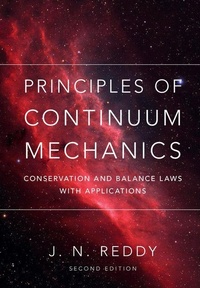
Principles of Continuum Mechanics
Conservation and Balance Laws with Applications
2nd Edition
Published on 16. November 2017
Book
Hardback
270 pages
978-1-107-19920-0 (ISBN)
Description
Continuum mechanics deals with the stress, deformation, and mechanical behaviour of matter as a continuum rather than a collection of discrete particles. The subject is interdisciplinary in nature, and has gained increased attention in recent times primarily because of a need to understand a variety of phenomena at different spatial scales. The second edition of Principles of Continuum Mechanics provides a concise yet rigorous treatment of the subject of continuum mechanics and elasticity at the senior undergraduate and first-year graduate levels. It prepares engineer-scientists for advanced courses in traditional as well as emerging fields such as biotechnology, nanotechnology, energy systems, and computational mechanics. The large number of examples and exercise problems contained in the book systematically advance the understanding of vector and tensor analysis, basic kinematics, balance laws, field equations, constitutive equations, and applications. A solutions manual is available for the book.
Reviews / Votes
'A gutsy attempt at a simplified yet insightful treatment of continuum mechanics, Principles of Continuum Mechanics 2nd Edition offers a rare opportunity for the uninitiated audience, including students at the undergraduate level, to learn the essence of the philosophy and the working of the continuum theory of solids and fluids. It has substantive appeal, not just for the beginner, but also for those intending to make use of basic continuum mechanics for industrial or research purposes of an interdisciplinary nature.' Debasish Roy, Indian Institute of Science 'J. N. Reddy's Principles of Continuum Mechanics excels at presenting in a comprehensible and rigorous style a topic that is generally found challenging by students. The book includes numerous examples and analogies that facilitate a solid understanding of otherwise sophisticated concepts, and it provides extensive discussions and inspiring quotes that motivate the reader to regard this discipline within its wider scientific context.' Gabriel Potirniche, University of IdahoMore details
Edition
2nd Revised edition
Language
English
Place of publication
Cambridge
United Kingdom
Target group
College/higher education
Edition type
Revised edition
Illustrations
Worked examples or Exercises
Dimensions
Height: 260 mm
Width: 183 mm
Thickness: 19 mm
Weight
716 gr
ISBN-13
978-1-107-19920-0 (9781107199200)
Copyright in bibliographic data and cover images is held by Nielsen Book Services Limited or by the publishers or by their respective licensors: all rights reserved.
Schweitzer Classification
Other editions
Additional editions
E-Book
01/2018
2nd Edition
Cambridge University Press
€58.99
Available for download
E-Book
11/2017
Cambridge University Press
€50.49
Available for download
Previous edition
Book
06/2010
Cambridge University Press
€68.08
Article exhausted; check for reprint
Person
J. N. Reddy is a Distinguished Professor, Regents Professor, and the Holder of Oscar S. Wyatt Endowed Chair in the Department of Mechanical Engineering at Texas A & M University. He is internationally-recognized for his research and education in applied and computational mechanics. The shear deformation plate and shell theories that he developed bear his name (the Reddy third-order shear deformation theory and the Reddy layerwise theory) in the literature. The finite element formulations and models he developed have been implemented into commercial software like ABAQUS, NISA, and HyperXtrude. He is the author of nearly 600 journal papers and twenty textbooks, some of them with multiple editions.
Content
1. Introduction; 2. Vectors and tensors; 3. Kinematics of a continuum; 4. Stress vector and stress tensor; 5. Conservation of mass and balance of momenta and energy; 6. Constitute equations; 7. Applications in heat transfer, fluid mechanics, and solid mechanics.