

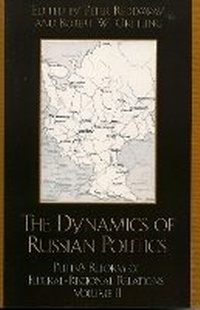
The Dynamics of Russian Politics
Putin's Reform of Federal-Regional Relations
Published on 16. September 2005
Book
Paperback/Softback
540 pages
978-0-7425-2646-4 (ISBN)
Description
Who rules Russia? This question is generated by President Vladimir Putin's most ambitious reform program to date-his attempt since 2000 to reshape the Russian federation, centralize much of the power lost by the Kremlin to the eighty-nine regional governors during the 1990s, and strengthen his weak grip on Russia's institutions and political elite. In The Dynamics of Russian Politics Russian and Western authors from the fields of political science, economics, ethnology, law, and journalism examine the reform's impact on key areas of Russian life, including big business, law enforcement, corruption, political party development, health care, local government, small business, and ethnic relations. Volume I presents the historical context and an overview of the reforms, then tracks how Putin's plans were implemented and resisted across each of the seven new federal okrugs, or megaregions, into which he divided Russia. In particular, the authors analyze the goals and contrasting political styles of his seven commissars and how their often-concealed struggles with the more independent and determined governors played out. Volume II examines the impact of these reforms on Russia's main political institutions; the increasingly assertive business community; and the defense, police, and security ministries. It also analyzes how the reforms have affected such key policy areas as local government, health care, political party development, the battle against corruption, small business, ethnic relations, and the ongoing Chechen war. Together, the two volumes simultaneously reveal that Putin's successes have been much more limited and ambiguous than is widely believed in the West while offering detailed and nuanced answers to the difficult but crucial question: Who rules Russia?
Reviews / Votes
A continuation of the first volume that examined the historical context and regional responses to Vladamir Putin's sweeping reforms of Russia's political system, this is the most comprehensive and authoritative compilation of research examining the short- and long- term implications of these reforms. * Slavic Review *More details
Language
English
Place of publication
United States
Publishing group
Bloomsbury Publishing Plc
Dimensions
Height: 228 mm
Width: 154 mm
Thickness: 40 mm
Weight
762 gr
ISBN-13
978-0-7425-2646-4 (9780742526464)
Copyright in bibliographic data and cover images is held by Nielsen Book Services Limited or by the publishers or by their respective licensors: all rights reserved.
Schweitzer Classification
Persons
Peter Reddaway is professor of political science at The George Washington University. Robert W. Orttung is the head of regional studies at the EastWest Institute (New York).
Content
Chapter 1 Introduction Chapter 2 PART I: Institutions Chapter 3 The Presidential Envoys within the System of the Federal Executive Branch Chapter 4 The Power Ministries and the Federal Reforms Chapter 5 Russia's Regions and Law Enforcement Chapter 6 Courts and Federalism in Putin's Russia Chapter 7 The Regions' Impact on Federal Policy: The Federation Council, State Council and Council of Legislators Chapter 8 President Putin's Local Government Reforms Chapter 9 Party Development in a Federal System: The Impact of Putin's Reforms Chapter 10 PART II: Business Chapter 11 Big Business in Russia's Regions and Its Role in the Federal Reform Chapter 12 Small Business and Putin's Federal Reform Chapter 13 Power Struggle: Reforming the Electricity Industry Chapter 14 PART III: Policies Chapter 15 Federalism with a Russian Face: Regional Inequality and Regional Budgets in Russia Chapter 16 Corruption in Russia 2000-2003: The Role of the Federal Okrugs and Presidential Envoys Chapter 17 Reforms in the Administration of the Regions and Their Influence on Ethno-Political Processes in Russia (1999-2003) Chapter 18 The Chechen War as the Prelude and Model for Federal Reforms in Russia Chapter 19 Health Care under the Federal Reforms Chapter 20 Implications of the Federal Reform in Three Regions Chapter 21 Conclusion: The Overall Impact of the Reforms