

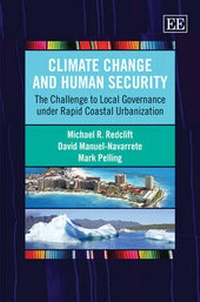
Climate Change and Human Security
The Challenge to Local Governance under Rapid Coastal Urbanization
Published on 29. July 2011
Book
Hardback
192 pages
978-1-84844-372-3 (ISBN)
Description
The challenge presented by climate change is by its nature, global. The populations of the Mexican Caribbean, the focus of this book, are faced by everyday decisions not unlike those in the urban North. The difference is that for the people of the Mexican Caribbean, evidence of the effects of climate change, including hurricanes, is very familiar to them. This important study documents the choices and risks of people who are powerless to change the economic development model which is itself forcing climate change.
The book examines the Mexican Caribbean coast and explores the wider issues of managing climate change in vulnerable areas of the tropics. It also points to the inability to integrate development thinking into climate change adaptation. The authors suggest that failures in local governance - the transparency of state actions, and the local populations lack of effective power - represents a greater threat to adaptation than the absence of technical capacity in vulnerable areas.
Using local case studies of communities, fishing villages and tourist destinations, this well-researched book will appeal to international students and academics working on climate change and professionals in development, conservation and tourism industries.
Contents: 1. Introduction; 2. The Dynamics of Coastal Urbanisation; 3. Nature and Space in the 'Discovery' of the Mexican Caribbean; 4. The Development of Mass Tourism in Mexico; 5. Human Security and Governance; 6. Governance as Process: the Evolution of 'Power Spheres' and Climate Change; 7. Lived Experiences on the Coast: Holbox and Mahahual; 8. Conclusion
The book examines the Mexican Caribbean coast and explores the wider issues of managing climate change in vulnerable areas of the tropics. It also points to the inability to integrate development thinking into climate change adaptation. The authors suggest that failures in local governance - the transparency of state actions, and the local populations lack of effective power - represents a greater threat to adaptation than the absence of technical capacity in vulnerable areas.
Using local case studies of communities, fishing villages and tourist destinations, this well-researched book will appeal to international students and academics working on climate change and professionals in development, conservation and tourism industries.
Contents: 1. Introduction; 2. The Dynamics of Coastal Urbanisation; 3. Nature and Space in the 'Discovery' of the Mexican Caribbean; 4. The Development of Mass Tourism in Mexico; 5. Human Security and Governance; 6. Governance as Process: the Evolution of 'Power Spheres' and Climate Change; 7. Lived Experiences on the Coast: Holbox and Mahahual; 8. Conclusion
More details
Language
English
Place of publication
Cheltenham
United Kingdom
Target group
Professional and scholarly
Dimensions
Height: 234 mm
Width: 156 mm
ISBN-13
978-1-84844-372-3 (9781848443723)
Copyright in bibliographic data and cover images is held by Nielsen Book Services Limited or by the publishers or by their respective licensors: all rights reserved.
Schweitzer Classification
Persons
Michael R. Redclift, Emeritus Professor of International Environmental Policy, King's College, University of London, UK, David Manuel-Navarrete, Assistant Professor, Arizona State University, US and Mark Pelling, Professor in Risk and Disaster Reduction, Institute of Risk and Disaster Reduction, University College London, UK
Content
Contents: 1. Introduction 2. The Dynamics of Coastal Urbanization 3. Nature and Space in the 'Discovery' of the Mexican Caribbean 4. The Development of Mass Tourism in Mexico 5. Human Security and Governance 6. Governance as Process: The Evolution of 'Power Spheres' and Climate Change 7. Lived Experiences on the Coast: Holbox and Mahahual 8. Conclusion Index