

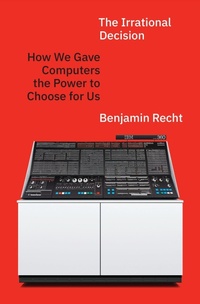
The Irrational Decision
How We Gave Computers the Power to Choose for Us
Will be published approx. on 10. March 2026
Book
Hardback
280 pages
978-0-691-27244-3 (ISBN)
Description
How the computer revolution shaped our conception of rationality-and why human problems require solutions rooted in human intuition, morality, and judgment
In the 1940s, mathematicians set out to design computers that could act as ideal rational agents in the face of uncertainty. The Irrational Decision tells the story of how they settled on a peculiar mathematical definition of rationality in which every decision is a statistical question of risk. Benjamin Recht traces how this quantitative standard came to define our understanding of rationality, looking at the history of optimization, game theory, statistical testing, and machine learning. He explains why, now more than ever, we need to resist efforts by powerful tech interests to drive public policy and essentially rule our lives.
While mathematical rationality has proven valuable in accelerating computers, regulating pharmaceuticals, and deploying electronic commerce, it fails to solve messy human problems and has given rise to a view of a rational world that is not only overquantified but surprisingly limited. Recht shows how these mathematical methods emerged from wartime research and influenced fields ranging from economics to health care, drawing on illuminating examples ranging from diet planning to chess to self-driving cars.
Highlighting both the power and limitations of mathematical rationality, The Irrational Decision reveals why only humans can resolve fundamentally political or value-based questions and proposes a more expansive approach to decision making that is appropriately supported by computational tools yet firmly rooted in human intuition, morality, and judgment.
In the 1940s, mathematicians set out to design computers that could act as ideal rational agents in the face of uncertainty. The Irrational Decision tells the story of how they settled on a peculiar mathematical definition of rationality in which every decision is a statistical question of risk. Benjamin Recht traces how this quantitative standard came to define our understanding of rationality, looking at the history of optimization, game theory, statistical testing, and machine learning. He explains why, now more than ever, we need to resist efforts by powerful tech interests to drive public policy and essentially rule our lives.
While mathematical rationality has proven valuable in accelerating computers, regulating pharmaceuticals, and deploying electronic commerce, it fails to solve messy human problems and has given rise to a view of a rational world that is not only overquantified but surprisingly limited. Recht shows how these mathematical methods emerged from wartime research and influenced fields ranging from economics to health care, drawing on illuminating examples ranging from diet planning to chess to self-driving cars.
Highlighting both the power and limitations of mathematical rationality, The Irrational Decision reveals why only humans can resolve fundamentally political or value-based questions and proposes a more expansive approach to decision making that is appropriately supported by computational tools yet firmly rooted in human intuition, morality, and judgment.
More details
Language
English
Place of publication
New Jersey
United States
Target group
College/higher education
Professional and scholarly
Product notice
Trade binding
Illustrations
6 b/w illus. 4 tables.
Dimensions
Height: 222 mm
Width: 149 mm
Thickness: 28 mm
Weight
454 gr
ISBN-13
978-0-691-27244-3 (9780691272443)
Copyright in bibliographic data and cover images is held by Nielsen Book Services Limited or by the publishers or by their respective licensors: all rights reserved.
Schweitzer Classification
Other editions
Additional editions
E-Book
03/2026
1st Edition
Princeton University Press
€28.99
Available for download
Person
Benjamin Recht is professor of electrical engineering and computer sciences at the University of California, Berkeley. He is the author (with Stephen J. Wright) of Optimization for Data Analysis and (with Moritz Hardt) Patterns, Predictions, and Actions: Foundations of Machine Learning (Princeton).