

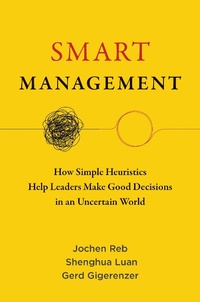
Smart Management
How Simple Heuristics Help Leaders Make Good Decisions in an Uncertain World
Published on 14. May 2024
Book
Paperback/Softback
272 pages
978-0-262-54801-4 (ISBN)
Description
Why successful leaders must embrace simple strategies in an increasingly uncertain and complex world.
Making decisions is one of the key tasks of managers, leaders, and professionals. In Smart Management, Jochen Reb, Shenghua Luan, and Gerd Gigerenzer demonstrate how business leaders can utilize heuristics—simple decision-making strategies adapted to the task at hand. In a world that has become increasingly volatile, uncertain, complex, and ambiguous (VUCA), the authors make the case against complex analytical methods that quickly reach their limits. This against-the-grain approach leads to decisions that are not only faster but also more accurate, transparent, and easier to learn about, communicate, and teach. Smart Management offers an evidence-based yet practical discussion of how business leaders can use smart heuristics to make good decisions in a VUCA world.
Building on the fast-and-frugal heuristics program, Smart Management demonstrates the efficacy of heuristic decision making in a twofold approach. First, it introduces the concept of ecological rationality, which prescribes the environmental conditions under which specific heuristics work well. Second, the book describes a repertoire of heuristics, referred to as the adaptive toolbox, that leaders, managers, and professionals can develop and rely on to make a variety of decisions, such as on business strategy, negotiation, and personnel selection. The toolbox not only showcases the practical usefulness of these heuristics but also inspires readers to discover and develop their own smart heuristics.
Making decisions is one of the key tasks of managers, leaders, and professionals. In Smart Management, Jochen Reb, Shenghua Luan, and Gerd Gigerenzer demonstrate how business leaders can utilize heuristics—simple decision-making strategies adapted to the task at hand. In a world that has become increasingly volatile, uncertain, complex, and ambiguous (VUCA), the authors make the case against complex analytical methods that quickly reach their limits. This against-the-grain approach leads to decisions that are not only faster but also more accurate, transparent, and easier to learn about, communicate, and teach. Smart Management offers an evidence-based yet practical discussion of how business leaders can use smart heuristics to make good decisions in a VUCA world.
Building on the fast-and-frugal heuristics program, Smart Management demonstrates the efficacy of heuristic decision making in a twofold approach. First, it introduces the concept of ecological rationality, which prescribes the environmental conditions under which specific heuristics work well. Second, the book describes a repertoire of heuristics, referred to as the adaptive toolbox, that leaders, managers, and professionals can develop and rely on to make a variety of decisions, such as on business strategy, negotiation, and personnel selection. The toolbox not only showcases the practical usefulness of these heuristics but also inspires readers to discover and develop their own smart heuristics.
More details
Language
English
Place of publication
Cambridge (Massachusetts)
United States
Publishing group
MIT Press Ltd
Illustrations
34 BLACK AND WHITE ILLUS.
Dimensions
Height: 228 mm
Width: 153 mm
Thickness: 20 mm
Weight
340 gr
ISBN-13
978-0-262-54801-4 (9780262548014)
Copyright in bibliographic data and cover images is held by Nielsen Book Services Limited or by the publishers or by their respective licensors: all rights reserved.
Schweitzer Classification
Other editions
Additional editions
Jochen Reb | Shenghua Luan | Gerd Gigerenzer
Smart Management
How Simple Heuristics Help Leaders Make Good Decisions in an Uncertain World
E-Book
05/2024
MIT Press
€43.99
Available for download
Persons
Jochen Reb is Professor of Organizational Behavior and Human Resources and founding Director of the Mindfulness Initiative at the Lee Kong Chian School of Business, Singapore Management University.
Shenghua Luan is Professor of Psychology and Principal Investigator of the Risk and Uncertainty Management Lab at the Institute of Psychology, Chinese Academy of Sciences.
Gerd Gigerenzer is Director of the Harding Center for Risk Literacy at the University of Potsdam, Director Emeritus at the Max Planck Institute for Human Development, and Partner of Simply Rational—the Institute for Decisions. He is the author of Calculated Risks, Gut Feelings, Risk Savvy, and How to Stay Smart in a Smart World (MIT Press).
Shenghua Luan is Professor of Psychology and Principal Investigator of the Risk and Uncertainty Management Lab at the Institute of Psychology, Chinese Academy of Sciences.
Gerd Gigerenzer is Director of the Harding Center for Risk Literacy at the University of Potsdam, Director Emeritus at the Max Planck Institute for Human Development, and Partner of Simply Rational—the Institute for Decisions. He is the author of Calculated Risks, Gut Feelings, Risk Savvy, and How to Stay Smart in a Smart World (MIT Press).
Content
Acknowledgments ix
Part I
1 What You (Likely) Won't Learn in Business School 3
2 Why Heuristics? 15
3 The Adaptive Toolbox 33
Part II
4 Hiring and Firing 55
5 Strategy 73
6 Innovation 89
7 Negotiating in the Real World 103
8 Building Better Teams and Communities 121
9 Leaders' Adaptive Toolbox 133
Part III
10 The Power of Intuition 151
11 Creating Smart Decision-Making Cultures 161
12 Artificial Intelligence and Psychological Intelligence 177
13 What You Should Learn in Business School 195
Glossary 211
Notes 217
References 231
Index 251
Part I
1 What You (Likely) Won't Learn in Business School 3
2 Why Heuristics? 15
3 The Adaptive Toolbox 33
Part II
4 Hiring and Firing 55
5 Strategy 73
6 Innovation 89
7 Negotiating in the Real World 103
8 Building Better Teams and Communities 121
9 Leaders' Adaptive Toolbox 133
Part III
10 The Power of Intuition 151
11 Creating Smart Decision-Making Cultures 161
12 Artificial Intelligence and Psychological Intelligence 177
13 What You Should Learn in Business School 195
Glossary 211
Notes 217
References 231
Index 251