

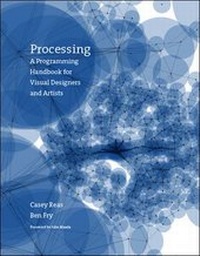
Processing
A Programming Handbook for Visual Designers and Artists
Published on 17. August 2007
Book
Hardback
712 pages
978-0-262-18262-1 (ISBN)
Description
It has been more than twenty years since desktop publishing reinvented design, and
it's clear that there is a growing need for designers and artists to learn programming skills to
fill the widening gap between their ideas and the capability of their purchased software. This book
is an introduction to the concepts of computer programming within the context of the visual arts. It
offers a comprehensive reference and text for Processing (www.processing.org), an open-source
programming language that can be used by students, artists, designers, architects, researchers, and
anyone who wants to program images, animation, and interactivity. The ideas in Processing have been
tested in classrooms, workshops, and arts institutions, including UCLA, Carnegie Mellon, New York
University, and Harvard University. Tutorial units make up the bulk of the book and introduce the
syntax and concepts of software (including variables, functions, and object-oriented programming),
cover such topics as photography and drawing in relation to software, and feature many short,
prototypical example programs with related images and explanations. More advanced professional
projects from such domains as animation, performance, and typography are discussed in interviews
with their creators. "Extensions" present concise introductions to further areas of
investigation, including computer vision, sound, and electronics. Appendixes, references to
additional material, and a glossary contain additional technical details. Processing can be used by
reading each unit in order, or by following each category from the beginning of the book to the end.
The Processing software and all of the code presented can be downloaded and run for future
exploration.Includes essays by Alexander R. Galloway, Golan Levin, R. Luke DuBois, Simon Greenwold,
Francis Li, and Hernando Barragán and interviews with Jared Tarbell, Martin Wattenberg, James
Paterson, Erik van Blockland, Ed Burton, Josh On, Jürg Lehni, Auriea Harvey and Michaël Samyn,
Mathew Cullen and Grady Hall, Bob Sabiston, Jennifer Steinkamp, Ruth Jarman and Joseph Gerhardt, Sue
Costabile, Chris Csikszentmihályi, Golan Levin and Zachary Lieberman, and Mark Hansen.Casey Reas is
Associate Professor in the Design Media Arts Department at the University of California, Los
Angeles. Ben Fry is Nierenburg Chair of Design in the School of Design at Carnegie Mellon
University, 2006-2007.
it's clear that there is a growing need for designers and artists to learn programming skills to
fill the widening gap between their ideas and the capability of their purchased software. This book
is an introduction to the concepts of computer programming within the context of the visual arts. It
offers a comprehensive reference and text for Processing (www.processing.org), an open-source
programming language that can be used by students, artists, designers, architects, researchers, and
anyone who wants to program images, animation, and interactivity. The ideas in Processing have been
tested in classrooms, workshops, and arts institutions, including UCLA, Carnegie Mellon, New York
University, and Harvard University. Tutorial units make up the bulk of the book and introduce the
syntax and concepts of software (including variables, functions, and object-oriented programming),
cover such topics as photography and drawing in relation to software, and feature many short,
prototypical example programs with related images and explanations. More advanced professional
projects from such domains as animation, performance, and typography are discussed in interviews
with their creators. "Extensions" present concise introductions to further areas of
investigation, including computer vision, sound, and electronics. Appendixes, references to
additional material, and a glossary contain additional technical details. Processing can be used by
reading each unit in order, or by following each category from the beginning of the book to the end.
The Processing software and all of the code presented can be downloaded and run for future
exploration.Includes essays by Alexander R. Galloway, Golan Levin, R. Luke DuBois, Simon Greenwold,
Francis Li, and Hernando Barragán and interviews with Jared Tarbell, Martin Wattenberg, James
Paterson, Erik van Blockland, Ed Burton, Josh On, Jürg Lehni, Auriea Harvey and Michaël Samyn,
Mathew Cullen and Grady Hall, Bob Sabiston, Jennifer Steinkamp, Ruth Jarman and Joseph Gerhardt, Sue
Costabile, Chris Csikszentmihályi, Golan Levin and Zachary Lieberman, and Mark Hansen.Casey Reas is
Associate Professor in the Design Media Arts Department at the University of California, Los
Angeles. Ben Fry is Nierenburg Chair of Design in the School of Design at Carnegie Mellon
University, 2006-2007.
More details
Language
English
Place of publication
Cambridge, Mass.
United States
Publishing group
MIT Press Ltd
Target group
Professional and scholarly
Illustrations
36 farbige Abbildungen
36 color illus.
Dimensions
Height: 229 mm
Width: 178 mm
Thickness: 0 mm
Weight
907 gr
ISBN-13
978-0-262-18262-1 (9780262182621)
Copyright in bibliographic data and cover images is held by Nielsen Book Services Limited or by the publishers or by their respective licensors: all rights reserved.
Schweitzer Classification
Other editions
New editions
Book
12/2014
2nd Edition
MIT Press
€94.50
Shipment within 10-20 days