

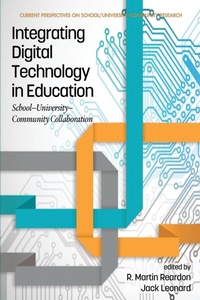
Integrating Digital Technology in Education
School-University-Community Collaboration
Published on 20. May 2019
Book
Paperback/Softback
290 pages
978-1-64113-670-9 (ISBN)
Description
This fourth volume in the Current Perspectives on School/University/Community Research series brings together the perspectives of authors who are deeply committed to the integration of digital technology with teaching and learning. Authors were invited to discuss either a completed project, a work-in-progress, or a theoretical approach which aligned with one of the trends highlighted by the New Media Consortium's NMC/CoSN Horizon Report: 2017 K-12 Edition, or to consider how the confluence of interest and action (Thompson, Martinez, Clinton, & Diaz, 2017) among school-university-community collaborative partners in the digital technology in education space resulted in improved outcomes for all-where "all" is broadly conceived and consists of the primary beneficiaries (the students) as well as the providers of the educational opportunities and various subsets of the community in which the integrative endeavors are enacted.
The chapters in this volume are grouped into four sections: Section 1 includes two chapters that focus on computational thinking/coding in the arts (music and visual arts); Section 2 includes three chapters that focus on the instructor in the classroom, preservice teacher preparation, and pedagogy; Section 3 includes four chapters that focus on building the academic proficiency of students; and Section 4 includes two chapters that focus on the design and benefits of school-university-community collaboration.
The chapters in this volume are grouped into four sections: Section 1 includes two chapters that focus on computational thinking/coding in the arts (music and visual arts); Section 2 includes three chapters that focus on the instructor in the classroom, preservice teacher preparation, and pedagogy; Section 3 includes four chapters that focus on building the academic proficiency of students; and Section 4 includes two chapters that focus on the design and benefits of school-university-community collaboration.
More details
Series
Language
English
Place of publication
Charlotte
United States
Publishing group
Emerald Publishing Inc
Target group
Professional and scholarly
Dimensions
Height: 234 mm
Width: 156 mm
Thickness: 16 mm
Weight
445 gr
ISBN-13
978-1-64113-670-9 (9781641136709)
Copyright in bibliographic data and cover images is held by Nielsen Book Services Limited or by the publishers or by their respective licensors: all rights reserved.
Schweitzer Classification
Other editions
Additional editions
R. Martin Reardon
Integrating Digital Technology in Education
School-University-Community Collaboration
E-Book
01/2019
1st Edition
Information Age Publishing
from
€62.33
Available for download
Persons
R. Martin Reardon, East Carolina University
Jack Leonard, University of Massachusetts-Boston
Jack Leonard, University of Massachusetts-Boston
Content
Part I. Digital Technology in the Arts.
Chapter 1. A Curricular Activity System for Integrating Computational Thinking Into Music and Visual Arts in Three Rural Middle Schools: A Computer Science for All Initiative; R. Martin Reardon and Claire Davie Webb.
Chapter 2. Teaching a Computer to Sing: Integrating Computing and Music in an After-School Program for Middle School Students; Daniel A. Walzer and Jesse M. Heines.
Part II. The Digital Technology Educator.
Chapter 3. A Multidisciplinary Approach to Incorporating Computational Thinking in STEM Courses for Preservice Teachers; Jennifer E. Slate, Rachel F. Adler, Joseph E. Hibdon, Scott T. Mayle, Hanna Kim, and Sudha Srinivas.
Chapter 4. The Availability of Pedagogical Responses and the Integration of Computational Thinking; Whitney Wall Bortz, Aakash Gautam, Deborah Tatar, Stephanie Rivale, and Kemper Lipscomb.
Chapter 5. Developing Elementary Students' Problem Solving, Critical Thinking, Creativity, and Collaboration Through a University-School Partnership; Nancy Streim, Susan Lowes, Elizabeth Herbert-Wasson, Yan Carlos Colon, Lalitha Vasudevan, Jung-Hyun Ahn, and Woonhee Sung.
Part III. Building Academic Proficiency.
Chapter 6. Using Technology to Facilitate P- 20 Partnerships in Rural Communities; Elizabeth E. Smith, Heather Young, and Vinson Carter.
Chapter 7. Tech Inequity: Preservice Teachers Combating the Digital Divide in an Urban School- and Community-Based Immersion Program; Abiola Farinde-Wu and Aaron J. Griffen.
Chapter 8. Integrating Digital Technology in Education: A Tech Center in the U.S. Borderland Region; Lucia Chacon-Diaz and Susan Brown.
Chapter 9. Collaborating With Educators: Video Games to Support Alternative Classroom Pedagogies to Support Boys' Meaning-Making; Carol-Ann Lane.
Part IV. Design And Benefits Of School-University-Collaborations.
Chapter 10. Digital School Networks: Technology Integration as a Joint Research and Development Effort; Michael Kerres and Bettina Waffner.
Chapter 11. Mutual Benefits of Partnerships Among K-12 Schools, Universities, and Communities to Incorporate a Computational Thinking Pedagogy in K-12 Education; Ahlam Lee.
About the Authors.
Chapter 1. A Curricular Activity System for Integrating Computational Thinking Into Music and Visual Arts in Three Rural Middle Schools: A Computer Science for All Initiative; R. Martin Reardon and Claire Davie Webb.
Chapter 2. Teaching a Computer to Sing: Integrating Computing and Music in an After-School Program for Middle School Students; Daniel A. Walzer and Jesse M. Heines.
Part II. The Digital Technology Educator.
Chapter 3. A Multidisciplinary Approach to Incorporating Computational Thinking in STEM Courses for Preservice Teachers; Jennifer E. Slate, Rachel F. Adler, Joseph E. Hibdon, Scott T. Mayle, Hanna Kim, and Sudha Srinivas.
Chapter 4. The Availability of Pedagogical Responses and the Integration of Computational Thinking; Whitney Wall Bortz, Aakash Gautam, Deborah Tatar, Stephanie Rivale, and Kemper Lipscomb.
Chapter 5. Developing Elementary Students' Problem Solving, Critical Thinking, Creativity, and Collaboration Through a University-School Partnership; Nancy Streim, Susan Lowes, Elizabeth Herbert-Wasson, Yan Carlos Colon, Lalitha Vasudevan, Jung-Hyun Ahn, and Woonhee Sung.
Part III. Building Academic Proficiency.
Chapter 6. Using Technology to Facilitate P- 20 Partnerships in Rural Communities; Elizabeth E. Smith, Heather Young, and Vinson Carter.
Chapter 7. Tech Inequity: Preservice Teachers Combating the Digital Divide in an Urban School- and Community-Based Immersion Program; Abiola Farinde-Wu and Aaron J. Griffen.
Chapter 8. Integrating Digital Technology in Education: A Tech Center in the U.S. Borderland Region; Lucia Chacon-Diaz and Susan Brown.
Chapter 9. Collaborating With Educators: Video Games to Support Alternative Classroom Pedagogies to Support Boys' Meaning-Making; Carol-Ann Lane.
Part IV. Design And Benefits Of School-University-Collaborations.
Chapter 10. Digital School Networks: Technology Integration as a Joint Research and Development Effort; Michael Kerres and Bettina Waffner.
Chapter 11. Mutual Benefits of Partnerships Among K-12 Schools, Universities, and Communities to Incorporate a Computational Thinking Pedagogy in K-12 Education; Ahlam Lee.
About the Authors.