

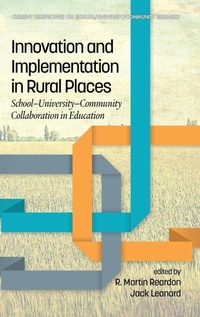
Innovation and Implementation in Rural Places
School-University-Community Collaboration in Education
Published on 12. March 2018
Book
Hardback
362 pages
978-1-64113-214-5 (ISBN)
Description
This volume focuses on innovative school-university-community collaborations that are being implemented in rural places in the United States. A foundational belief that underpins the contributions to this volume is that rural communities contain within themselves the resources to promote and sustain vibrant educational endeavors. This belief has inspired a wealth of innovations that collectively offer a countervailing perspective to the view that global competitiveness is the preeminent goal of education, and that this goal is best served by "big education." Since early last century, there has been a pervasive implicit, and sometimes explicit, assumption that rural places are bereft of the ability to educate children effectively. As repeatedly witnessed in this volume, in collaboration with universities, schools in rural places and the communities that both sustain and rely on them can appropriately configure the educational environment to optimally nurture the intellectual growth of children.
The chapters in this volume are grouped into three parts that explore, in turn, the design features of innovative school-universitycommunity collaborations, some novel approaches to such collaborations, and the contours of parental and community involvement in such collaborations. Chapters discuss both larger scale collaborations that involve many school districts across wide -spread regions, and smaller scale collaborations that involve intensive engagements among the educators and members of smaller communities, and offer theoretical insights into the collaborative process itself. As mentioned above, two narrative threads run through the chapters: that effective collaborations address goals and aspirations expressed by those who are privileged to live in rural America, and that effective collaborations are oriented to building on the strengths inherent in the social fabric of those rural communities.
The chapters in this volume are grouped into three parts that explore, in turn, the design features of innovative school-universitycommunity collaborations, some novel approaches to such collaborations, and the contours of parental and community involvement in such collaborations. Chapters discuss both larger scale collaborations that involve many school districts across wide -spread regions, and smaller scale collaborations that involve intensive engagements among the educators and members of smaller communities, and offer theoretical insights into the collaborative process itself. As mentioned above, two narrative threads run through the chapters: that effective collaborations address goals and aspirations expressed by those who are privileged to live in rural America, and that effective collaborations are oriented to building on the strengths inherent in the social fabric of those rural communities.
More details
Series
Language
English
Place of publication
Charlotte
United States
Publishing group
Emerald Publishing Inc
Target group
Professional and scholarly
Dimensions
Height: 240 mm
Width: 161 mm
Thickness: 24 mm
Weight
708 gr
ISBN-13
978-1-64113-214-5 (9781641132145)
Copyright in bibliographic data and cover images is held by Nielsen Book Services Limited or by the publishers or by their respective licensors: all rights reserved.
Schweitzer Classification
Content
Part I. Design Features.
Chapter 1. Developing and Sustaining School-University-Community Collaborative Partnerships to Develop School Leaders in Rural Areas; Bonnie C. Fusarelli, Lance D. Fusarelli, and Lesley G. Wirt.
Chapter 2. Germinating, Growing, and Renewing a District-University Partnership to Prepare Rural School Leaders; Kimberly Kappler Hewitt, Jon Schmidt-Davis, and Ann W. Davis.
Chapter 3. Spanning Boundaries to Enhance School Leadership: Examining a Research-Practice Partnership Co-Design Team; Frederick C. Buskey, Hans W. Klar, Kristin Shawn Huggins, and Julie K. Desmangles.
Chapter 4. Toward a Conceptual Framework for Designing and Implementing the Teacher Residency for Rural Education; Emilie Mitescu Reagan, Andrew D. Coppens, Leslie J. Couse, Elyse Hambacher, Daniel Lord, Kathryn McCurdy, Diane Silva Pimentel.
Chapter 5. Too Many Cooks in the Kitchen: Struggling for Voice and Sense of Place in a Rural School-University-Community Collaboration; Steve Myran.
Part II. Novel Approaches.
Chapter 6. Third Space Partnerships for Teacher Education in Rural Communities; Michael A. Kopish.
Chapter 7. Design and Implementation of Needs-Based Collaborative Project: Experiences From a Small, Rural Community in Rockbridge County, Virginia; Joshua G. Iddings and Haley W. Sigler.
Chapter 8. Practicing What We Teach; Tracey G. Scherr and Robin Fox.
Chapter 9. Implementing Multi-Tiered Systems of Supports in Rural Schools Via a School-University Partnership; Sara E. House Rich and Brit'ny Stein.
Part III. Parental and Community Involvement.
Chapter 10. Using the Researcher-Practitioner Partnership to Build Family-School Partnerships in a Rural High School; Kara Lasater.
Chapter 11. Impacting Rural Communities Through School-University-Community Collaboration Partnerships: The Parent Teacher Leadership Academy; M. Blake Berryhill and Holly G. Morgan.
Chapter 12. Examining Community College Targeted Expansions in a Rural Environment: The Case of Butler County Community College; Lou L. Sabina, Nicholas C. Neupauer, and Kiara L. Sabina.
Chapter 13. Rural Incubators: Re-Visioning Rural Districts as Centers for Innovative School and Community Collaboration; Kirk Koennecke, Sharon Watkins, and Ryan Rismiller.
Chapter 1. Developing and Sustaining School-University-Community Collaborative Partnerships to Develop School Leaders in Rural Areas; Bonnie C. Fusarelli, Lance D. Fusarelli, and Lesley G. Wirt.
Chapter 2. Germinating, Growing, and Renewing a District-University Partnership to Prepare Rural School Leaders; Kimberly Kappler Hewitt, Jon Schmidt-Davis, and Ann W. Davis.
Chapter 3. Spanning Boundaries to Enhance School Leadership: Examining a Research-Practice Partnership Co-Design Team; Frederick C. Buskey, Hans W. Klar, Kristin Shawn Huggins, and Julie K. Desmangles.
Chapter 4. Toward a Conceptual Framework for Designing and Implementing the Teacher Residency for Rural Education; Emilie Mitescu Reagan, Andrew D. Coppens, Leslie J. Couse, Elyse Hambacher, Daniel Lord, Kathryn McCurdy, Diane Silva Pimentel.
Chapter 5. Too Many Cooks in the Kitchen: Struggling for Voice and Sense of Place in a Rural School-University-Community Collaboration; Steve Myran.
Part II. Novel Approaches.
Chapter 6. Third Space Partnerships for Teacher Education in Rural Communities; Michael A. Kopish.
Chapter 7. Design and Implementation of Needs-Based Collaborative Project: Experiences From a Small, Rural Community in Rockbridge County, Virginia; Joshua G. Iddings and Haley W. Sigler.
Chapter 8. Practicing What We Teach; Tracey G. Scherr and Robin Fox.
Chapter 9. Implementing Multi-Tiered Systems of Supports in Rural Schools Via a School-University Partnership; Sara E. House Rich and Brit'ny Stein.
Part III. Parental and Community Involvement.
Chapter 10. Using the Researcher-Practitioner Partnership to Build Family-School Partnerships in a Rural High School; Kara Lasater.
Chapter 11. Impacting Rural Communities Through School-University-Community Collaboration Partnerships: The Parent Teacher Leadership Academy; M. Blake Berryhill and Holly G. Morgan.
Chapter 12. Examining Community College Targeted Expansions in a Rural Environment: The Case of Butler County Community College; Lou L. Sabina, Nicholas C. Neupauer, and Kiara L. Sabina.
Chapter 13. Rural Incubators: Re-Visioning Rural Districts as Centers for Innovative School and Community Collaboration; Kirk Koennecke, Sharon Watkins, and Ryan Rismiller.