


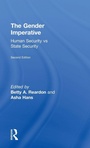
The Gender Imperative
Human Security Vs State Security
1st Edition
Published on 28. July 2010
Book
Hardback
466 pages
978-0-415-58577-4 (ISBN)
Description
The book asserts that human security derives from the experience and expectation of human well-being which depends on four essential conditions: a life sustaining environment, the meeting of essential physical needs, respect for the identity and dignity of persons and groups, protection from avoidable harm and expectations of remedy from them. The book demonstrates their integral relationship to human security.
Patriarchy being the germinal paradigm from which most major human institutions such as the state, the economy, organised religions and social relations have evolved, the book argues that fundamental inequalities must be challenged for the sake of equality and security. The fundamental point raised is that expectation of human well-being is a continuing cause of armed conflict which constitutes a threat to peace and survival of all humanity and human security cannot exist within a militarised security system.
The editors of the book bring together 14 essays which critically examine militarised security in order to find human security pathways, show ways in which to refute the dominant paradigm, indicate a clear gender analysis that challenges the current system, and suggests alternatives to militarised security.
With a mix of female and male feminist scholar activists as contributors, the book makes an important contribution to a new discourse on human security.
Patriarchy being the germinal paradigm from which most major human institutions such as the state, the economy, organised religions and social relations have evolved, the book argues that fundamental inequalities must be challenged for the sake of equality and security. The fundamental point raised is that expectation of human well-being is a continuing cause of armed conflict which constitutes a threat to peace and survival of all humanity and human security cannot exist within a militarised security system.
The editors of the book bring together 14 essays which critically examine militarised security in order to find human security pathways, show ways in which to refute the dominant paradigm, indicate a clear gender analysis that challenges the current system, and suggests alternatives to militarised security.
With a mix of female and male feminist scholar activists as contributors, the book makes an important contribution to a new discourse on human security.
More details
Language
English
Place of publication
London
United Kingdom
Publishing group
Taylor & Francis Ltd
Target group
College/higher education
Product notice
Paper over boards
Dimensions
Height: 216 mm
Width: 140 mm
Weight
658 gr
ISBN-13
978-0-415-58577-4 (9780415585774)
Copyright in bibliographic data and cover images is held by Nielsen Book Services Limited or by the publishers or by their respective licensors: all rights reserved.
Schweitzer Classification
Other editions
New editions
Book
07/2018
2nd Edition
Routledge India
€208.60
Shipment within 10-20 days
Additional editions

Book
01/2016
1st Edition
CRC Press
€70.75
Article exhausted; check for reprint
Persons
Asha Hans is Founder Director, School of Women's Studies, Utkal University, India.
Betty A. Reardon is Director, Peace Foundation Program, Teacher's College, Columbia University, USA.
Betty A. Reardon is Director, Peace Foundation Program, Teacher's College, Columbia University, USA.
Content
Introduction: The Gender Imperative: Human Security vs. State Security Part 1. Confronting the Militarized State Security Paradigm: Human Security from a Feminist Perspective 1. Women and Human Security: A Feminist Framework and Critique of the Prevailing Patriarchal Security System Betty A. Reardon 2. Gendered Insecurity under Long Term Military Presence: the Case of Okinawa Kozue Akibayashi and Suzuyo Takazato 3. Human Security and Layers of Oppression: Women in South Africa Bernedette Muthien Part 2. Patriarchal Conditioning to Violence and Human Insecurity 4. Challenging the Patriarchal National Security Paradigm: The Role of Ethiopian Women in Peace and Security Mesfin G. Ayele 5. War and Armed Conflict: Threat to African Women's Human Security Fatuma Ahmed Ali 6. Sexual Violence and Genocide, the Greatest Violation of Human Security: Responses to the Case of Darfur Lisa Price 7. Security Discourse: A Gender Perspective Michele Milner Part 3. Militarization/ Demilitarization: Eroding and Promoting Human Security 8. Struggles for Peace and Security by Pacific Island Women Ronni Alexander 9. School Burning in Afghanistan: Maintaining Patriarchy through Military and Gender Violence Chloe Breyer 10. Opposing Militarism: Soldiers' Mothers in Russia Valerie Zawilski Part 4. Alternative and Transitional Approaches to Human Security 11. Security Council Resolution 1325: Toward Gender Equality in Peace and Security Policy Making Soumita Basu 12. Jordanian Women's Concepts of Human Security Norma Nemeh 13. Gender, Health, Peace and Security Albie Sharpe 14. An Experiment in Transition from Military to Human Security Asha Hans Conclusion: Framing a Gender and Human Security Discourse: Initiating the Inquiry Annexes: Security Council Resolutions 1325 and 1820 Index