

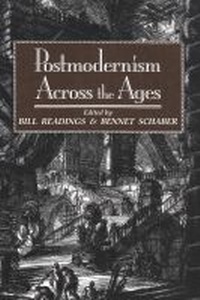
Postmodernism Across the Ages
Published on 30. November 1993
Book
Paperback/Softback
304 pages
978-0-8156-2581-0 (ISBN)
Description
Piranesi builds a shopping mall, Giotto supervises a training analysis, Milton directs a film. In this text, the traditional notion of change in history, the linear analogy of human development, comes in for its own share of interpretation, of reading, and hence doubles back on itself. This collection of essays examines the way in which the concept of postmodernism has forced a rethinking of the intersection of time and text. Appropriately, these essays themselves reach across the ages, considering authors ranging from Alexander the Great, to Chaucer and Milton, to Ford Madox Ford and Umberto Eco. The volume concludes with a series of four dissenting afterwords that assess the importance of these postmodern readings on some of the major interpretive projects of our day: feminism, Marxism, humanism and deconstruction, and gay studies.
More details
Language
English
Place of publication
New York
United States
Target group
College/higher education
Professional and scholarly
Illustrations
9 black and white illustrations
Dimensions
Height: 226 mm
Width: 149 mm
Thickness: 17 mm
Weight
454 gr
ISBN-13
978-0-8156-2581-0 (9780815625810)
Copyright in bibliographic data and cover images is held by Nielsen Book Services Limited or by the publishers or by their respective licensors: all rights reserved.
Schweitzer Classification
Content
Introduction, William Readings and Bennet Schaber; Alexander, Biologist - Oriental Monstrosities and the ""Epistola Alexandri ad Anstotelem"", James Romm; The Aesthetics of Deception - Giotto in the Text of Boccacio, Bennet Schaber; ""The Miller's Tale"" in Chaucer's Time, Nicholas Royle; The Hyphen in the Mouth of Modernity, Marshall Grossman; Milton at the Movies - An Afterword to ""Paradise Lost"", William Readings; Discourse of One's Own, Thomas Di Piero; The Paranormal Roxana, Veronica Kelly; Telling Accounts - De Quincey at the Booksellers, Stacy Hubbard; The Wrong Saddest Story - Reading the Appearance of Post-Modernity in Ford's ""The Good Soldier"", Robert M. Robertson; The Ruins of Allegory and the Allegory of Ruins - The Postmodern in the 18th Century, Grant Holly; Postmodern Romance, Diane Elam; Skeptical Feminist Postscript to the Postmodern, Judith Butler; Marxism and Postmodernism ""Across the Ages"" - A Commentary, Bruce Robbins; Deconstruction and Postmodernism/""Beatbox"" - A Short Walk Around the Postmodern Block, Stephen Melville; The Postmodernist and the Homosexual - A Dialogue, Greg Bredbeck.