

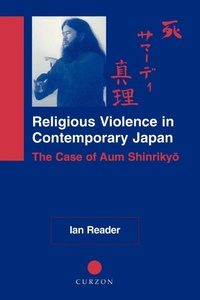
Religious Violence in Contemporary Japan
The Case of Aum Shinrikyo
1st Edition
Published on 20. April 2000
Book
Paperback/Softback
304 pages
978-0-7007-1109-3 (ISBN)
Description
The Tokyo subway attack in March 1995 was just one of a series of criminal activities including murder, kidnapping, extortion, and the illegal manufacture of arms and drugs carried out by the Japanese new religious movement Aum Shinrikyo, under the guidance of its leader Asahara Shoko. Reader looks at Aum's claims about itself and asks, why did a religious movement ostensibly focussed on yoga, meditation, asceticism and the pursuit of enlightenment become involved in violent activities?
Reader discusses Aum's spiritual roots, placing it in the context of contemporary Japanese religious patterns. Asahara's teaching are examined from his earliest public pronouncements through to his sermons at the time of the attack, and statements he has made in court. In analysing how Aum not only manufactured nerve gases but constructed its own internal doctrinal justifications for using them Reader focuses on the formation of what made all this possible: Aum's internal thought-world, and on how this was developed.
Reader argues that despite the horrors of this particular case, Aum should not be seen as unique, nor as solely a political or criminal terror group. Rather it can best be analysed within the context of religious violence, as an extreme example of a religious movement that has created friction with the wider world that escalated into violence.
Reader discusses Aum's spiritual roots, placing it in the context of contemporary Japanese religious patterns. Asahara's teaching are examined from his earliest public pronouncements through to his sermons at the time of the attack, and statements he has made in court. In analysing how Aum not only manufactured nerve gases but constructed its own internal doctrinal justifications for using them Reader focuses on the formation of what made all this possible: Aum's internal thought-world, and on how this was developed.
Reader argues that despite the horrors of this particular case, Aum should not be seen as unique, nor as solely a political or criminal terror group. Rather it can best be analysed within the context of religious violence, as an extreme example of a religious movement that has created friction with the wider world that escalated into violence.
Reviews / Votes
'One of the strengths of this study is the careful analysis of primary sources Reader has provided us with an illuminating account of how and why one Japanese religion turned violent. This is not just a book for students of Japanese religion, however. The comparisons and parallels notet between Aum and other new religious movements that have been closely associated with violent eruptions will make this study of interest to many scholars and concerned individuals outside of the field of Japanese studies.' - Mark R. Mullins, Japanese Journal of Religious StudiesMore details
Language
English
Place of publication
London
United Kingdom
Publishing group
Taylor & Francis Ltd
Target group
College/higher education
Dimensions
Height: 234 mm
Width: 156 mm
Thickness: 17 mm
Weight
491 gr
ISBN-13
978-0-7007-1109-3 (9780700711093)
Copyright in bibliographic data and cover images is held by Nielsen Book Services Limited or by the publishers or by their respective licensors: all rights reserved.
Schweitzer Classification
Other editions
Additional editions
E-Book
10/2013
1st Edition
Routledge
€104.99
Available for download
E-Book
10/2013
1st Edition
Routledge
€104.99
Available for download
Book
04/2000
1st Edition
Routledge
€206.90
Shipment within 10-20 days
Person
Ian Reader
Content
Introduction ??; 1: A Death in the Culture of Coercive Asceticism - Killing for Salvation, Religious Violence and Aum Shinriky? ?; 2: Compassionate Cruelty and the Cosmic Struggle - The Life and Nature of Asahara Sh?k? ??; 3: Creation, Preservation and Destruction - The Development and Nature of the Religion of Supreme Truth ?; 4: The World of the True Victors - The Motivations, Experiences and Practices of Asahara's Followers ?; 5: Losing the Struggle - From World Salvation to World Destruction, 1988-1990 ??; 6: Perpetual Conflict, Foreign Excursions and Cosmic Wars - Conspiracies, Retribution and the Right to Kill ??; 7: The Violence of the Lambs - Murder; Chaos, Vengeance, Power and Immortality ?; 8: Concluding Comments - Aum Shinriky? and Religious Violence ?