

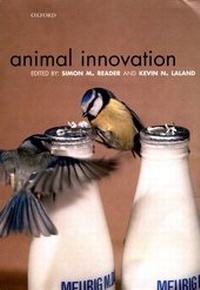
Animal Innovation
Published on 25. September 2003
Book
Paperback/Softback
354 pages
978-0-19-852622-3 (ISBN)
Description
In 1953 a young female Japanese macaque called Imo began washing sweet potatoes before eating them, presumably to remove dirt and sand grains. Soon other monkeys had adopted this behaviour, and potato washing gradually spread throughout the troop. When, three years after her first invention, Imo devised a second novel foraging behaviour, that of separating wheat from sand by throwing mixed handfuls into water and scooping out the floating grains, she was almost instantly heralded around the world as a 'monkey genius'. Imo is probably the most celebrated of animal innovators. In fact, many animals will invent new behaviour patterns, adjust established behaviours to a novel context, or respond to stresses in an appropriate and novel manner.
Innovation is an important component of behavioural flexibility, vital to the survival of individuals in species with generalist or opportunistic lifestyles, and potentially of critical importance to those endangered or threatened species forced to adjust to changed or impoverished environments. Innovation may also have played a central role in avian and primate brain evolution. Yet until recently animal innovation has been subject to almost complete neglect by behavioural biologists, psychologists, social learning researchers, and conservation-minded biologists.
This collection of stimulating and readable articles by leading scientific authorities is the first ever book on 'animal innovation', designed to put the topic of animal innovation on the map and heighten awareness of this developing field.
Innovation is an important component of behavioural flexibility, vital to the survival of individuals in species with generalist or opportunistic lifestyles, and potentially of critical importance to those endangered or threatened species forced to adjust to changed or impoverished environments. Innovation may also have played a central role in avian and primate brain evolution. Yet until recently animal innovation has been subject to almost complete neglect by behavioural biologists, psychologists, social learning researchers, and conservation-minded biologists.
This collection of stimulating and readable articles by leading scientific authorities is the first ever book on 'animal innovation', designed to put the topic of animal innovation on the map and heighten awareness of this developing field.
Reviews / Votes
This interesting collection of chapters seems bound to stimulate further research, and it may well cause researchers to be more alert to the potential importance of phenomena that might previously have been dismissed as one-off events or anecdotes. It is also a thought-provoking and pleasant read . . . Acquire Animal Innovation, and you'll probably get some new and useful ideas for your teaching and research. * Folia Primatol * I really enjoyed reading this book. The pleasure stemmed from both specific and general features ... All of the chapters are eminently readable, so this could serve as additional reading on an undergraduate course ... I thought this book provided a pile of fun information on animal behavior as well as research challenges for the future. About how many edited volumes can you say the same? * ISBE Newsletter * . . . the book provides a state-of-the-art compendium of different approaches to animal innovation, with several chapters neatly summarising the results of several years' work, and is rich in ideas for further work. This should make it invaluable to students, especially post-graduates, interested in the area . . . an informative and stimulating volume. * Animal Welfare, 13 * Probing the relation between development and innovation is one of the 'ten unanswered questions' that Reader and Laland pose in their opening chapter and, having now read Animal Innovation for myself, I can assure tham that their book does indeed 'provide a stimulus to generating answers to . . . these interesting and important questions', even if I am going to try to do so in the lowly baboon and not the groovy guppy. * Louise Barrett in Animal Behaviour, 67 * . . . this book presents a convincing case that innovation is a coherent and exciting topic for biologists. And as such it meets its aim to stimulate awareness in this newly developing field. * Trends in Cognitive Sciences * The editors have succeeded in putting innovation well and truly on the map as a phenomenon to be reckoned with. They provide a series of outstanding questions that demand answers, and the book will stimulate further research efforts. * Nature * Innovation has likely been a significant causal force in the evolution of many species. This book provides a wide-ranging and up-to-date review of an important phenomenon. * Henry Plotkin, Professor of Psychobiology, University College, London, UK * Over the past 20 years, as scientists have conducted increasingly detailed, long-term studies of animals, they have come to know their subjects' behaviour so well that they can state with confidence when a truly novel innovation has appeared. Animal Innovation offers the first attempt to analyse such discoveries in a careful, scientific manner. The volume is filled with wonderful examples - strikingly innovative behaviours by species ranging from guppies to chimpanzees ... Observing an animal do something it has never done before is genuinely exciting. Animal Innovation offers the equally exciting prospect of studying such creative behaviour scientifically. * Robert Seyfarth, University of Pennsylvania, USA * Innovation - the Mother of All Culture - has been curiously neglected for decades, in part because no one really knew how to study it. Now, at last, we do, and this book shows how it should be done and documents the surprising advances that have been made in just a few years. * Carel van Schaik, Professor/Director of Graduate Studies, Department of Biological Anthropology and Anatomy, Duke University, USA * I thoroughly recommend this book to anyone with an interest in primate behaviour. It describes a fascinating range of innovative behaviours seen in primate and non-primate species alike and is extremely thought-provoking in describing the challenges to be faced by those wishing to drive this area of scientific enquiry forward. All chapters are highly readable and pitched at a level accessible to final year undergraduates, this makes the book an excellent text for courses in primatology or animal bahviour more broadly. * Stuart Semple, Roehampton University *More details
Language
English
Place of publication
Oxford
United Kingdom
Target group
Professional and scholarly
Illustrations
numerous figures and halftones
Dimensions
Height: 240 mm
Width: 168 mm
Thickness: 19 mm
Weight
606 gr
ISBN-13
978-0-19-852622-3 (9780198526223)
Copyright in bibliographic data and cover images is held by Nielsen Book Services Limited or by the publishers or by their respective licensors: all rights reserved.
Schweitzer Classification
Persons
Content
PART I - DEFINITIONS AND KEY QUESTIONS ; 1. Animal innovation: an introduction ; PART II - COMPARATIVE AND EVOLUTIONARY ANALYSES OF INNOVATION ; 2. Positive and negative correlates of feeding innovations in birds: evidence for limited modularity ; 3. Behavioural innovation: a neglected issue in the ecological and evolutionary literature? ; 4. Environmental variability and primate behavioural flexibility ; 5. Is innovation in bird song adaptive? ; 6. Social Learning: promoter or inhibitor of innovation? ; PART III - PATTERNS AND CAUSES OF ANIMAL INNOVATION ; 7. Experimental studies of innovation in the guppy ; 8. The role of neophobia and neophilia in the development of innovative behaviour of birds ; 9. Characteristics and propensities of marmosets and tamarins: Implications for studies of innovation ; PART IV - INNOVATION, INTELLIGENCE, AND COGNITION ; 10. Conditions of innovative behaviour in primates ; 11. Novelty in deceit ; 12. Innovation as a behavioural response to environmental challenges: a cost and benefit approach ; 13. Innovation and creativity in forest-living rehabilitant orangutans ; PART V - HUMAN INNOVATION ; 14. Human innovation: two Darwinian analyses ; PART VI - DISCUSSION ; 16. To innovate or not to innovate? That is the question