

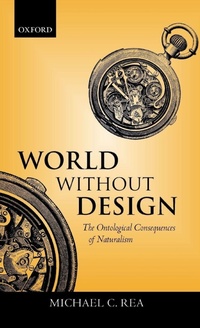
World Without Design
The Ontological Consequences of Naturalism
Published on 1. August 2002
Book
Hardback
256 pages
978-0-19-924760-8 (ISBN)
Description
Philosophical naturalism, according to which philosophy is continuous with the natural sciences, has dominated the Western academy for well over a century; but Michael Rea claims that it is without rational foundation, and that the costs of embracing it are surprisingly high.
The first part of World Without Design aims to provide a fair and historically informed characterization of naturalism. Rea then argues compellingly to the surprising conclusion that naturalists are committed to rejecting realism about material objects, materialism, and perhaps realism about other minds. This conclusion is striking, largely because naturalism is often simply identified with materialism, and the remaining two theses are ones that naturalists very typically want to endorse. Rea goes on to examine two alternative research programs: intuitionism and supernaturalism, and argues for the conclusion that intuitionism, under certain circumstances, is self-defeating.
World Without Design offers a provocative challenge to philosophical orthodoxy. It will make uncomfortable reading for many philosophers.
The first part of World Without Design aims to provide a fair and historically informed characterization of naturalism. Rea then argues compellingly to the surprising conclusion that naturalists are committed to rejecting realism about material objects, materialism, and perhaps realism about other minds. This conclusion is striking, largely because naturalism is often simply identified with materialism, and the remaining two theses are ones that naturalists very typically want to endorse. Rea goes on to examine two alternative research programs: intuitionism and supernaturalism, and argues for the conclusion that intuitionism, under certain circumstances, is self-defeating.
World Without Design offers a provocative challenge to philosophical orthodoxy. It will make uncomfortable reading for many philosophers.
Reviews / Votes
... wide-ranging ... however we react to Rea's arguments, they do us the service of forcing us to reflect anew on the epistemology of metaphysics. * Australasian Journal of Philosophy * The first part of Rea's book is an informed and useful history of naturalism as a philosophical movement ... full of interesting points. * Times Literary Supplement * ... succinct and penetrating ... Thoroughly researched and richly argued, World Without Design will prove valuable to anyone interested in the naturalistic tradition. * Troy Cross, Notre Dame Philosophical Reviews * Rea's is a dense and closely argued book, illustrating the convergence of philosophy of religion and sophisticated metaphysics and representativeof the best of Christian philosophy today. * Philosophia Christi *More details
Language
English
Place of publication
Oxford
United Kingdom
Target group
Professional and scholarly
Dimensions
Height: 222 mm
Width: 145 mm
Thickness: 19 mm
Weight
497 gr
ISBN-13
978-0-19-924760-8 (9780199247608)
Copyright in bibliographic data and cover images is held by Nielsen Book Services Limited or by the publishers or by their respective licensors: all rights reserved.
Schweitzer Classification
Other editions
Additional editions
Book
04/2004
Oxford University Press
€65.30
Shipment within 15-20 days
E-Book
08/2002
1st Edition
Oxford University Press
€175.16
Available for download
Person
Michael C. Rea is Associate Professor of Philosophy at the University of Notre Dame.
Content
2. PILLARS OF THE TRADITION ; 4. THE DISCOVERY PROBLEM ; 8. INTUITIONISM