

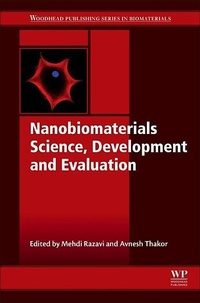
Nanobiomaterials Science, Development and Evaluation
Published on 26. May 2017
Book
Hardback
340 pages
978-0-08-100963-5 (ISBN)
Description
Nanobiomaterials Science, Development and Evaluation examines the practical aspects of producing nanostructured biomaterials for a range of applications. With a strong focus on materials, such as metals, ceramics, polymers, and composites, the book also examines nanostructured coatings and toxicology aspects.
Chapters in Part One look at materials classes and their synthesis with information on all major material groups. Part Two focuses on nanostructured coatings and practical aspects associated with the use of nanobiomaterials in vivo.
This book brings together the work of international contributors who are actively engaged on the forefront of research in their respective disciplines, and is a valuable resource for materials scientists in academia, industry, and all those who wish to broaden their knowledge in the allied field.
Chapters in Part One look at materials classes and their synthesis with information on all major material groups. Part Two focuses on nanostructured coatings and practical aspects associated with the use of nanobiomaterials in vivo.
This book brings together the work of international contributors who are actively engaged on the forefront of research in their respective disciplines, and is a valuable resource for materials scientists in academia, industry, and all those who wish to broaden their knowledge in the allied field.
More details
Language
English
Place of publication
Cambridge
United Kingdom
Publishing group
Elsevier Science & Technology
Target group
Professional and scholarly
Materials scientists and researchers in the biomedical/bioengineering field
Product notice
sewn/stitched
Cloth over boards
Dimensions
Height: 231 mm
Width: 155 mm
Thickness: 18 mm
Weight
544 gr
ISBN-13
978-0-08-100963-5 (9780081009635)
Copyright in bibliographic data and cover images is held by Nielsen Book Services Limited or by the publishers or by their respective licensors: all rights reserved.
Schweitzer Classification
Other editions
Additional editions
Mehdi Razavi | Avnesh Thakor
Nanobiomaterials Science, Development and Evaluation
E-Book
05/2017
Woodhead Publishing
€215.00
Available for download
Persons
Dr. Mehdi Razavi is Assistant Professor of Medicine, Materials Science and Engineering, and BiionixTM (Bionic Materials, Implants & Interfaces) Cluster at University of Central Florida (UCF) since September 2019. Prior to his current appointment, he was a Postdoctoral Research Fellow in Regenerative Medicine with the Interventional Regenerative Medicine and Imaging Laboratory at Stanford University School of Medicine from September 2016 to September 2019. Before that he was a Postdoctoral Research Fellow in Biomaterials with the Brunel Centre for Advanced Solidification Technology (BCAST) in Institute of Materials and Manufacturing and Brunel Institute for Bioengineering (BIB) at Brunel University London from May 2015 to August 2016. He was also a Research Scholar in Biomaterials and Tissue Engineering with the School of Materials Science and Engineering, Helmerich Advanced Technology Research Center (HRC), at Oklahoma State University from July 2013 to April 2014 and an Adjunct Faculty with the Dental Materials Research Center, at Isfahan University of Medical Sciences from September 2014. He holds a PhD in Biomaterials from Isfahan University of Technology, awarded in August 2014, MSc in Materials Engineering from Isfahan University of Technology, awarded in February 2011 and a BSc in Materials Engineering from Isfahan University of Technology, awarded in September 2008. As his research honors, Isfahan University of Technology awarded him "The Best PhD Thesis?; and in June 2019, Stanford University awarded him "Poster Winner? of the 100+ posters presented at Bio-X. His research interests are mainly on Biomaterials, Nanomedicine, Tissue Engineering and Regenerative Medicine, Stem Cells, Orthopedic Implants and Bone scaffolds, Drug/Gene Delivery Systems, Ultrasound Therapy, Cancer Nanotechnology, and Pancreatic Islet Transplantation. His work has resulted in the publication of over 62 peer-reviewed journal articles, 16 book chapters, 5 books, 5 patents pending or granted, and 24 conference proceedings/talks, of which 69 have been as a first author and 57 as a corresponding author. His publications have been cited for over 1540 times, with an h-index of 25, and i-10 index of 37. He also serves as the chief editor, a member of editorial boards and a scientific reviewer for over 128 different journals, conferences, books, grants and dissertations. Dr. Thakor is an Assistant Professor and Clinician-Scientist at Stanford University. He is dual fellowship trained in both pediatric and adult Interventional Radiology having undertaken Interventional Radiology fellowships at the University of Cambridge (Addenbrookes Hospital), University of British Columbia (Vancouver General Hospital) and University of Toronto (SickKids Hospital). His first PhD was in fetal cardiovascular physiology at the University of Cambridge which he then followed with another doctoral degree in Molecular Imaging and Nanotechnology at Stanford University and the University of Cambridge. Dr Thakor's current interests are in developing and translating minimally invasive Regenerative Medicine techniques, stem cell biology and applications, and the development of new bioactive transplantable scaffolds.
Editor
Assistant Professor, BiionixTM (Bionic Materials, Implants and Interfaces) Cluster, Department of Internal Medicine, College of Medicine, Assistant Professor by courtesy, Department of Materials Science and Engineering, University of Central Florida, USA
Assistant Professor of Interventional Radiology, Department of Radiology, School of Medicine, Stanford University, Palo Alto, California, USA
Content
1. Introduction
2. Particles/Fibers/Bulk
3. Porous scaffolds
4. Naturally based and biologically derived nanobiomaterials
5. Nanogels for biomedical applications: Drug delivery, imaging, tissue engineering, and biosensors
6. Lipid-based nanobiomaterials
7. Peptide-based nanobiomaterials
8. Nanoparticles hybridization to engineer biomaterials for drug delivery
9. Nanotherapeutics in the management of infections and cancer
10. Nanostructured coatings for biomaterials
11. Evaluation techniques
12. Nanotoxicity
13. Immune response to nanobiomaterials
14. Safety, regulatory issues, long-term biotoxicity, and the processing environment
15. Practical aspects
16. Summary and future of nanomaterials in medicine/biomaterials
2. Particles/Fibers/Bulk
3. Porous scaffolds
4. Naturally based and biologically derived nanobiomaterials
5. Nanogels for biomedical applications: Drug delivery, imaging, tissue engineering, and biosensors
6. Lipid-based nanobiomaterials
7. Peptide-based nanobiomaterials
8. Nanoparticles hybridization to engineer biomaterials for drug delivery
9. Nanotherapeutics in the management of infections and cancer
10. Nanostructured coatings for biomaterials
11. Evaluation techniques
12. Nanotoxicity
13. Immune response to nanobiomaterials
14. Safety, regulatory issues, long-term biotoxicity, and the processing environment
15. Practical aspects
16. Summary and future of nanomaterials in medicine/biomaterials