

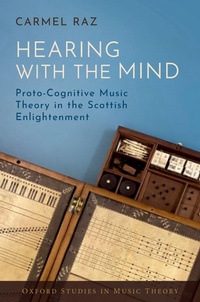
Hearing with the Mind
Proto-Cognitive Music Theory in the Scottish Enlightenment
Will be published approx. on 19. August 2028
Book
Hardback
304 pages
978-0-19-778617-8 (ISBN)
Description
Hearing with the Mind synthesizes two exciting approaches to music--cognitive psychology and social history--by focusing on the remarkable work of musical theorist John Holden (1729--72) during the Scottish Enlightenment. One of the first musical thinkers to propose a detailed account of how the human mind perceives music, Holden had an unconventional background as a merchant potter and appears to have been largely self-taught in music theory.
In his Essay toward a Rational Theory of Music (1770), Holden explores the cognitive aspects of music perception, focusing on chord relationships, key identification, and mental processes. He reinforces his cognitive claims using tenets of contemporaneous Scottish psychology pertaining to attention and memory. His ideas continued to resonate, as can be seen in the music-theoretical work of the Scottish minister Walter Young (1745--1814) and his sister, Anne Young (1756--c.1813), a piano teacher and the inventor of a complex and intriguing musical board game.
Drawing widely from the histories of music theory, science, sociology, and philosophy, as well as from feminist criticism and ludo-musicology, Carmel Raz richly situates the lives and productions of John Holden and Walter and Anne Young within the contexts of the Scottish Enlightenment. Hearing with the Mind thereby shows how the contributions of relatively marginalized figures in the history of music theory reflect Britain's social transformations and global entanglements in the rising age of empire.
This is an open access title available under the terms of a CC BY-NC-ND 4.0 International licence. It is free to read on the Oxford Academic platform and offered as a free PDF download from OUP and selected open access locations.
In his Essay toward a Rational Theory of Music (1770), Holden explores the cognitive aspects of music perception, focusing on chord relationships, key identification, and mental processes. He reinforces his cognitive claims using tenets of contemporaneous Scottish psychology pertaining to attention and memory. His ideas continued to resonate, as can be seen in the music-theoretical work of the Scottish minister Walter Young (1745--1814) and his sister, Anne Young (1756--c.1813), a piano teacher and the inventor of a complex and intriguing musical board game.
Drawing widely from the histories of music theory, science, sociology, and philosophy, as well as from feminist criticism and ludo-musicology, Carmel Raz richly situates the lives and productions of John Holden and Walter and Anne Young within the contexts of the Scottish Enlightenment. Hearing with the Mind thereby shows how the contributions of relatively marginalized figures in the history of music theory reflect Britain's social transformations and global entanglements in the rising age of empire.
This is an open access title available under the terms of a CC BY-NC-ND 4.0 International licence. It is free to read on the Oxford Academic platform and offered as a free PDF download from OUP and selected open access locations.
Reviews / Votes
Hearing with the Mind will be an important text for any scholar working on music theory or the Scottish Enlightenment. * Brianna E. Robertson-Kirkland, Eighteenth-Century Scotland *More details
Series
Language
English
Place of publication
New York
United States
Target group
Professional and scholarly
Product notice
sewn/stitched
Cloth over boards
Illustrations
54
Dimensions
Height: 238 mm
Width: 161 mm
Thickness: 22 mm
Weight
678 gr
ISBN-13
978-0-19-778617-8 (9780197786178)
Copyright in bibliographic data and cover images is held by Nielsen Book Services Limited or by the publishers or by their respective licensors: all rights reserved.
Schweitzer Classification
Other editions
Additional editions
E-Book
05/2025
OUP eBook
€70.49
Available for download
Person
Carmel Raz is Assistant Professor of Music at Cornell University and Research Group Leader of Histories of Music, Mind, and Body at the Max Planck Institute for Empirical Aesthetics in Frankfurt am Main. She has published widely on the intertwined histories of music and the neural sciences and on the histories of musical attention and cognition. She is co-editor with James Grande of Sound and Sense in British Romanticism.
Content
Introduction Chapter 1: Potter, Musician, Merchant, Scribe: The Many Lives of John Holden (1729DS1772) Chapter 2: An Eighteenth-Century Theory of Musical Cognition? John Holden> 's Essay towards a Rational System of Music (1770) Chapter 3: <"Our Nurse> 's Tunes> ": John Holden and Scottish Psalmody Chapter 4: To <"Fill Up, Completely, the Whole Capacity of the Mind> ": Listening with Attention in Late Eighteenth-Century Scotland Chapter 5: Rhythm as a Universal <"Science of Man> ": Walter Young> 's <"Essay on Rythmical Measures> " (1790) Chapter 6: What> 's in a Game? Rediscovering the Music Theory of Anne Young Afterword