

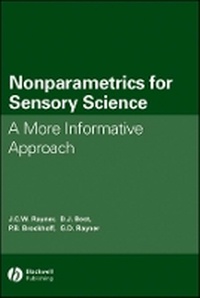
Nonparametrics for Sensory Science
A More Informative Approach
1st Edition
Published on 22. February 2006
Book
Hardback
192 pages
978-0-8138-1112-3 (ISBN)
Description
Sensory evaluation is the perception science of the food industry. Sensory data can be costly to obtain and so gleaning the most information possible from the data is key. Increasingly, value is added to sensory evaluation by the use of statistics, especially to improve the quality of product development and to make the most of market research. Nonparametrics for Sensory Science is written to complement existing parametric methodology. Nonparametric methods are appropriate when facts are only available in nominal or ordinal form, and when the model assumptions necessary for parametric procedures do not hold. Author Rayner and his colleagues consider problems including the most commonly occurring and important experimental designs: the one-sample, k-sample, blocked samples, samples with factorial structure and samples with correlation structure. Innovative new techniques are outlined and complemented with real examples. Techniques described may be applied to data where the traditional, most frequently applied nonparametric tests, such as the Kruskal-Wallis, the Friedman and the Spearman tests, are applied.
Those familiar with traditional nonparametric testing will be able to update their knowledge, acquiring powerful new methods. Those without prior knowledge of nonparametric testing will be able to acquire that knowledge through this book. Aimed at sensory scientists and statisticians interested in nonparametrics, the techniques of Nonparametrics for Sensory Science are of broad general interest, but are of particular interest in sensory evaluation applications.
Those familiar with traditional nonparametric testing will be able to update their knowledge, acquiring powerful new methods. Those without prior knowledge of nonparametric testing will be able to acquire that knowledge through this book. Aimed at sensory scientists and statisticians interested in nonparametrics, the techniques of Nonparametrics for Sensory Science are of broad general interest, but are of particular interest in sensory evaluation applications.
More details
Language
English
Place of publication
Hoboken
United Kingdom
Publishing group
John Wiley and Sons Ltd
Target group
Professional and scholarly
Dimensions
Height: 237 mm
Width: 160 mm
Thickness: 17 mm
Weight
417 gr
ISBN-13
978-0-8138-1112-3 (9780813811123)
Copyright in bibliographic data and cover images is held by Nielsen Book Services Limited or by the publishers or by their respective licensors: all rights reserved.
Schweitzer Classification
Other editions
Additional editions
John C. W. Rayner | D. John Best | Per Brockhoff
Nonparametrics for Sensory Science
A More Informative Approach
E-Book
04/2016
Wiley-Blackwell
€218.99
Available for download
Persons
J.C.W. RAYNER, Ph.D. is associate professor in the School of Mathematics and Applied Statistics at the University of Wollongong, Australia. D.J. BEST, Ph.D. is former principal research scientist at CSIRO Division of Food Research and is now principal research fellow in the School of Mathematics and Applied Statistics at the University of Wollongong, Australia.
P.B. BROCKHOFF, Ph.D. is professor of Informatics and Mathematical Modelling at the Technical University of Denmark.
G.D. RAYNER, Ph.D.is a fellow of the University of Wollongong, Australia.
P.B. BROCKHOFF, Ph.D. is professor of Informatics and Mathematical Modelling at the Technical University of Denmark.
G.D. RAYNER, Ph.D.is a fellow of the University of Wollongong, Australia.
Content
Preface. 1. Introduction.
2. The Completely Randomized Design.
3. The Randomized Block Design.
4. Balanced Incomplete Block Designs.
5. Correlation Effects.
6. Categorical Data for Randomized Block Designs.
7. Goodness of Fit.
8. Concluding Remarks.
References.
Subject Index.
Author Index.
Examples Index
2. The Completely Randomized Design.
3. The Randomized Block Design.
4. Balanced Incomplete Block Designs.
5. Correlation Effects.
6. Categorical Data for Randomized Block Designs.
7. Goodness of Fit.
8. Concluding Remarks.
References.
Subject Index.
Author Index.
Examples Index