

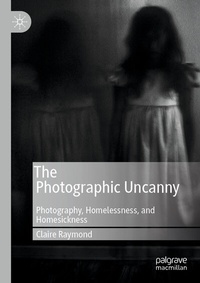
The Photographic Uncanny
Description
This book argues for a renewed understanding of the fundamentally uncanny quality of the medium of photography. It especially makes the case for the capacity of certain photographs-precisely through their uncanniness-to contest structures of political and social dominance. The uncanny as a quality that unsettles the perception of home emerges as a symptom of modern and contemporary society and also as an aesthetic apparatus by which some key photographs critique the hegemony of capitalist and industrialist domains. The book's historical scope is large, beginning with William Henry Fox Talbot and closing with contemporary indigenous photographer Bear Allison and contemporary African American photographer Devin Allen. Through close readings, exegesis, of individual photographs and careful deployment of contemporary political and aesthetic theory, The Photographic Uncanny argues for a re-envisioning of the political capacity of photography to expose the haunted, homeless,condition of modernity.
Reviews / Votes
"Raymond's compelling book throws into relief the political uncanny that haunts photography and the homelessness - or instability - of photography. By returning to pre-Freudian understandings, Raymond's lucid book draws out the political uncanny in the work of photographers whose images attend to estrangement, unbelonging, and moments of subtle political resistance. Raymond weaves together elegant close readings of photographs with a politics of seeing that attends to photography's entanglement with moments of social violence and the uncanny experience of looking at photographs. Importantly, this book is subtly, but firmly, threaded through with a disquiet about the current political climate. Raymond's sharp ability to combine cultural critique with rich and detailed discussions of a range of photographs makes this a revelatory book, one that has made me return to - to look again at - many photographs." (Dr Jane Simon, Macquarie University)
"this is a crucial book and will garner a wide audience. Its attention to homelessness as literal and figurative phenomena, its articulation of violence and its racial and sexual dimensions and its focus on the discreet image as a portal to larger social and ethical problems is gorgeously rendered" (Paula Rabinowitz, Editor-in-Chief, Oxford Research Encyclopaedia of Literature)
More details
Other editions
Additional editions
Person
Claire Raymond is the author of six books on aesthetic theory, feminist theory, and photography. Her previous works include
Witnessing Sadism in Texts of the American South
(2014),
Francesca Woodman's Dark Gaze
(2016), and
Women Photographers and Feminist Aesthetics
(2017). She teaches for the Program in Art History at the University of Virginia, USA.
Content
1.A Political Uncanny: The Homelessness of Photographs.- 2.Eugene Atget's Sacred Spaces: Uncanny Capitalism.- 3.August Sander's Habitus.- 4.Walker Evans's Emotions.- 5.Diane Arbus's Uncanny Aura.- 6.Second Selves: Woodman, Meatyard, Allison.- 7.North American Uncanny: Shelley Niro.- 8.Ghosts of West Baltimore: Devin Allen.- 9.Conclusion: Revisiting the 18 th -Century Visual Uncanny.