

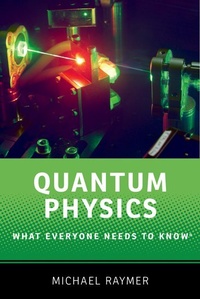
Quantum Physics
What Everyone Needs to Know (R)
Published on 14. September 2017
Book
Hardback
334 pages
978-0-19-025072-0 (ISBN)
Description
Around 1900, physicists started to discover particles like electrons, protons, and neutrons, and with these discoveries they believed they could predict the internal behavior of the atom. However, once their predictions were compared to the results of experiments in the real world, it became clear that the principles of classical physics and mechanics were far from capable of explaining phenomena on the atomic scale. With this realization came the advent of quantum physics, one of the most important intellectual movements in human history.
Today, quantum physics is everywhere: it explains how our computers work, how radios transmit sound, and allows scientists to predict accurately the behavior of nearly every particle in nature. Its application led to the recent discovery of the Higgs Boson, and continues to be fundamental in the investigation of the broadest and most expansive questions related to our world and the universe. However, while the field and principles of quantum physics are known to have nearly limitless applications, the reasons why this is the case are far less understood. In "Quantum Physics: What Everyone Needs to Know," Michael Raymer distills the basic principles of such an abstract field, and addresses the many ways quantum physics is a key factor in today's scientific climate and beyond. The book tackles questions as broad as the definition of a quantum state and as specific and timely as why the British government plans to spend 270 million GBP on quantum technology research in the next five years. Raymer's list of topics is diverse, and showcases the sheer range of questions and ideas in which quantum physics is involved. From applications like data encryption and micro-circuitry to principles and concepts like Absolute Zero and Heisenberg's Uncertainty principle, "Quantum Physics: What Everyone Needs to Know" is wide-reaching introduction to a nearly ubiquitous scientific topic.
Today, quantum physics is everywhere: it explains how our computers work, how radios transmit sound, and allows scientists to predict accurately the behavior of nearly every particle in nature. Its application led to the recent discovery of the Higgs Boson, and continues to be fundamental in the investigation of the broadest and most expansive questions related to our world and the universe. However, while the field and principles of quantum physics are known to have nearly limitless applications, the reasons why this is the case are far less understood. In "Quantum Physics: What Everyone Needs to Know," Michael Raymer distills the basic principles of such an abstract field, and addresses the many ways quantum physics is a key factor in today's scientific climate and beyond. The book tackles questions as broad as the definition of a quantum state and as specific and timely as why the British government plans to spend 270 million GBP on quantum technology research in the next five years. Raymer's list of topics is diverse, and showcases the sheer range of questions and ideas in which quantum physics is involved. From applications like data encryption and micro-circuitry to principles and concepts like Absolute Zero and Heisenberg's Uncertainty principle, "Quantum Physics: What Everyone Needs to Know" is wide-reaching introduction to a nearly ubiquitous scientific topic.
Reviews / Votes
I highly recommend Quantum Physics for its content and price to everyone. * Reva Garg, Optics & Photonics News * This book is accessible as it is written in everyday language and intended for general readership. * B. Ishak, Contemporary Physics *More details
Series
Language
English
Place of publication
New York
United States
Illustrations
30
Dimensions
Height: 145 mm
Width: 206 mm
Thickness: 25 mm
Weight
550 gr
ISBN-13
978-0-19-025072-0 (9780190250720)
Copyright in bibliographic data and cover images is held by Nielsen Book Services Limited or by the publishers or by their respective licensors: all rights reserved.
Schweitzer Classification
Other editions
Additional editions
Book
09/2017
Oxford University Press Inc
€16.50
Article in reprint
E-Book
06/2017
1st Edition
OUP eBook
€11.99
Available for download
E-Book
06/2017
1st Edition
OUP eBook
€11.99
Available for download
Person
Dr. Mike Raymer is the Knight Professor of Liberal Arts and Sciences and Professor of Physics, University of Oregon.
Content
Chapter 1 - What is Quantum Physics? Chapter 2 - Quantum Measurement and Its Consequences Chapter 3 - Quantum Data Encryption Chapter 4 - Quantum Behavior and Its Description Chapter 5 - Sensing Gravity with Quantum Interference Chapter 6 - Quantum Possibilities as Waves Chapter 7 - Milestones and a Fork in the Road Chapter 8 - The End of Local Realism As a World View Chapter 9 - Quantum Entanglement and Teleportation Chapter 10- Quantum Computing Chapter 11 - Energy Quantization and Atoms Chapter 12 - Sensing Time, Motion, and Gravity with Quantum Technology Chapter 13 - Quantum Fields Chapter 14 - Lingering Questions and Awkwardness