

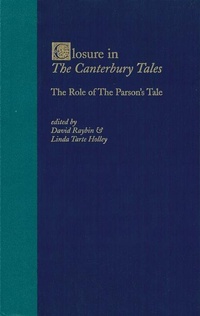
Closure in the Canterbury Tales
The Role of The Parson's Tale
Published on 1. July 2000
Book
Hardback
290 pages
978-1-58044-011-0 (ISBN)
Description
For all its spiritual cheerfulness and obvious importance as a tale to conclude tales, a last word from a notable maker of words, The Parson's Tale seems to have inspired sentence and solaas in remarkably few critics. This volume rejects the tradition that assumes the tale to be of questionable literary value. The studies included span the range of Parson's Tale criticism from the textual, to the philological, to the hermeneutical. What they share is the assumption that if one is to understand the role of The Parson's Tale, one must begin by accepting the language and method by which Chaucer fashioned it. This rethinking of traditional scholarship on this crucial aspect of The Canterbury Tales will be of great interest to Chaucer scholars and students of medieval literature.
More details
Series
Edition
New edition
Language
English
Place of publication
United States
Target group
Professional and scholarly
Edition type
New edition
Product notice
sewn/stitched
Dimensions
Height: 229 mm
Width: 153 mm
Weight
605 gr
ISBN-13
978-1-58044-011-0 (9781580440110)
Copyright in bibliographic data and cover images is held by Nielsen Book Services Limited or by the publishers or by their respective licensors: all rights reserved.
Schweitzer Classification
Persons
David Raybin is a professor of English at Eastern Illinois University and has extensively published on the Canterbury Tales. Linda Tarte Holley is professor emerita of English from North Carolina State University
Content
Acknowledgments
Introduction by David Raybin and Linda Tarte Holley
The Parson's Tale in Current Literary Studies by Siegfried Wenzel
"Manye been the weyes": The Flower, Its Roots, and the Ending of The Canterbury Tales by David Raybin
The Parson's Tale and Its Generic Affiliations by Richard Newhauser
Prolegomenon to a Print History of the Parson's Tale: The Novelty and Legacy of Wynkyn de Worde's Text by Daniel J. Ransom
The Words of the Parson's "Vertuous Sentence" by Peggy Knapp
Chaucer's Parson and the "Idiosyncracies of Fiction" by Judith Ferster
Dropping the Personae and Reforming the Self: The Parson's Tale and the End of The Canterbury Tales by Gregory Roper
"The goode wey": Ending and Not-Ending in the Parson's Tale by Charlotte Gross
Epilogue: Closing the Eschatological Account by Linda Tarte Holley
Bibliography of Scholarship Treating the Parson's Tale by David Raybin
Contributors
Index
Introduction by David Raybin and Linda Tarte Holley
The Parson's Tale in Current Literary Studies by Siegfried Wenzel
"Manye been the weyes": The Flower, Its Roots, and the Ending of The Canterbury Tales by David Raybin
The Parson's Tale and Its Generic Affiliations by Richard Newhauser
Prolegomenon to a Print History of the Parson's Tale: The Novelty and Legacy of Wynkyn de Worde's Text by Daniel J. Ransom
The Words of the Parson's "Vertuous Sentence" by Peggy Knapp
Chaucer's Parson and the "Idiosyncracies of Fiction" by Judith Ferster
Dropping the Personae and Reforming the Self: The Parson's Tale and the End of The Canterbury Tales by Gregory Roper
"The goode wey": Ending and Not-Ending in the Parson's Tale by Charlotte Gross
Epilogue: Closing the Eschatological Account by Linda Tarte Holley
Bibliography of Scholarship Treating the Parson's Tale by David Raybin
Contributors
Index