

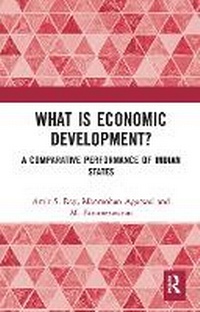
What is Economic Development?
A Comparative Performance of Indian States
1st Edition
Published on 25. June 2024
Book
Paperback/Softback
172 pages
978-1-032-65377-8 (ISBN)
Description
Development performance is not merely economic growth and prosperity, but includes a multitude of goals. This monograph makes an attempt to conceptualize development, consisting of eight dimensions - material prosperity, education, health, economic security, personal security, environmental conditions, political voice and social connections. The authors implement this multidimensional concept to design not only an overall index of development (DI) for Indian states but also three sub indices, human development (HD), security (SEC) and voice and confidence (VC), that broadly represent three distinct aspects of development. The results clearly show that state level performances vary considerably across the various dimensions of development. No state does uniformly well or badly across all levels, thereby exposing the fallacy of branding the development experience of a particular state as ideal based on its achievement on some aspects of development. Since good performance in one dimension does not ensure doing well on other dimensions too, it would be inappropriate to ignore the performances on the three sub-indices and the eight dimensions. Recognition of such diversity of performance is particularly important in a federal structure, like India, where different states may have different development priorities. This study will enable states to reflect on whether they have been performing according to their priorities and if not, they may choose to tweak their policies or their development strategies.
Please note: Taylor & Francis does not sell or distribute the Hardback in India, Pakistan, Nepal, Bhutan, Bangladesh and Sri Lanka
Please note: Taylor & Francis does not sell or distribute the Hardback in India, Pakistan, Nepal, Bhutan, Bangladesh and Sri Lanka
More details
Language
English
Place of publication
London
United Kingdom
Publishing group
Taylor & Francis Ltd
Target group
College/higher education
Postgraduate
Dimensions
Height: 216 mm
Width: 138 mm
Weight
260 gr
ISBN-13
978-1-032-65377-8 (9781032653778)
Copyright in bibliographic data and cover images is held by Nielsen Book Services Limited or by the publishers or by their respective licensors: all rights reserved.
Schweitzer Classification
Other editions
Additional editions
Amit S. Ray | Manmohan Agarwal | M. Parameswaran
What is Economic Development?
A Comparative Performance of Indian States
Book
01/2019
1st Edition
Routledge
€204.90
Shipment within 15-20 days
Amit S. Ray | Manmohan Agarwal | M. Parameswaran
What is Economic Development?
A Comparative Performance of Indian States
E-Book
01/2019
1st Edition
Routledge
€59.49
Available for download
Amit S. Ray | Manmohan Agarwal | M. Parameswaran
What is Economic Development?
A Comparative Performance of Indian States
E-Book
01/2019
Routledge
€59.49
Available for download
Persons
Amit S. Ray is a Professor of Economics at the Centre for International Trade and Development (CITD) of the School of International Studies in Jawaharlal Nehru University, New Delhi.
Manmohan Agarwal studied at the Delhi School of Economics and the Massachusetts Institute of Technology. He has been teaching at the Centre of International Trade and Development at JNU for more than a quarter of a century.
M. Parameswaran is an Associate Professor at the Centre for Developing Studies.
Manmohan Agarwal studied at the Delhi School of Economics and the Massachusetts Institute of Technology. He has been teaching at the Centre of International Trade and Development at JNU for more than a quarter of a century.
M. Parameswaran is an Associate Professor at the Centre for Developing Studies.
Content
1. Introduction 2. Evolving concepts of development 3. Measuring development: international approaches 4. Measuring development: studies on India 5. From conceptualization to implementation: designing a composite measure of development for Indian states 6. Where are the Indian states? 7. Concluding remarks