

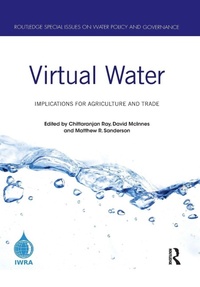
Virtual Water
Implications for Agriculture and Trade
1st Edition
Published on 30. June 2021
Book
Paperback/Softback
208 pages
978-1-032-08397-1 (ISBN)
Description
Virtual Water explores the role of "virtual water" - the water embedded in a product - in ongoing conversations of agriculture, trade and sustainability in an increasingly inter-connected world.
A pervasive theme throughout the book is the general lack of knowledge of the use of water in producing and consuming food. The chapters, arising from a workshop supported by the OECD Co-operative Research Programme: Biological Resources Management for Sustainable Agricultural Systems, on virtual water, agriculture and trade at the University of Nebraska-Lincoln, consider questions of gaps in knowledge, why sustainability matters and the policy implications of virtual water trade. Contributors show how water is a lens through which to examine an array of vital issues facing humanity and the planet: human and animal health; food production; environmental management; resource consumption; climate change adaptation and mitigation; economic development, trade and competitiveness; and ethics and consumer trust.
Virtual Water will be of great interest to scholars of water, resource management and consumption, the environmental aspects of development, agriculture and food production.
It originally published as a special issue of Water International.
A pervasive theme throughout the book is the general lack of knowledge of the use of water in producing and consuming food. The chapters, arising from a workshop supported by the OECD Co-operative Research Programme: Biological Resources Management for Sustainable Agricultural Systems, on virtual water, agriculture and trade at the University of Nebraska-Lincoln, consider questions of gaps in knowledge, why sustainability matters and the policy implications of virtual water trade. Contributors show how water is a lens through which to examine an array of vital issues facing humanity and the planet: human and animal health; food production; environmental management; resource consumption; climate change adaptation and mitigation; economic development, trade and competitiveness; and ethics and consumer trust.
Virtual Water will be of great interest to scholars of water, resource management and consumption, the environmental aspects of development, agriculture and food production.
It originally published as a special issue of Water International.
More details
Series
Language
English
Place of publication
London
United Kingdom
Publishing group
Taylor & Francis Ltd
Target group
College/higher education
Postgraduate and Undergraduate
Dimensions
Height: 244 mm
Width: 170 mm
Thickness: 11 mm
Weight
369 gr
ISBN-13
978-1-032-08397-1 (9781032083971)
Copyright in bibliographic data and cover images is held by Nielsen Book Services Limited or by the publishers or by their respective licensors: all rights reserved.
Schweitzer Classification
Other editions
Additional editions
Chittaranjan Ray | David McInnes | Matthew Sanderson
Virtual Water
Implications for Agriculture and Trade
E-Book
06/2020
1st Edition
Routledge
€59.49
Available for download
Chittaranjan Ray | David McInnes | Matthew Sanderson
Virtual Water
Implications for Agriculture and Trade
E-Book
06/2020
1st Edition
Routledge
€59.49
Available for download
Chittaranjan Ray | David McInnes | Matthew Sanderson
Virtual Water
Implications for Agriculture and Trade
Book
12/2019
1st Edition
Routledge
€206.10
Shipment within 15-20 days
Persons
Chittaranjan Ray serves as the Director of Nebraska Water Center at Robert B. Daugherty Water for Food Institute at the University of Nebraska, Lincoln, USA, and is a Professor in the Department of Civil Engineering. Besides his leadership role in water at the university, his research focuses on water quality impacts from agriculture.
David McInnes is Principal of DMci Strategies, where he is a Strategic Advisor, Speaker and Facilitator on change and opportunity facing the global food system. He is also a Senior Fellow at Canada 2020, an independent, progressive think-tank, where he leads the Canada Food Brand project. Dr McInnes is also a Contributing Editor of The Economist Intelligence Unit, and an Advisor to the Delegation of Canada for the Inter-American Institute for Cooperation on Agriculture.
Matthew R. Sanderson is the Randall C. Hill Distinguished Professor of Sociology, Anthropology and Social Work at Kansas State University, Manhattan, USA. His research focuses on the demographic and environmental aspects of development in global political-economic context.
David McInnes is Principal of DMci Strategies, where he is a Strategic Advisor, Speaker and Facilitator on change and opportunity facing the global food system. He is also a Senior Fellow at Canada 2020, an independent, progressive think-tank, where he leads the Canada Food Brand project. Dr McInnes is also a Contributing Editor of The Economist Intelligence Unit, and an Advisor to the Delegation of Canada for the Inter-American Institute for Cooperation on Agriculture.
Matthew R. Sanderson is the Randall C. Hill Distinguished Professor of Sociology, Anthropology and Social Work at Kansas State University, Manhattan, USA. His research focuses on the demographic and environmental aspects of development in global political-economic context.
Content
Introduction: Virtual water: its implications on agriculture and trade Chittaranjan Ray, David McInnes and Matthew Sanderson 1. The water footprint of the EU: quantification, sustainability and relevance Davy Vanham 2. The exposure of a fresh fruit and vegetable supply chain to global water-related risks Tim Hess and Chloe Sutcliffe 3. Advising Morocco: adopting recommendations of a water footprint assessment would increase risk and impair food security for the country and its farmers Dennis Wichelns 4. Future crop yields and water productivity changes for Nebraska rainfed and irrigated crops Yaqiong Lu, Xianyu Yang and Lara Kueppers 5. Can Sub-Saharan Africa feed itself? The role of irrigation development in the region's drylands for food security Hua Xie, Nicostrato Perez, Weston Anderson, Claudia Ringler and Liangzhi You 6. Sustainability of aquifers supporting irrigated agriculture: a case study of the High Plains aquifer in Kansas James J. Butler, Donald O. Whittemore, B. Brownie Wilson and Geoffrey C. Bohling 7. Irrigation variability and climate change affect derived distributions of simulated water recharge and nitrate leaching Timothy R. Green and Saseendran S. Anapalli 8. The water footprint challenge for water resources management in Chilean arid zones Pablo Alvarez 9. The effect of diet changes and food loss reduction in reducing the water footprint of an average American Mesfin M. Mekonnen and Julian Fulton 10. Water footprint for Korean rice products and virtual water trade in a water-energy-food nexus Sang-Hyun Lee, Jin-Yong Choi, Seung-Hwan Yoo and Rabi H. Mohtar 11. Water footprint of beef production on Texas High Plains pasture Charles P. West and Lisa L. Baxter 12. Tradeoffs in the water-energy- food nexus in the urbanizing Asia-Pacific region Makoto Taniguchi, Naoki Masuhara and Shun Teramoto