

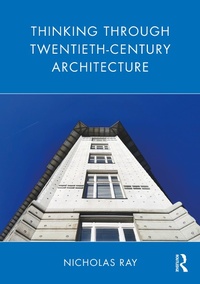
Thinking Through Twentieth-Century Architecture
1st Edition
Published on 8. February 2023
Book
Paperback/Softback
298 pages
978-1-032-15612-5 (ISBN)
Description
***Shortlisted for the Architectural Book Awards 2024***
Thinking Through Twentieth-Century Architecture connects the practice of architecture with its recent history and its theoretical origins - those philosophical ideas that lay behind modernism and its aftermath. By analyzing in straightforward and jargon-free language the genesis of modernism and the complex reactions to it, the book clarifies a continuing debate. It has been specifically written to connect issues of theory, history and contemporary practice and to allow students to make these connections easily.
This is a history of twentieth-century architecture, written with close critical attention to the theories that lie behind the works described. Importantly, unlike other historical accounts, it does not take sides and urge the reader to identify with one strand of thinking or style of architecture at the expense of others, but it presents a dispassionate view, with persuasive arguments on behalf of different positions. It pursues the history of European and American architecture chronologically, but the history is interwoven with the philosophical ideas that informed both writers and architects and are essential for its understanding.
The book is relevant to current issues of contemporary practice and education, showing that philosophical issues are fundamental and those relating to design decisions never go away. It includes 200 illustrations and will appeal to all those interested in twentieth-century architecture and to architectural students.
Thinking Through Twentieth-Century Architecture connects the practice of architecture with its recent history and its theoretical origins - those philosophical ideas that lay behind modernism and its aftermath. By analyzing in straightforward and jargon-free language the genesis of modernism and the complex reactions to it, the book clarifies a continuing debate. It has been specifically written to connect issues of theory, history and contemporary practice and to allow students to make these connections easily.
This is a history of twentieth-century architecture, written with close critical attention to the theories that lie behind the works described. Importantly, unlike other historical accounts, it does not take sides and urge the reader to identify with one strand of thinking or style of architecture at the expense of others, but it presents a dispassionate view, with persuasive arguments on behalf of different positions. It pursues the history of European and American architecture chronologically, but the history is interwoven with the philosophical ideas that informed both writers and architects and are essential for its understanding.
The book is relevant to current issues of contemporary practice and education, showing that philosophical issues are fundamental and those relating to design decisions never go away. It includes 200 illustrations and will appeal to all those interested in twentieth-century architecture and to architectural students.
Reviews / Votes
"This book is welcome for treating theory and practice together, as the architects of the period did, giving students tackling current concerns a coherent account of the built legacy of twentieth-century architecture and 'where it all came from'."Harry Charrington, Head of School of Architecture and Cities, University of Westminster
"This book is the fruit of a lifetime's consistent engagement with modern architecture's moral and aesthetic aims. Nicholas Ray writes with a lucidity and a seriousness of purpose that are much needed amidst the cultural confusion of today."
Andrew Saint, author, formerly editor of the Survey of London and historian at Historic England
"This book will be welcomed by practicing architects because it stimulates us to look beyond the usual day-to-day preoccupations - describing a philosophical dimension which Ray argues has always accompanied 'thoughtful buildings' and which must surely be central in determining our profession's priorities in the face of unprecedented existential challenges."
Ben Zucchi, Principal & Chair of Architecture Profession, BDP
"Why were early modern architects so hell-bent on their agenda? Why were reactions to it so passionately debated? What's with all the manifestos? Why did it all matter so much? Understanding the to-and-fro of twentieth-century modernism is indispensable for anyone wanting to understand architecture today, but navigating its waters requires a gentle, patient and plain-spoken guide. Fortunately, we have Nick Ray for this. A keen observer, a sometime participant and experienced teacher, Ray is the ideal guide for explaining not only the 'what happened?' of modern architecture, but more importantly, the 'why?' of a movement that ultimately conquered the world."
Tom Spector, Oklahoma University, General Editor Journal of the International Society for the Philosophy of Architecture
"Weaving between architectural practice and theory, this books explores design through the convictions of their creators....An outline of each architect is provided with a summary of key designs and theories. The book will therefore serve as a useful resource for a wide market, including students.....and if the philosophical approach deters casual audiences, illustrations on almost every page will help."
Alborz Dianat, C20 Magazine
"Ray combines short biographies, project descriptions, historical contexts, and a panoply of secondary literature to present readers with the fundamentals of numerous architects' works, their design principles, the larger architectural culture of their time, and the present relevance of their ideas. An abundance of representative images illustrates each step of the narrative like visual footnotes [...] it fulfils its purpose by retelling a familiar story in an abridged and accessible yet intricate and informative way."
Andre Patrao, Drawing Matter
More details
Language
English
Place of publication
London
United Kingdom
Publishing group
Taylor & Francis Ltd
Target group
College/higher education
Adult education
Adult education, Postgraduate, Undergraduate Advanced, and Undergraduate Core
Illustrations
90 s/w Abbildungen, 110 farbige Abbildungen, 52 s/w Photographien bzw. Rasterbilder, 108 Farbfotos bzw. farbige Rasterbilder, 38 s/w Zeichnungen, 2 farbige Zeichnungen
2 Line drawings, color; 38 Line drawings, black and white; 108 Halftones, color; 52 Halftones, black and white; 110 Illustrations, color; 90 Illustrations, black and white
Dimensions
Height: 247 mm
Width: 176 mm
Thickness: 18 mm
Weight
792 gr
ISBN-13
978-1-032-15612-5 (9781032156125)
Copyright in bibliographic data and cover images is held by Nielsen Book Services Limited or by the publishers or by their respective licensors: all rights reserved.
Schweitzer Classification
Other editions
Additional editions
Nicholas Ray
Thinking Through Twentieth-Century Architecture
E-Book
02/2023
1st Edition
Routledge
€48.99
Available for download
Nicholas Ray
Thinking Through Twentieth-Century Architecture
E-Book
02/2023
1st Edition
Routledge
€48.99
Available for download
Nicholas Ray
Thinking Through Twentieth-Century Architecture
Book
01/2023
1st Edition
Routledge
€193.45
Shipment within 10-20 days
Person
Nicholas Ray, currently a Visiting Professor at the University of Liverpool, practised and taught at Cambridge for more than 40 years, where he is an Emeritus Fellow of Jesus College. Previous publications include monographs on Alvar Aalto and Rafael Moneo and co-authored books and articles with Christian Illies, a German philosopher.
Content
Introduction 1. A philosophical framework 2. Origins of Modernism - the European picture 3. Fin de siecle Vienna as a paradigm of Modernism 4. The Modernist Canon: the Bauhaus, Le Corbusier and CIAM 5. Positive Scepticism: Alvar Aalto as an alternative modernist 6. Ideals and their representation: Louis Kahn 7. Humanizing Modernism: Team Ten and the Dutch 8. Postmodernism: Irony and Inclusiveness 9. The typological critique 10. Conflicting existential ideals 11. Conclusions - 21st century hindsight Acknowledgements Select bibliography Index