

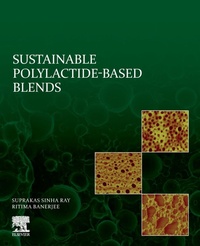
Sustainable Polylactide-Based Blends
Published on 18. February 2022
Book
Paperback/Softback
458 pages
978-0-323-85868-7 (ISBN)
Description
Sustainable Polylactide-Based Blends provides a critical overview of the state-of-the-art in polylactide (PLA)-based blends, addressing the latest advances, innovative processing techniques and fundamental issues that persist in the field. Sections cover the fundamentals of sustainable polymeric materials, polylactide and polymer blends, current and upcoming processing technologies, structure and morphology characterization techniques for PLA and PLA-based blends, and the processing, morphology development, and properties of polylactide-based blends. Final chapters focus on current and future applications, market potential, key challenges and future outlooks.
Throughout the book, theoretical modeling of immiscible polymer blends helps to establish structure-property relationships in various PLA-based polymer blends. With in-depth coverage of fundamentals and processing techniques, the book aims to support the selection of each processing method, along with an understanding of surface chemistry to achieve improved compatibility between phases.
Throughout the book, theoretical modeling of immiscible polymer blends helps to establish structure-property relationships in various PLA-based polymer blends. With in-depth coverage of fundamentals and processing techniques, the book aims to support the selection of each processing method, along with an understanding of surface chemistry to achieve improved compatibility between phases.
More details
Language
English
Place of publication
Philadelphia
United States
Target group
Professional and scholarly
Academic: Researchers, scientists, and advanced students, across polymer science, materials science, and engineering, as well as all those working with bio-based materials. Industry: Engineers, researchers, and R&D professionals interested in developing PLA-based sustainable products for a range of advanced applications.
Product notice
Paperback (trade)
Illustrations
200 illustrations (40 in full color); Illustrations
Dimensions
Height: 235 mm
Width: 191 mm
Thickness: 24 mm
Weight
783 gr
ISBN-13
978-0-323-85868-7 (9780323858687)
Copyright in bibliographic data and cover images is held by Nielsen Book Services Limited or by the publishers or by their respective licensors: all rights reserved.
Schweitzer Classification
Other editions
Additional editions
Suprakas Sinha Ray | Ritima Banerjee
Sustainable Polylactide-Based Blends
E-Book
02/2022
Elsevier
€220.00
Available for download
Persons
Professor Suprakas Sinha Ray is a Chief Research Scientist and Manager of the Centre for Nanostructures and Advanced Materials, and Director of the DSTI-CSIR Nanotechnology Innovation Centre, Council for Scientific and Industrial Research, Pretoria, South Africa. He received his PhD degree in Physical Chemistry at the University of Calcutta, India, in 2001, and was a recipient of the ''Sir P. C Ray Research Award'' for the best PhD work. Prof. Ray's current research focuses on the applications of advanced nanostructured & polymeric materials. He is one of the most active and highly cited authors (h-index of 99) in the field of polymer nanocomposite materials, and he has recently been ranked by Thomson Reuters among the Top 1% most impactful and influential scientists and among the top 50 high-impact chemists.
He has delivered more than 77 plenary/keynote/invited presentations at international conferences and has organised or co-organised several events. He authored 16 books, co-authored 13 edited books, wrote 65 book chapters on various aspects of polymer-based nano-structured materials and their applications, and published 687 articles in high-impact international journals. His work also includes 14 articles in peer-reviewed international conference proceedings and 30 articles in national and international conference proceedings. Additionally, he holds nine patents (registered or pending) and has developed 13 new technologies, which he has shared with colleagues, collaborators, and industry partners. His team has commercialised several products and supported SMMEs. Over the past 19 years, he has mentored 27 postdoctoral fellows and supervised 48 PhD and 17 Master's students. In 2016, he was honored with South Africa's most prestigious NSTF Award.
Dr. Ritima Banerjee completed her Masters in Polymer Science and Technology at the Indian Institute of Technology, Delhi (IITD), India. After working in the polymer industry (GE Plastics and SABIC) for 7 years, she returned to academia. She taught in Delhi Technological University for two years and subsequently completed her PhD from the Department of Materials Science and Engineering, IITD, the area of her work being microcellular processing of thermoplastic elastomer based blends and nanocomposites. She is presently a faculty member in the Department of Chemical Engineering in Calcutta Institute of Technology, India. Her research interests include microcellular processing and the structure-property-processing relationship of polymeric materials.
He has delivered more than 77 plenary/keynote/invited presentations at international conferences and has organised or co-organised several events. He authored 16 books, co-authored 13 edited books, wrote 65 book chapters on various aspects of polymer-based nano-structured materials and their applications, and published 687 articles in high-impact international journals. His work also includes 14 articles in peer-reviewed international conference proceedings and 30 articles in national and international conference proceedings. Additionally, he holds nine patents (registered or pending) and has developed 13 new technologies, which he has shared with colleagues, collaborators, and industry partners. His team has commercialised several products and supported SMMEs. Over the past 19 years, he has mentored 27 postdoctoral fellows and supervised 48 PhD and 17 Master's students. In 2016, he was honored with South Africa's most prestigious NSTF Award.
Dr. Ritima Banerjee completed her Masters in Polymer Science and Technology at the Indian Institute of Technology, Delhi (IITD), India. After working in the polymer industry (GE Plastics and SABIC) for 7 years, she returned to academia. She taught in Delhi Technological University for two years and subsequently completed her PhD from the Department of Materials Science and Engineering, IITD, the area of her work being microcellular processing of thermoplastic elastomer based blends and nanocomposites. She is presently a faculty member in the Department of Chemical Engineering in Calcutta Institute of Technology, India. Her research interests include microcellular processing and the structure-property-processing relationship of polymeric materials.
Author
Centre for Nanostructures and Advanced Materials, DSTI-CSIR Nanotechnology Innovation Centre, Council for Scientific and Industrial Research, Pretoria, South Africa
Faculty Member, Department of Chemical Engineering, Calcutta Institute of Technology, India; Department of Chemical Sciences, University of Johannesburg, Johannesburg, South Africa
Content
1. Introduction
2. Terminology and dimensions of sustainability, life cycle assessment, and characteristics of sustainable polymer materials
3. Science and technology of polylactide
4. Synthesis, properties, advantages, and challenges of bio-based and biodegradable polymers used for the preparation of blends with polylactide
5. Fundamentals of polymer blend technology
6. Processing technologies for polylactide-based blends
7. Techniques for structural and morphological characterization of polymer blends
8. Mechanical models for polymer blends
9. Polylactide stereocomplex
10. Polylactide/natural rubber blends
11. Polylactide/starch blends
12. Polylactide/chitosan blends
13. Polylactide/poly(hydroxyalkanoate) blends
14. Polylactide/lignin blends
15. Polylactide/natural oil blends
16. Polylactide/poly(butylene succinate) blends
17. Polylactide/poly[(butylene succinate)-co-adipate] blends
18. Polylactide/poly(?-caprolactone) blends
19. Polylactide/poly(butylene adipate terephthalate) blends
20. Market, current and future applications
21. Conclusions, challenges, and future outlook
2. Terminology and dimensions of sustainability, life cycle assessment, and characteristics of sustainable polymer materials
3. Science and technology of polylactide
4. Synthesis, properties, advantages, and challenges of bio-based and biodegradable polymers used for the preparation of blends with polylactide
5. Fundamentals of polymer blend technology
6. Processing technologies for polylactide-based blends
7. Techniques for structural and morphological characterization of polymer blends
8. Mechanical models for polymer blends
9. Polylactide stereocomplex
10. Polylactide/natural rubber blends
11. Polylactide/starch blends
12. Polylactide/chitosan blends
13. Polylactide/poly(hydroxyalkanoate) blends
14. Polylactide/lignin blends
15. Polylactide/natural oil blends
16. Polylactide/poly(butylene succinate) blends
17. Polylactide/poly[(butylene succinate)-co-adipate] blends
18. Polylactide/poly(?-caprolactone) blends
19. Polylactide/poly(butylene adipate terephthalate) blends
20. Market, current and future applications
21. Conclusions, challenges, and future outlook