

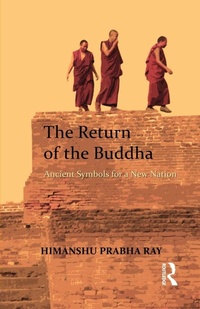
The Return of the Buddha
Ancient Symbols for a New Nation
1st Edition
Published on 1. February 2016
Book
Paperback/Softback
312 pages
978-1-138-66394-7 (ISBN)
Description
The Return of the Buddha traces the development of Buddhist archaeology in colonial India, examines its impact on the reconstruction of India's Buddhist past, and the making of a public and academic discourse around these archaeological discoveries.
The book discusses the role of the state and modern Buddhist institutions in the reconstitution of national heritage through promulgation of laws for the protection of Buddhist monuments, acquiring of land around the sites, restoration of edifices, and organization of the display and dissemination of relics. It also highlights the engagement of prominent Indian figures, such as Nehru, Gandhi, Ambedkar, and Tagore, with Buddhist themes in their writings.
Stressing upon the lasting legacy of Buddhism in independent India, the author explores the use of Buddhist symbols and imagery in nation-building and the making of the constitution, as also the recent efforts to resurrect Buddhist centers of learning such as Nalanda. With rich archival sources, the book will immensely interest scholars, researchers and students of modern Indian history, culture, archaeology, Buddhist studies, and heritage management.
The book discusses the role of the state and modern Buddhist institutions in the reconstitution of national heritage through promulgation of laws for the protection of Buddhist monuments, acquiring of land around the sites, restoration of edifices, and organization of the display and dissemination of relics. It also highlights the engagement of prominent Indian figures, such as Nehru, Gandhi, Ambedkar, and Tagore, with Buddhist themes in their writings.
Stressing upon the lasting legacy of Buddhism in independent India, the author explores the use of Buddhist symbols and imagery in nation-building and the making of the constitution, as also the recent efforts to resurrect Buddhist centers of learning such as Nalanda. With rich archival sources, the book will immensely interest scholars, researchers and students of modern Indian history, culture, archaeology, Buddhist studies, and heritage management.
More details
Language
English
Place of publication
London
United Kingdom
Publishing group
Taylor & Francis Ltd
Target group
College/higher education
Postgraduate
Dimensions
Height: 216 mm
Width: 140 mm
Thickness: 17 mm
Weight
397 gr
ISBN-13
978-1-138-66394-7 (9781138663947)
Copyright in bibliographic data and cover images is held by Nielsen Book Services Limited or by the publishers or by their respective licensors: all rights reserved.
Schweitzer Classification
Other editions
Additional editions
E-Book
08/2014
Routledge
€0.00
Available for download
E-Book
08/2014
Routledge
€0.00
Available for download
Book
12/2013
1st Edition
Routledge
€241.90
Shipment within 15-20 days
Person
Himanshu Prabha Ray is Chairperson of National Monuments Authority, New Delhi, and former Professor, Centre for Historical Studies (CHS), Jawaharlal Nehru University (JNU), New Delhi.
Content
Preface. Preamble: The Buddha in Twenty-First-Century India 1. Engaging With Buddhism 2. The Search for the Historical Buddha 3. The Empire in the Footsteps of Ashoka 4. Excluded Buddhism 5. Buddhism in Memory and History 6. Buddhism and the Birth of a Nation 7. In Retrospect. Bibliography