

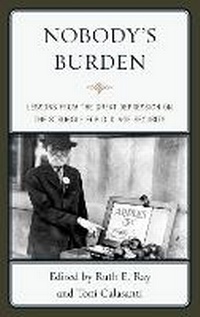
Nobody's Burden
Lessons from the Great Depression on the Struggle for Old-Age Security
Published on 13. June 2013
Book
Paperback/Softback
378 pages
978-0-7391-6532-4 (ISBN)
Description
Nobody's Burden: Lessons on Old Age from the Great Depression is the first book-length study of the experience of old-age during the Great Depression. Part history, part social critique, the contributors rely on archival research, social history, narrative study and theoretical analysis to argue that Americans today, as in the past, need to rethink old-age policy and accept their shared responsibility for elder care. The Great Depression serves as the cultural backdrop to this argument, illustrating that during times of social and economic crisis, society's ageism and the limitations in old-age care become all the more apparent.
At the core of the book are vivid stories of specific men and women who applied for old-age pensions from a private foundation in Detroit, Michigan, between 1927 and 1933. Most applicants who received pensions became life-long clients, and their lives were documented in great detail by social workers employed by the foundation. These stories raise issues that elders and their families face today: the desire for independence and autonomy; the importance of having a place of one's own, despite financial and physical dependence; the fears of being and becoming a burden to one's self and others; and the combined effects of ageism, racism, sexism and classism over the life course of individuals and families. Contributors focus in particular on issues of gender and aging, as the majority of clients were women over 60, and all of the case workers - among the first geriatric social workers in the country - were women in their 20s and early 30s. Nobody's Burden is unique not only in content, but also in method and form. The contributors were members of an archival research group devoted to the study of these case files. Research was conducted collaboratively and involved scholars from the humanities (English, folklore) and the social sciences (anthropology, communications, gerontology, political science, social work, and sociology).
At the core of the book are vivid stories of specific men and women who applied for old-age pensions from a private foundation in Detroit, Michigan, between 1927 and 1933. Most applicants who received pensions became life-long clients, and their lives were documented in great detail by social workers employed by the foundation. These stories raise issues that elders and their families face today: the desire for independence and autonomy; the importance of having a place of one's own, despite financial and physical dependence; the fears of being and becoming a burden to one's self and others; and the combined effects of ageism, racism, sexism and classism over the life course of individuals and families. Contributors focus in particular on issues of gender and aging, as the majority of clients were women over 60, and all of the case workers - among the first geriatric social workers in the country - were women in their 20s and early 30s. Nobody's Burden is unique not only in content, but also in method and form. The contributors were members of an archival research group devoted to the study of these case files. Research was conducted collaboratively and involved scholars from the humanities (English, folklore) and the social sciences (anthropology, communications, gerontology, political science, social work, and sociology).
Reviews / Votes
Using an innovative and interdisciplinary approach, this book examines the construction and experience of (old-age_ burden and dependency in depression era America and beyond. Fourteen scholars from a range of disciplines came together over two years to read and discuss the same materials and to create, successfully, 'a new object which belongs to no one'.Even with a multiplicity of perspectives, the book achieves coherence, with many connections across the chapters and an overarching desire to investigate, problematise, and overcome discourses of burden and their effects.
This is a book of wide relevance, not just for social gerontologists in their many guises, but to anyone seeking a model of how deep and coherent interdisciplinary work can be managed. * Journal of Ageing & Society *
More details
Language
English
Place of publication
United States
Publishing group
Bloomsbury Publishing Plc
Target group
Professional and scholarly
Dimensions
Height: 228 mm
Width: 150 mm
Thickness: 27 mm
Weight
558 gr
ISBN-13
978-0-7391-6532-4 (9780739165324)
Copyright in bibliographic data and cover images is held by Nielsen Book Services Limited or by the publishers or by their respective licensors: all rights reserved.
Schweitzer Classification
Persons
Ruth E. Ray is professor of English/liberal arts at Wayne State University. Toni Calasanti is professor of sociology at Virginia Tech.
Content
Chapter 1: Studying the 'Burden' of Age: The Work of the Hannan Archival Research Group
Part 2 Part I: The Burden of Age in the Great Depression
Chapter 3 Chapter 2: Public Response to the Needs of Old People
Chapter 4 Chapter 3: Private Response to the Needs of Old People
Part 5 Part II: This Old Man and That Old Woman
Chapter 6 Client Sketches
Part 7 Part III: Old Age in Hard Times
Chapter 8 Chapter 4: The Multiple Roles of Social Workers in the Great Depression
Chapter 9 Chapter 5: Resisting Dependence and Burden: On Refusing to Become a 'Little Old Lady'
Chapter 10 Chapter 6: Privileged but Pensioned? How Two Formerly Well-Off Women Experienced Receiving Aid
Chapter 11 Chapter 7: What is Held Dear: Personhood and Material Culture in Old Age
Chapter 12 Chapter 8: Race, Class, Gender and the Social Construction of 'Burden' in Old Age
Chapter 13 Chapter 9: The Haunting Fear: Narrative Burdens in the Great Depression
Part 14 Part IV: Rethinking the 'Burden' of Age
Chapter 15 Chapter 10: Reflections on Ageism: Perspective of a Septuagenarianon the Avoidance of Burdenhood
Chapter 16 Chapter 11: The Continuing Struggle for Old-Age Security
Chapter 17 Chapter 12: Toward a Future When We Truly Care for Old People
Chapter 18 Afterword: From Charity to Care
Part 2 Part I: The Burden of Age in the Great Depression
Chapter 3 Chapter 2: Public Response to the Needs of Old People
Chapter 4 Chapter 3: Private Response to the Needs of Old People
Part 5 Part II: This Old Man and That Old Woman
Chapter 6 Client Sketches
Part 7 Part III: Old Age in Hard Times
Chapter 8 Chapter 4: The Multiple Roles of Social Workers in the Great Depression
Chapter 9 Chapter 5: Resisting Dependence and Burden: On Refusing to Become a 'Little Old Lady'
Chapter 10 Chapter 6: Privileged but Pensioned? How Two Formerly Well-Off Women Experienced Receiving Aid
Chapter 11 Chapter 7: What is Held Dear: Personhood and Material Culture in Old Age
Chapter 12 Chapter 8: Race, Class, Gender and the Social Construction of 'Burden' in Old Age
Chapter 13 Chapter 9: The Haunting Fear: Narrative Burdens in the Great Depression
Part 14 Part IV: Rethinking the 'Burden' of Age
Chapter 15 Chapter 10: Reflections on Ageism: Perspective of a Septuagenarianon the Avoidance of Burdenhood
Chapter 16 Chapter 11: The Continuing Struggle for Old-Age Security
Chapter 17 Chapter 12: Toward a Future When We Truly Care for Old People
Chapter 18 Afterword: From Charity to Care