

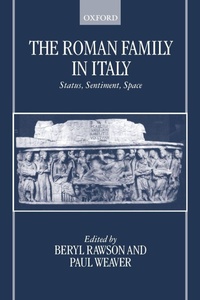
The Roman Family in Italy
Status, Sentiment, Space
Published on 30. September 1999
Book
Paperback/Softback
400 pages
978-0-19-815283-5 (ISBN)
Description
The family continues to be seen as a central institution in Roman as well as modern, Western society. The Roman family is often used as a stereotype, sometimes of severity, sometimes of decadence, with its decline often cited as a cause of wider decline and fall. Definitions and concepts continue to be modified and nuanced, however, as the availability of new evidence and new methodologies make possible a much less simplistic picture. In this volume, the study of family draws on a wide range of disciplines to develop the intertwined themes of status, sentiment, and space. For example, on status there are contributions about Junian Latins and a survey of senators' monuments, while sentiment is represented by a gloomy but convincing picture of old age and a paper on the sentimental ideal which argues that conflict as well as concord is a feature of family life. Space is represented, among others, by the contribution on who commemorates whom in Roman Italy, pointing up the regional variations in custom and the difficulties in tracing complete families. The final contributions focus on the house: how people lived in the Roman house, the use of rooms, and the artefacts that might indicate this use.
The book makes use of many types of evidence from the legal and literary to the iconographical and archaeological. Visual and material evidence play an important role in reconstructing real lives in considerable colour and variety. The book moves beyond the city of Rome to the rest of Roman Italy and even into the provinces, just as Roman culture moved outwards and mingled with other cultures. Chronologically too there are new directions, towards the later Empire and Christianity. So, although the contributors do not abandon any of the territory already gained in Rome, nor literary and epigraphical sources, nor the late Republic or early Empire, there is an exciting sense of new discovery.
The book makes use of many types of evidence from the legal and literary to the iconographical and archaeological. Visual and material evidence play an important role in reconstructing real lives in considerable colour and variety. The book moves beyond the city of Rome to the rest of Roman Italy and even into the provinces, just as Roman culture moved outwards and mingled with other cultures. Chronologically too there are new directions, towards the later Empire and Christianity. So, although the contributors do not abandon any of the territory already gained in Rome, nor literary and epigraphical sources, nor the late Republic or early Empire, there is an exciting sense of new discovery.
Reviews / Votes
The series is now required reading for anyone interested in Roman social history, and many of these essays will be useful in advanced undergraduate courses in Roman civilization. * Craige Champion, Allegheny College, Classical World, Vol 92, no. 5, 1999 * a generally well-written and valuable resource for undergraduates as well as scholars. * Jeanne Neumann O'Neill, Religious Studies Review *More details
Series
Language
English
Place of publication
Oxford
United Kingdom
Target group
Professional and scholarly
Illustrations
halftones, line illustrations, tables
Dimensions
Height: 234 mm
Width: 156 mm
Thickness: 21 mm
Weight
605 gr
ISBN-13
978-0-19-815283-5 (9780198152835)
Copyright in bibliographic data and cover images is held by Nielsen Book Services Limited or by the publishers or by their respective licensors: all rights reserved.
Schweitzer Classification
Other editions
Additional editions
Book
06/1997
Oxford University Press
€94.24
Shipment within 15-20 days
Persons
Content
Introduction ; Roman Kinship: Structure and Sentiment ; Legal Stumbling-Blocks for Lower-Class Families in Rome ; Children of Junian Latins ; Rome and the Outside World: Senatorial Families and the World They Lived In ; Sons, Slaves and Christians ; Out of Sight, Out of Mind: Elderly Members of the Roman Family ; Conflict in the Roman Family ; Interpreting Epithets in Roman Epitaphs ; The Iconography of Roman Childhood ; Iconography: Another Perspective ; Roman Familial Structures: A Regional Approach ; Perceptions of Domestic Space in Roman Italy ; Repopulating the Roman House ; Artefact Distribution and Spatial Function in Pompeian Houses