

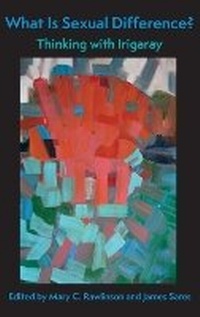
What Is Sexual Difference?
Thinking with Irigaray
Published on 6. June 2023
Book
Hardback
472 pages
978-0-231-20272-5 (ISBN)
Description
Luce Irigaray has written that "sexual difference is one of the major philosophical issues, if not the issue, of our age." Spanning metaphysics, phenomenology, and psychoanalysis, her work examines how sexual difference structures being and subjectivity, organizes our experience of the world, and affects the images and discourses involved in knowledge production and practical action. No other philosopher has paid such careful attention to the consequences of the elision of sexual difference in philosophical thought. However, at a time when notions of sexual and gender difference are hotly contested, Irigaray's thought has often been dismissed as essentialist or reductively binary.
This book brings together leading scholars to consider the philosophical implications of Irigaray's writing on sexual difference, particularly for issues of gender and race. Their essays directly confront the charge of essentialism, exploring how Irigaray's thought opens new possibilities for understanding the complexity of gender identities, including nonbinary and trans experiences as well as alternative configurations of masculinity and femininity. Though Irigaray is sometimes accused of a failure to appreciate racial difference, contributors show the productive role of her work in thinking race. This book also illuminates how Irigaray's work provides creative practices that help realign human experience and our relations with nature and each other.
This book brings together leading scholars to consider the philosophical implications of Irigaray's writing on sexual difference, particularly for issues of gender and race. Their essays directly confront the charge of essentialism, exploring how Irigaray's thought opens new possibilities for understanding the complexity of gender identities, including nonbinary and trans experiences as well as alternative configurations of masculinity and femininity. Though Irigaray is sometimes accused of a failure to appreciate racial difference, contributors show the productive role of her work in thinking race. This book also illuminates how Irigaray's work provides creative practices that help realign human experience and our relations with nature and each other.
Reviews / Votes
What is Sexual Difference? thinks with and against Luce Irigaray in a new and invigorating way. Posing the fundamental question as to what sexual difference is opens up a range of possibilities for reading Irigaray beyond the oppositional attitudes of the essentialism question. Essays from a diversity of perspectives consider Irigaray in relation to colonialism, race, ecological questions, and gender identity. The inclusion of essays that read Irigaray in the context of trans philosophy and the critique of cissexism are an especially welcome contribution. -- Elaine P. Miller, author of <i>Head Cases: Julia Kristeva on Philosophy and Art in Depressed Times</i> This is a timely and impressive re-examination of Luce Irigaray's influential ontological philosophy. By explicitly placing Irigaray's thinking within our pressing contemporary concerns with new, and returning, political, social, and environmental crises, the volume examines how 'sexual difference' constructs lived experience for/by/with diverse communities in affirmative, transversal, and specific ways. Its four sections address the capacity of writing about colonial, racial, sexual, or migrational issues through sexual difference, in order to suggest affirmative and ethical relations or subjectivities. As such, Irigaray's thinking may help enable us to re-think what it means to live together, at times and in places, so deeply constituted by societal, political, and environmental inequity and uncertainty. -- Peg Rawes, author of <i>Relational Architectural Ecologies: Architecture, Nature and Subjectivity</i> This rich collection shows that Irigaray's philosophy of sexual difference remains fruitful and important. Engaging with ontology, essentialism, the sex/gender distinction, trans identities, colonialism, critical race theory, nature and ecology, and new materialisms, the authors interpret and take forward the idea of sexual difference creatively. They bring out many generative resonances between Irigaray's work and contemporary critical thought. -- Alison Stone, author of <i>Luce Irigaray and the Philosophy of Sexual Difference</i> The text that you hold, What is Sexual Difference?, beautifully captures the constitutive dynamism, dialectical and conceptual generativity, and deep openness that is reflective of the ongoing work of Luce Irigaray. The engaging and critically fecund voices and discursive framings within the text precisely reflect the phenomenon of wonder as postponement vis-a-vis the meaning of sexual difference. The text embodies a conceptual excess that resists closure regarding the work of Irigaray but does not sacrifice the necessity to think with her. Indeed, it is this process of thinking with Irigaray that disrupts autarchic myths of univocal meaning, and interpretive hegemony regarding her work. It is clear to me that the spirit and passion of Irigarayan wonder (as a mode of mourning) imbues this text. In this way, Rawlinson and Sares have fashioned a polyvocal philosophical site that refuses (as it should) to suit us totally and functions as a critically engaging textual advent. -- George Yancy, Samuel Candler Dobbs Professor of Philosophy, Emory UniversityMore details
Language
English
Place of publication
New York
United States
Target group
Professional and scholarly
Product notice
Trade binding
Illustrations
14 b&w illustrations
Dimensions
Height: 229 mm
Width: 152 mm
ISBN-13
978-0-231-20272-5 (9780231202725)
Copyright in bibliographic data and cover images is held by Nielsen Book Services Limited or by the publishers or by their respective licensors: all rights reserved.
Schweitzer Classification
Other editions
Additional editions
E-Book
08/2023
1st Edition
Columbia University Press
€38.99
Available for download
Persons
Mary C. Rawlinson is professor emerita of philosophy at Stony Brook University and senior research fellow at the Institute for Advanced Studies, University College London. Her books include, most recently, The Betrayal of Substance: Death, Literature, and Sexual Difference in Hegel's Phenomenology of Spirit (Columbia, 2021), and she is the cofounder of the Luce Irigaray Circle.
James Sares is affiliated faculty in philosophy at Emerson College and holds a PhD in philosophy from Stony Brook University. He is the recipient of the 2018 Karen Burke Memorial Prize, awarded by the Irigaray Circle.
James Sares is affiliated faculty in philosophy at Emerson College and holds a PhD in philosophy from Stony Brook University. He is the recipient of the 2018 Karen Burke Memorial Prize, awarded by the Irigaray Circle.
Content
Foreword, by Elizabeth Grosz
List of Abbreviations (Works by Irigaray)
Introduction: Irigaray and the Question of Sexual Difference, by James Sares and Mary C. Rawlinson
Part I: The Ontology of Sexual Difference
1. The Ontological Negativity of Sexual Difference, by James Sares
2. Opening Hegel's Autological Circle: Irigaray and the Metaphysics of Sexual Difference, by Mary C. Rawlinson
3. One, Two, Many? Sexual Difference and the Problem of Universals, by Stephen D. Seely
4. Returning to Irigaray's Radical Materialism: Sexuate Difference, Ontology, and Bodies of Water, by Laura Roberts
Part II: Sexual Difference Beyond Sex/Gender
5. Life Itself and Sexual Difference: Nature and Culture, by Ruthanne Crapo Kim
6. Sexuation as a Frame for Human Becoming: Reading a "Plastic" Essence in Irigaray's Philosophy, by Belinda Eslick
7. Looking Back at "This Sex Which Is Not One": Post-deconstructive New Materialisms and Their (Sexual) Difference, by Penelope Deutscher
Part III: Sexuate Nature and Subjectivity
8. An Uncontainable Subject: Thinking Feminine Sexuate Subjectivity with Irigaray, by Jennifer Carter
9. Male Re-imaginings: From the Ontology of the Anal Toward a Phenomenology of Fluidity, by Ovidiu Anem?oaicei
10. Sexual Difference as Qualitative Becoming: Irigaray Beyond Cissexism?, by Oli Stephano
11. An Onto-ethics of Transsexual Difference, by Mitchell Damian Murtagh
Part IV: Placing Sexual Difference
12. Sexuate Difference in the Black Atlantic: Reading Irigaray with Hartman, by Rachel Jones
13. Bloodshed: Kinship as a Site of Violence in Irigaray and Spillers, by Sabrina L. Hom
14. Toward a Sexuate Jurisprudence and on the "Second Rape" of Law, by Yvette Russell
15. Place Thinking with Irigaray and Neidjie, by Rebecca Hill
Part V: Back to the Future of Sexual Difference
16. Reading Speculum Again: Narrative, Optics, Time, by Emanuela Bianchi
17. Indebtedness: A Sexuate Malaise, by Ivan Hofman
18. Mysterics: Extinction and Emptiness, by Lynne Huffer
List of Contributors
Index
List of Abbreviations (Works by Irigaray)
Introduction: Irigaray and the Question of Sexual Difference, by James Sares and Mary C. Rawlinson
Part I: The Ontology of Sexual Difference
1. The Ontological Negativity of Sexual Difference, by James Sares
2. Opening Hegel's Autological Circle: Irigaray and the Metaphysics of Sexual Difference, by Mary C. Rawlinson
3. One, Two, Many? Sexual Difference and the Problem of Universals, by Stephen D. Seely
4. Returning to Irigaray's Radical Materialism: Sexuate Difference, Ontology, and Bodies of Water, by Laura Roberts
Part II: Sexual Difference Beyond Sex/Gender
5. Life Itself and Sexual Difference: Nature and Culture, by Ruthanne Crapo Kim
6. Sexuation as a Frame for Human Becoming: Reading a "Plastic" Essence in Irigaray's Philosophy, by Belinda Eslick
7. Looking Back at "This Sex Which Is Not One": Post-deconstructive New Materialisms and Their (Sexual) Difference, by Penelope Deutscher
Part III: Sexuate Nature and Subjectivity
8. An Uncontainable Subject: Thinking Feminine Sexuate Subjectivity with Irigaray, by Jennifer Carter
9. Male Re-imaginings: From the Ontology of the Anal Toward a Phenomenology of Fluidity, by Ovidiu Anem?oaicei
10. Sexual Difference as Qualitative Becoming: Irigaray Beyond Cissexism?, by Oli Stephano
11. An Onto-ethics of Transsexual Difference, by Mitchell Damian Murtagh
Part IV: Placing Sexual Difference
12. Sexuate Difference in the Black Atlantic: Reading Irigaray with Hartman, by Rachel Jones
13. Bloodshed: Kinship as a Site of Violence in Irigaray and Spillers, by Sabrina L. Hom
14. Toward a Sexuate Jurisprudence and on the "Second Rape" of Law, by Yvette Russell
15. Place Thinking with Irigaray and Neidjie, by Rebecca Hill
Part V: Back to the Future of Sexual Difference
16. Reading Speculum Again: Narrative, Optics, Time, by Emanuela Bianchi
17. Indebtedness: A Sexuate Malaise, by Ivan Hofman
18. Mysterics: Extinction and Emptiness, by Lynne Huffer
List of Contributors
Index