

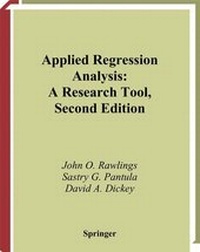
Applied Regression Analysis
A Research Tool
2nd Edition
Published on 23. March 2013
Book
Paperback/Softback
XVIII, 660 pages
978-1-4757-7155-8 (ISBN)
Description
Least squares estimation, when used appropriately, is a powerful research tool. A deeper understanding of the regression concepts is essential for achieving optimal benefits from a least squares analysis. This book builds on the fundamentals of statistical methods and provides appropriate concepts that will allow a scientist to use least squares as an effective research tool.
Applied Regression Analysis is aimed at the scientist who wishes to gain a working knowledge of regression analysis. The basic purpose of this book is to develop an understanding of least squares and related statistical methods without becoming excessively mathematical. It is the outgrowth of more than 30 years of consulting experience with scientists and many years of teaching an applied regression course to graduate students. Applied Regression Analysis serves as an excellent text for a service course on regression for non-statisticians and as a reference for researchers. It also provides a bridge between a two-semester introduction to statistical methods and a thoeretical linear models course.
Applied Regression Analysis emphasizes the concepts and the analysis of data sets. It provides a review of the key concepts in simple linear regression, matrix operations, and multiple regression. Methods and criteria for selecting regression variables and geometric interpretations are discussed. Polynomial, trigonometric, analysis of variance, nonlinear, time series, logistic, random effects, and mixed effects models are also discussed. Detailed case studies and exercises based on real data sets are used to reinforce the concepts. The data sets used in the book are available on the Internet.
Applied Regression Analysis is aimed at the scientist who wishes to gain a working knowledge of regression analysis. The basic purpose of this book is to develop an understanding of least squares and related statistical methods without becoming excessively mathematical. It is the outgrowth of more than 30 years of consulting experience with scientists and many years of teaching an applied regression course to graduate students. Applied Regression Analysis serves as an excellent text for a service course on regression for non-statisticians and as a reference for researchers. It also provides a bridge between a two-semester introduction to statistical methods and a thoeretical linear models course.
Applied Regression Analysis emphasizes the concepts and the analysis of data sets. It provides a review of the key concepts in simple linear regression, matrix operations, and multiple regression. Methods and criteria for selecting regression variables and geometric interpretations are discussed. Polynomial, trigonometric, analysis of variance, nonlinear, time series, logistic, random effects, and mixed effects models are also discussed. Detailed case studies and exercises based on real data sets are used to reinforce the concepts. The data sets used in the book are available on the Internet.
Reviews / Votes
From the reviews: IEEE ELECTRICAL INSULATION MAGAZINE "Virtually all data taken require some form of modeling and curve fitting. This excellent book will give the reader a very clear understanding of the techniques used for fitting most types of data; and, because it covers all the significant areas, it can serve as a reference source. Students and especially researchers involved with data taking and modeling will greatly benefit from this book."More details
Product info
Paperback
Series
Language
English
Place of publication
New York, NY
United States
Target group
Research
Edition type
Revised edition
Illustrations
biography
Dimensions
Height: 254 mm
Width: 180 mm
Thickness: 38 mm
Weight
1201 gr
ISBN-13
978-1-4757-7155-8 (9781475771558)
DOI
10.1007/978-0-387-22753-5
Schweitzer Classification
Other editions
Additional editions
Book
04/2001
2nd Edition
Springer
€128.39
Shipment within 5-7 days
Content
1. Review of Simple Regression; 2. Introduction to Matrices; 3. Multiple Regression in Matrix Notation; 4. Analysis of Variance and Quadratic Forms; 5. Case Study: Five Independent Variables; 6. Geometric Interpretation of Least Squares; 7. Model Development: Variable Selection; 8. Polynomial Regression; 9. Class Variables in Regression; 10. Problem Areas in Least Squares; 11. Regression Diagnostics; 12. Transformation of Variables; 13. Collinearity; 14. Case Study: Collinearity Problems; 15. Models Nonlinear in the Parameters; 16. Case Study: Response Curve Modeling; 17. Analysis of Unbalanced Data; 18. Mixed Effects Models; 19: Case Study: Analysis of Unbalanced Data.