

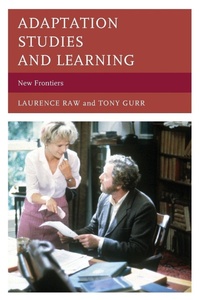
Adaptation Studies and Learning
New Frontiers
Published on 4. April 2013
Book
Paperback/Softback
194 pages
978-0-8108-8793-0 (ISBN)
Description
Adaptation Studies is a fast-emerging discipline which has expanded into other areas of media scholarship. With its roots in literature and film, this discipline can be applied to much broader uses, even as a process that governs every aspect of our lives. Indeed, by expanding the scope of "adaptation" to encompass a larger perspective, this discipline can promote lifelong learning that emphasizes communication, social interaction, and aesthetic engagement.
In Adaptation Studies and Learning: New Frontiers, Laurence Raw and Tony Gurr seek to redefine the ways in which adaptation is taught and learned. Comprised of essays, reflections, and "learning conversations" about the ways in which this approach to adaptation might be implemented, this book focuses on issues of curriculum construction, the role of technology, and the importance of collaboration. Including a series of case-studies and classroom experiences, the authors explore the relationship between adaptation and related disciplines such as history, media, and translation. The book also includes a series of case studies from the world of cinema, showing how collaboration and social interaction lies at the heart of successful film adaptations.
By looking beyond the classroom, Raw and Gurr demonstrate how adaptation studies involves real-world issues of prime importance-not only to film and theater professionals, but to all learners. Covering a wide range of material, including film history, educational theory, and literary criticism, Adaptation Studies and Learning offers a radical repositioning of the way we think about adaptation both inside and outside academia.
In Adaptation Studies and Learning: New Frontiers, Laurence Raw and Tony Gurr seek to redefine the ways in which adaptation is taught and learned. Comprised of essays, reflections, and "learning conversations" about the ways in which this approach to adaptation might be implemented, this book focuses on issues of curriculum construction, the role of technology, and the importance of collaboration. Including a series of case-studies and classroom experiences, the authors explore the relationship between adaptation and related disciplines such as history, media, and translation. The book also includes a series of case studies from the world of cinema, showing how collaboration and social interaction lies at the heart of successful film adaptations.
By looking beyond the classroom, Raw and Gurr demonstrate how adaptation studies involves real-world issues of prime importance-not only to film and theater professionals, but to all learners. Covering a wide range of material, including film history, educational theory, and literary criticism, Adaptation Studies and Learning offers a radical repositioning of the way we think about adaptation both inside and outside academia.
Reviews / Votes
"Adaptation studies," as the title suggests, refers to how adaptation informs and educates learners in a larger sense. Such borrowing, as Raw and Gurr explain, exposes people to "a dialogic sphere of influence, appropriation, and citation." The authors further define "adaptation" as a principal educational vehicle for millennial culture involving skills in valuing, communicating, social interaction, and aesthetic engagement. A chapter on 21st-century learning, for example, cites a Jane Austen seminar utilizing blogs. This book functions as a "curriculum generator," inspiring skills in critical thinking, conceptualizing, and analysis. It rejects memory-based curricula and disparages literary study based on "what you knew rather than what you could do with what you knew." Regarding Shakespeare, the authors argue that adaptation becomes less textual and more a vehicle to change behavior and add "flexibility in perspective," resulting in collaboration, feedback, and reflection. Borrowing ideas from cognitive psychologist Jerome Bruner, they suggest that new transmedial adaptations arise from the selection and transformation of material, and the result is an axiomatic shift that privileges process over content. The authors affirm that "all texts borrow from a wellspring of textual annunciations with no static, explicit point of origin." Summing Up: Recommended. All levels of students and instructors. * Choice Reviews *More details
Language
English
Place of publication
Lanham, MD
United States
Target group
College/higher education
Professional and scholarly
Dimensions
Height: 229 mm
Width: 152 mm
Thickness: 11 mm
Weight
290 gr
ISBN-13
978-0-8108-8793-0 (9780810887930)
Copyright in bibliographic data and cover images is held by Nielsen Book Services Limited or by the publishers or by their respective licensors: all rights reserved.
Schweitzer Classification
Other editions
Additional editions
E-Book
04/2013
1st Edition
Scarecrow Press
€73.99
Available for download
E-Book
04/2013
1st Edition
Scarecrow Press
€73.99
Available for download
Persons
Laurence Raw is one of the leading figures in contemporary adaptation studies. His previous books include Adapting Henry Jamesto the Screen (Scarecrow, 2006), The Pedagogy of Adaptation (Scarecrow, 2010), and Translation, Adaptation and Transformation (2012).
Tony Gurr is an educational consultant and instructional skills facilitator based in Ankara, Turkey. His blog, "allthingslearning," is popular with educators, trainers, curriculum and assessment specialists and educational managers.
Tony Gurr is an educational consultant and instructional skills facilitator based in Ankara, Turkey. His blog, "allthingslearning," is popular with educators, trainers, curriculum and assessment specialists and educational managers.
Content
Table of Contents
Learning AdaptationTwenty-First Century LearningCurricula Past, Present, and FutureShakespeare in Education: Learning That LastsReflective PracticeWhy Bruner MattersActor, Image, Narrative: Anthony Drazan's Hurlyburly (1999)Negotiating Adaptation and TranslationTransdisciplinarity, History, and AssessmentUnderstanding a Community of Purpose: Michael Winner's The Big Sleep (1978)Star Wars: May the Force be with You (All)Journey's End: Or is it?Works Cited
Learning AdaptationTwenty-First Century LearningCurricula Past, Present, and FutureShakespeare in Education: Learning That LastsReflective PracticeWhy Bruner MattersActor, Image, Narrative: Anthony Drazan's Hurlyburly (1999)Negotiating Adaptation and TranslationTransdisciplinarity, History, and AssessmentUnderstanding a Community of Purpose: Michael Winner's The Big Sleep (1978)Star Wars: May the Force be with You (All)Journey's End: Or is it?Works Cited