

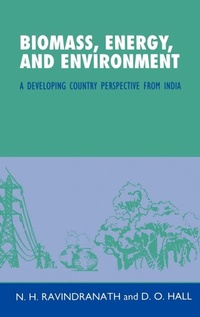
Biomass, Energy, and Environment
A Developing Country Perspective from India
Published on 7. September 1995
Book
Hardback
390 pages
978-0-19-856436-2 (ISBN)
Description
Developing countries are searching for alternative energy options to promote sustainable and equitable development. Bioenergy, especially as a modernized fuel, is known to be an environmentally-sound energy option, but its potential and impacts need to be assessed for each developing country.
The current sources, uses, and socio-economic and environmental impacts of biomass energy are analysed for India. The energy needs for development are assessed. Conventional energy planning has not led to equitable and sustainable development. Bioenergy options are shown to have potential to meet the energy needs of rural areas of a populous country like India. Case studies of successful bioenergy projects and economic analysis of bioenergy options are presented. Land is not a constraint to producing woody biomass for energy even in a densely populated country like India. Bioenergy options provide significant socio-economic benefits along with large potential for carbon-emission reduction and promotion of biodiversity in degraded lands.
The potential for bioenergy is high for developing-countries of South-east Asia, Sub-Saharan Africa, and South America. There is global interest in bioenergy as a sustainable energy and green house gas emission reduction option. The Indian case study could be a model for other developing countries.
The current sources, uses, and socio-economic and environmental impacts of biomass energy are analysed for India. The energy needs for development are assessed. Conventional energy planning has not led to equitable and sustainable development. Bioenergy options are shown to have potential to meet the energy needs of rural areas of a populous country like India. Case studies of successful bioenergy projects and economic analysis of bioenergy options are presented. Land is not a constraint to producing woody biomass for energy even in a densely populated country like India. Bioenergy options provide significant socio-economic benefits along with large potential for carbon-emission reduction and promotion of biodiversity in degraded lands.
The potential for bioenergy is high for developing-countries of South-east Asia, Sub-Saharan Africa, and South America. There is global interest in bioenergy as a sustainable energy and green house gas emission reduction option. The Indian case study could be a model for other developing countries.
Reviews / Votes
The analysis is relevant to the majority of developing countries. * CAB Abstracts * `... this book is an excellent exploration of the potential for biomass energy in meeting development goals and a very useful guide to the technical possibilities and the policy initiatives needed for its expansion.' The Journal of Energy Literature a comprehensive guide to the use of biomass energy in India ... this book is an excellent exploration of the potential for biomass energy in meeting development goals and a very useful guide to the technical possibilities and the policy initiatives needed for its expansion * The Journal of Energy Literature II.2 1996 *More details
Language
English
Place of publication
Oxford
United Kingdom
Target group
Professional and scholarly
Illustrations
halftones, line figures, tables
Dimensions
Height: 240 mm
Width: 161 mm
Thickness: 26 mm
Weight
752 gr
ISBN-13
978-0-19-856436-2 (9780198564362)
Copyright in bibliographic data and cover images is held by Nielsen Book Services Limited or by the publishers or by their respective licensors: all rights reserved.
Schweitzer Classification
Persons
Content
Introduction ; 1. Energy and biomass consumption patterns in India ; 2. Environmental impacts of biomass energy ; 3. Assessment of bioenergy programmes in India ; 4. Bioenergy projects ; 5. Bioenergy - a modernized fuel option for India ; 6. Land and biomass availability for sustainable bioenergy ; 7. Environmental and socio-economic benefits of bioenergy ; 8. Economic analysis of bioenergy options ; 9. Approaches to implementing bioenergy programmes ; 10. Implications for bioenergy in developing countries ; 11. Bioenergy: Barriers, policy options, and guidelines ; 12. Conclusions and implications