

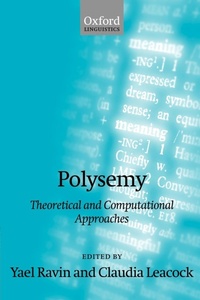
Polysemy
Theoretical and Computational Approaches
Published on 8. November 2001
Book
Paperback/Softback
240 pages
978-0-19-925086-8 (ISBN)
Description
This volume of newly commissioned essays examines current theoretical and computational work on polysemy, the term used in semantic analysis to describe words with more than one meaning. Such words present few difficulties in everyday language, but pose central problems for linguists and lexicographers, especially for those involved in lexical semantics and in computational modelling. The contributors to this book -- leading researchers in theoretical and computational linguistics -- consider the implications of these problems for linguistic theory and how they may be addressed by computational means.
The theoretical essays in the book examine polysemy as an aspect of a broader theory of word meaning. Three theoretical approaches are presented: the Classical (or Aristotelian), the Prototypical, and the Relational. Their authors describe the nature of polysemy, the criteria for detecting it, and its manifestations across languages. They examine the issues arising from the regularity of polysemy and the theoretical principles proposed to account for the interaction of lexical meaning with the semantics and syntax of the context in which it occurs. Finally they consider the formal representations of meaning in the lexicon, and their implications for dictionary construction.
The computational essays are concerned with the challenge of polysemy to automatic sense disambiguation -- how the intended meaning for a word occurrence can be identified. The approaches presented include the exploitation of lexical information in machine-readable dictionaries, machine learning based on patterns of word co-occurrence, and hybrid approaches that combine the two.
As a whole the volume shows how on the one hand theoretical work provides the motivation and may suggest the basis for computational algorithms, while on the other computational results may validate, or reveal problems in, the principles set forth by theories.
The theoretical essays in the book examine polysemy as an aspect of a broader theory of word meaning. Three theoretical approaches are presented: the Classical (or Aristotelian), the Prototypical, and the Relational. Their authors describe the nature of polysemy, the criteria for detecting it, and its manifestations across languages. They examine the issues arising from the regularity of polysemy and the theoretical principles proposed to account for the interaction of lexical meaning with the semantics and syntax of the context in which it occurs. Finally they consider the formal representations of meaning in the lexicon, and their implications for dictionary construction.
The computational essays are concerned with the challenge of polysemy to automatic sense disambiguation -- how the intended meaning for a word occurrence can be identified. The approaches presented include the exploitation of lexical information in machine-readable dictionaries, machine learning based on patterns of word co-occurrence, and hybrid approaches that combine the two.
As a whole the volume shows how on the one hand theoretical work provides the motivation and may suggest the basis for computational algorithms, while on the other computational results may validate, or reveal problems in, the principles set forth by theories.
Reviews / Votes
This volume distinguishes itself by its very catholic table of contents ... the chapters themselves stand as valuable contributions to the debate about what polysemy is and how it is to be represented in (psycho)linguistic and computational models. * Language * It should therefore hold an important place on the shelves of any researcher in the fields of lexical semantics and word sense disambiguation, and will certainly be valued by many of our graduate students". * Computational Linguistics *More details
Language
English
Place of publication
Oxford
United Kingdom
Target group
Professional and scholarly
Illustrations
11 figures; 11 tables
Dimensions
Height: 234 mm
Width: 156 mm
Thickness: 13 mm
Weight
371 gr
ISBN-13
978-0-19-925086-8 (9780199250868)
Copyright in bibliographic data and cover images is held by Nielsen Book Services Limited or by the publishers or by their respective licensors: all rights reserved.
Schweitzer Classification
Other editions
Additional editions
Book
06/2000
Oxford University Press
€271.00
Shipment within 15-20 days
Persons
Yael Ravin is a manager at the T. J. Watson Research Center of IBM in New York, where she has been working in computational linguistics. Her current research focuses on integrating information extraction and text retrieval techniques into knowledge management applications.
Claudia Leacock is Co-Director of Research at ETS Technologies, a subsidiary of Educational Testing Service, where she does research on automated scoring technologies.
Claudia Leacock is Co-Director of Research at ETS Technologies, a subsidiary of Educational Testing Service, where she does research on automated scoring technologies.
Editor
Research staff member at the T. J. Watson Research Center of IBM, New YorkResearch staff member at the T. J. Watson Research Center of IBM, New York
Research Scientist, Division of Cognitive and Instructional Science, Educational Testing ServiceResearch Scientist, Division of Cognitive and Instructional Science, Educational Testing Service
Content
1. Polysemy: An overview ; 2. Aspects of the Micro-Structure of Word Meanings ; 3. Autotroponomy ; 4. Lexical Shadowing and Argument Closure ; 5. Describing Polysemy: The case of 'Crawl' ; 6. 'The Garden Swarms with Bees' and the Fallacy of 'Argument Alternation' ; 7. Polysemy: A problem of definition ; 8. Lexical Representations for Sentence Processing ; 9. Large Vocabulary Word Sense Disambiguation ; 10. Polysemy in a Broad-Coverage Natural Language Processing System ; 11. Disambiguation and Connectionism