

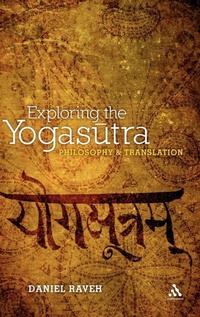
Exploring the Yogasutra
Philosophy and Translation
Published on 10. May 2012
Book
Hardback
184 pages
978-1-4411-4622-9 (ISBN)
Description
Patajali's Yogasutra is an ancient canonic Indian text composed in Sanskrit in the 3rd or 4th century. Belonging to a very different cultural milieu, this multi-layered text is philosophical, psychological and practical in nature. Offering a philosophical reading of Pata jali's Yogasutra, this book discusses themes such as freedom, self-identity, time and transcendence, and translation between languages, cultures and eras. Drawing substantially upon contemporary Indian materials, it discusses for the first time classical yoga as reflected upon by Daya Krishna (1924-2007) with constant reference to Krishna Chandra Bhattacharyya's (1875-1949) studies in yoga philosophy. The genuine attempt on behalf of these two original thinkers to engage philosophically with Patajala-yoga sets the tone of the textual exploration provided here. This book features a new annotated translation of the Yogasutra, and the author provides a useful background to the extensive Samkhya terminology employed by Patajali. Daniel Raveh also offers a close reflection of the very act of translation, and the book concludes with suggestions for further reading and a glossary of central notions.
Reviews / Votes
'Thinking anew with Patanjali: this is a modern-day translation and meditation on the spiritual praxis and philosophy of the Yogasutras, the great ancient Indian classic. Daniel Raveh's refreshing book is, at the same time, a sensitive reflection on meaningful cross-cultural and cross-epochal translation which he sees as a process of creative transformation, a process inevitable for retaining significance.' -- Dr Mukund Lath, University of Rajasthan, Jaipur, India. 'Raveh's thoughtful reflections on the nature of translation, his investigation of five key themes: practice, dispassion, ignorance, clinging, and yogic knowledge, as well as his skilfully rendered new translation of the Yoga Sutra make this book indispensible reading for anyone with a serious interest in the study of classical Yoga.' -- Christopher Key Chapple, Doshi Professor of Indic and Comparative Theology, Loyola Marymount University, USA. 'As a philosophical work attempting to answer some questions that Patanjali's YS raises, it is a refreshing change from the recent trend of Yoga books dealing mainly with "physical-Yoga".' -- Dr. T.S. Rukmani, Professor and Chair in Hindu Studies, Concordia University, Canada 'Exploring the Yogasutra presents a new, engaging perspective on Patanjali from a philosophical point of view. It is a contribution invaluable for anybody interested in this authoritative source of Yoga theory.' -- Dr Yohanan Grinshpon, Department of Comparative Religion, The Hebrew University of Jerusalem, Israel 'Raveh undertakes an extraordinary clarification of the old, profound, paradoxical, often mysterious inward-seeking inwardness of the Yogasutra...Altogether, the book is a great didactic success in the translation of the thought and practice of one culture into the terms of another.' -- Ben-Ami Scharfstein, author of A Comparative History of World Philosophy: From the Upanishads to Kant, and Professor Emeritus of Philosophy, Tel-Aviv University, IsraelMore details
Language
English
Place of publication
New York
United States
Target group
Professional and scholarly
Dimensions
Height: 240 mm
Width: 161 mm
Thickness: 15 mm
Weight
449 gr
ISBN-13
978-1-4411-4622-9 (9781441146229)
Copyright in bibliographic data and cover images is held by Nielsen Book Services Limited or by the publishers or by their respective licensors: all rights reserved.
Schweitzer Classification
Person
Daniel Raveh is Lecturer of Indian and Comparative Philosophy at Tel Aviv University, Israel. Over the last twenty years he has divided his time between Israel and India, and has translated several Indian texts into Hebrew.
Content
Entree: Translating the Other: Reflections on a Fictional Dialogue; Introduction: Yoga, Translation, the Other; 1. Abhyasa/Vairagya: A Conceptual Investigation into the Process of Yoga; 2. Revisiting avidya and abhinivesa: A Note on Yoga Psychology; 3. Rethinking Prajna: Yogasutra 1.49 Under a Philosophical Magnifying Glass; 4.Text as a Process: Introduction to Daya Krishna; 5. 'The Yoga-Sutras: The Undeciphered Text - Anomalies, Problems and Paradoxes' by Daya Krishna; Concise Glossary; Appendix I: The Yogasutra in Transliteration; Appendix II: The Yogasutra in Translation; Bibliography; Index.