

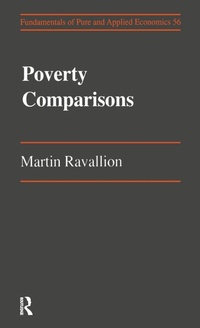
Poverty Comparisons
1st Edition
Published on 31. January 2017
Book
Hardback
164 pages
978-1-138-16039-2 (ISBN)
Description
First published in 1994. Drawing on a personal network, an economist can still relatively easily stay well informed in the narrow field in which he works, but to keep up with the development of economics as a whole is a much more formidable challenge. Economics are confronted with difficulties associated with the rapid development of their discipline. There is a risk of 'balkanization' in economics, which may not be favorable to its development. Fundamentals of Pure and Applied Economics has been created to meet this problem. Poverty comparisons - such as assessments of whether poverty has increased, or where it is greatest - are typically clouded in conceptual and methodological uncertainties. How should individual4 well-being' be assessed in deciding who is poor? Is a household survey a reliable guide? Where should the poverty line be drawn, and does the choice matter? What poverty measure should be used in aggregating data on individual well-being? Does that choice matter? This monograph surveys the issues that need to be considered in answering these questions.
More details
Language
English
Place of publication
London
United Kingdom
Publishing group
Taylor & Francis Ltd
Target group
College/higher education
Dimensions
Height: 222 mm
Width: 145 mm
Thickness: 13 mm
Weight
346 gr
ISBN-13
978-1-138-16039-2 (9781138160392)
Copyright in bibliographic data and cover images is held by Nielsen Book Services Limited or by the publishers or by their respective licensors: all rights reserved.
Schweitzer Classification
Other editions
Additional editions
Martin Ravallion
Poverty Comparisons
Book
03/1994
1st Edition
Routledge
€70.50
Article not available for order
Person
Martin Ravallion The World Bank, Washington DC, USA
Content
Introduction to the Series Preface 1. Introduction 2. Concepts and Methods of Poverty Analysis 3. Putting Theory into Practice 4. Conclusions and Recommendations