

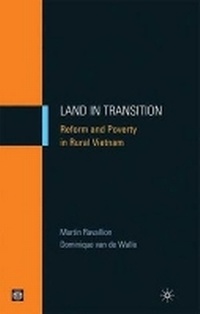
Land in Transition
Reform and Poverty in Rural Vietnam
Will be published approx. on 30. April 2008
Book
Paperback/Softback
220 pages
978-0-8213-7274-6 (ISBN)
Description
This book offers a set of methods, drawing on the tool kit of modern economics, to ascertain what Vietnam's economy would have looked like without reforms and assesses what types of households are likely to gain from the reforms. The book's findings have implications on broader issues of social protection in developing rural economies.
Reviews / Votes
'Land in Transition provides a thought-provoking read. Through a comprehensive, yet comprehensible analysis of lessons learned from Vietnam's land reforms, Ravallion and van de Walle share with us insights gained from a thoughtful study of key issues for poverty reduction and social protection in a developing country on the road to a market economy.' - Moe Thuzar, Asean Economic Bulletin 'This excellent book...is a valuable publication, which should be of great interest to scholars and students of Vietnamese and Southeast Asian studies, as well as to anyone interested in development studies and transition economies.' - Newsletter of the Association of Southeast Asian StudiesMore details
Other editions
Additional editions
Book
04/2008
World Bank Publications
€69.54
Article exhausted; check different version
Persons
MARTIN RAVALLION is Senior Research Manager in the Development Research Group of the World Bank. He holds a Ph.D. in economics from the London School of Economics, and Political Science, UK, and has taught economics at L.S.E., Oxford University, the Australian National University, and Princeton University. His main research interests over the last twenty years have concerned poverty and policies for fighting it. He has advised numerous governments and international agencies on this topic, and he has written extensively on this and other subjects in economics, including two books and over 150 papers in scholarly journals and edited volumes. He currently serves on the Editorial Boards of ten economics journals and is a Senior Fellow of the Bureau for Research in Economic Analysis of Development.
DOMINIQUE VAN DE WALLE is a Lead Economist in the Development Research Group (Human Development and Public Services Team). Her research interests are in the general area of poverty and public expenditures. She holds a Masters in Economics from the London School of Economics and Political Science, UK, and a Ph. D. in economics from the Australian National University, and began her career at the Bank as a member of the core team that produced the 1990 World Development Report on Poverty. She has worked on Argentina, Hungary, Morocco, Tunisia, Zimbabwe, Yemen, Cambodia, Laos and Vietnam. The bulk of her recent research has been on Vietnam, covering poverty, rural development, land reform, infrastructure (rural roads and irrigation) and poverty, impact evaluation and safety nets.
DOMINIQUE VAN DE WALLE is a Lead Economist in the Development Research Group (Human Development and Public Services Team). Her research interests are in the general area of poverty and public expenditures. She holds a Masters in Economics from the London School of Economics and Political Science, UK, and a Ph. D. in economics from the Australian National University, and began her career at the Bank as a member of the core team that produced the 1990 World Development Report on Poverty. She has worked on Argentina, Hungary, Morocco, Tunisia, Zimbabwe, Yemen, Cambodia, Laos and Vietnam. The bulk of her recent research has been on Vietnam, covering poverty, rural development, land reform, infrastructure (rural roads and irrigation) and poverty, impact evaluation and safety nets.
Content
Introduction The setting and the policy debates Data and summary statistics Welfare impacts of privatizing land-use rights Land re-allocation after introducing a land market Rising landlessness: A sign of success or failure? Land, credit and the public anti-poverty programs Conclusions