

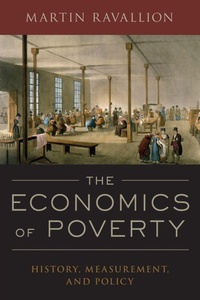
The Economics of Poverty
History, Measurement, and Policy
Published on 21. January 2016
Book
Paperback/Softback
736 pages
978-0-19-021277-3 (ISBN)
Description
While there is no denying that the world has made huge progress against absolute poverty over the last 200 years, until recent times the bulk of that progress had been made in wealthy countries only. The good news is that we have seen greater progress against poverty in the developing world in recent times-indeed, a faster pace of progress against extreme poverty than the rich world saw over a period of 100 years or more of economic development. However, continuing progress is far from assured. High and rising inequality has stalled progress against poverty in many countries. We are seeing generally rising relative poverty in the rich world as a whole over recent decades. And even in the developing world, there has been less progress in reaching the poorest, who risk being left behind, and a great many people in the emerging middle class remain highly vulnerable to falling back into poverty.
The Economics of Poverty strives to support well-informed efforts to put in place effective policies to assure continuing success in reducing poverty in all its dimensions. The book reviews critically the past and present debates on the central policy issues of economic development everywhere. How much poverty is there? Why does poverty exist? What can be done to eliminate poverty?
Martin Ravallion provides an accessible new synthesis of current knowledge on these issues. It does not assume that readers know economics already. Those new to economics get a lot of help along the way in understanding its concepts and methods. Economics lives though its relevance to real world problems, and here the problem of global poverty is both the central focus and a vehicle for learning.
The Economics of Poverty strives to support well-informed efforts to put in place effective policies to assure continuing success in reducing poverty in all its dimensions. The book reviews critically the past and present debates on the central policy issues of economic development everywhere. How much poverty is there? Why does poverty exist? What can be done to eliminate poverty?
Martin Ravallion provides an accessible new synthesis of current knowledge on these issues. It does not assume that readers know economics already. Those new to economics get a lot of help along the way in understanding its concepts and methods. Economics lives though its relevance to real world problems, and here the problem of global poverty is both the central focus and a vehicle for learning.
Reviews / Votes
"Many economics students are motivated by the struggle for a better world. Here, at last, is the book for them. Building on extensive research, Ravallion asks: What can we learn about poverty from past thinkers? How should we measure poverty? What reduces it? Readers don't need prior knowledge of economics: this clear, rigorous text teaches the economic basics, not as a chore, but as part of learning what's wrong and how to put it right."-- Michael Lipton, Research Professor of Economics, University of Sussex
"This book is a tour de force. Covering history of thought, analytical tools and policy issues, it provides an indispensable introduction to the economics of poverty. Martin Ravallion is a global leader in the field of poverty analysis. His book will prove to be of lasting value not only to students, but also to seasoned researchers and policy analysts."
-- Ravi Kanbur, T.H. Lee Professor of World Affairs and Professor of Economics, Cornell University
"This landmark book demonstrates clearly and convincingly the power of economic ideas and analysis in tackling the blight of global poverty and provides the perfect grounding-rigorous yet inspirational-for young scholars seeking to help the world's poorest."
-- Lyn Squire, Director of the World Bank's 1990 World Development Report, Poverty
"For the first time in history, we have the knowledge and tools to end extreme poverty. Dr. Ravallion's insightful and practical analysis provides a blueprint for the next generation of leaders to seize this opportunity and build vibrant, inclusive economies."
-- Rajiv Shah, Administrator of the United States Agency for International Development (USAID)
"An indispensable reference for anyone interested in any aspect of the economics of poverty by the indisputable world expert in this area."
-- Francois Bourguignon, Paris School of Economics
More details
Language
English
Place of publication
New York
United States
Target group
Professional and scholarly
College/higher education
Dimensions
Height: 234 mm
Width: 156 mm
Thickness: 44 mm
Weight
1235 gr
ISBN-13
978-0-19-021277-3 (9780190212773)
Copyright in bibliographic data and cover images is held by Nielsen Book Services Limited or by the publishers or by their respective licensors: all rights reserved.
Schweitzer Classification
Other editions
Additional editions
Book
01/2016
Oxford University Press Inc
€216.65
Shipment within 15-20 days
E-Book
12/2015
1st Edition
OUP eBook
€63.49
Available for download
E-Book
12/2015
1st Edition
OUP eBook
€63.49
Available for download
Person
Martin Ravallion holds the inaugural Edmond D. Villani Chair of Economics at Georgetown University, prior to which he was the Director of the World Bank's research department. He has advised numerous governments and international agencies on poverty and policies for fighting it, and he has written extensively on this and other subjects in economics, including four books and 200 papers in scholarly journals and edited volumes. He is President of the Society for the Study of Economic Inequality. Amongst various prizes and awards, in 2012 he was awarded the John Kenneth Galbraith Prize from the American Agricultural and Applied Economics Association.
Content
PART 1: HISTORY OF THOUGHT ; Chapter 1: Origins of the Idea of a World Free of Poverty ; Chapter 2: New Thinking on Poverty after 1950 ; PART 2: MEASURES AND METHODS ; Chapter 3: Measuring Welfare ; Chapter 4: Poverty Lines ; Chapter 5: Poverty and Inequality Measures ; Chapter 6: Impact Evaluation ; PART 3: POVERTY AND POLICY ; Chapter 7: Dimensions of Poverty and Inequality in the World ; Chapter 8: Growth, Inequality and Poverty ; Chapter 9: Economy-Wide and Sectoral Policies ; Chapter 10: Targeted Interventions ; Conclusions: Past Progress and Future Challenges